
Property owners
Prairie Verbena
- Plant
- Prairie Verbena
- Botanical name
- Glandularia bipinnatifida
- Group
- Low shrubs and perennials
Prairie Verbena: Full sun to light shade.[^pv-npsot]
On this page
Botanical name: Glandularia bipinnatifida.
Plant group: Low shrubs and perennials.
Light
Full sun to light shade.[1]
Soil and drainage
Dry, rocky, well-drained ground - it grows wild on limestone prairies.[2]
Height
6-12 inches.[3]
Spread
1-2 feet, spreading into a low mat.[3]
Foliage
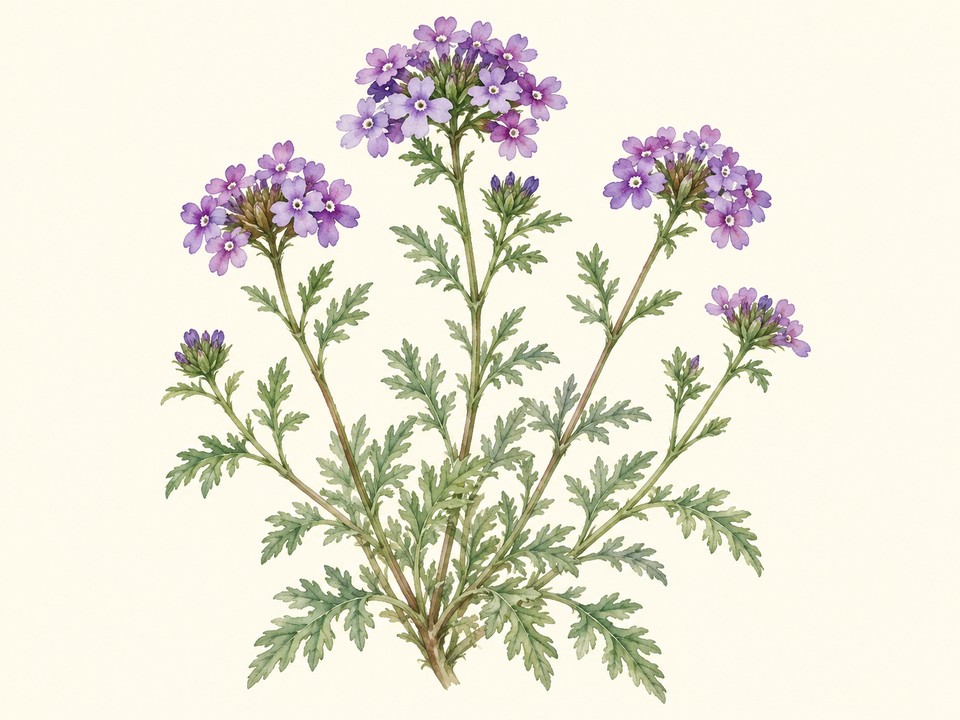
Finely cut, ferny green foliage; semi-evergreen in mild winters.[1]
Water
Very low once established.[2]
Pruning
Shear lightly after a bloom flush to keep it dense and blooming.[3]
Seasonal behavior
Purple flower clusters from spring through fall - one of our longest-blooming native perennials.[1]
When to Plant Prairie Verbena
Plant Prairie Verbena in spring or fall in Central Texas.[1]
If you would like a hand, the Texas Allied Landscape team can plant your Prairie Verbena and keep it thriving.
Planting
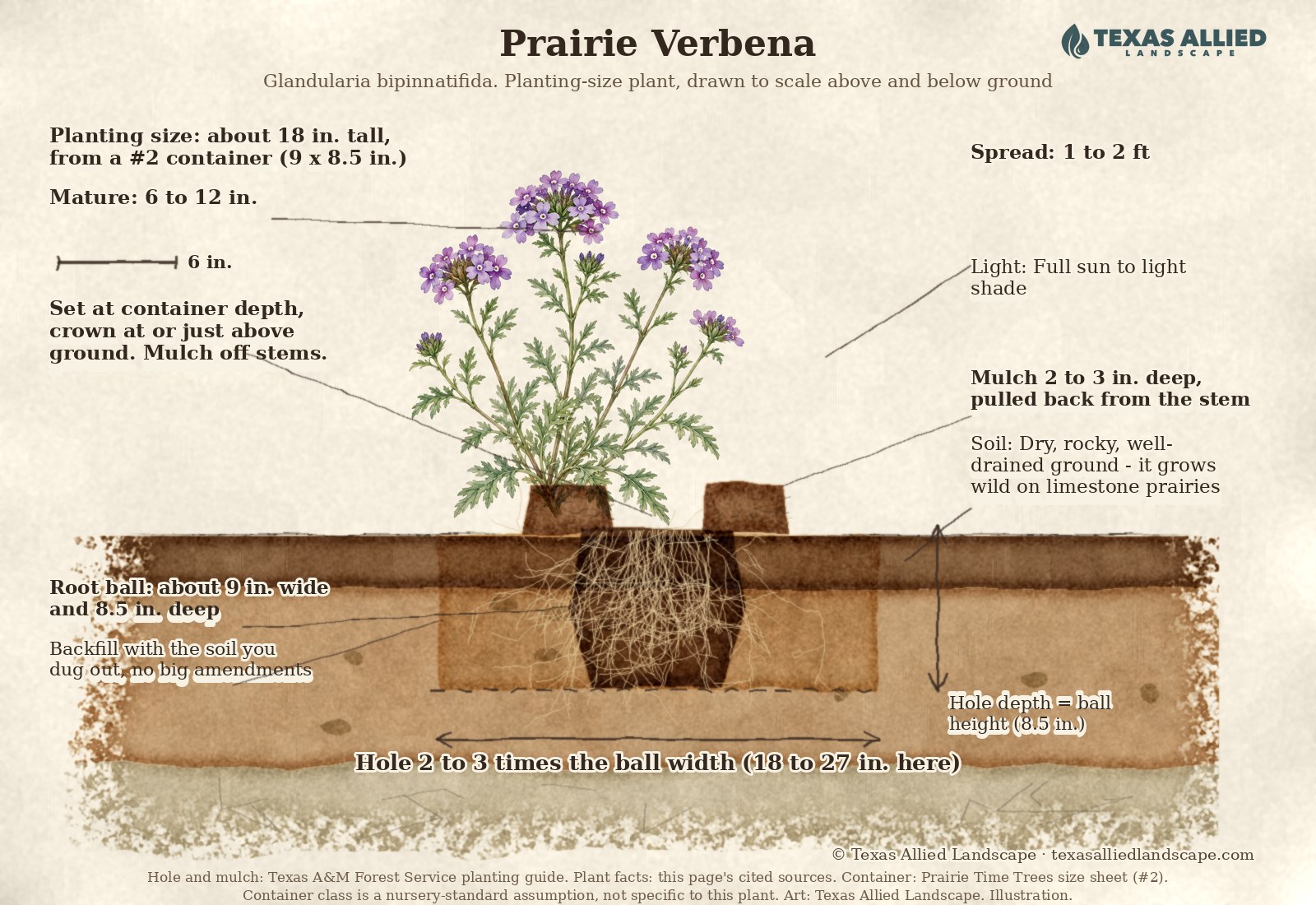
- Dig a hole twice as wide as the pot and no deeper, with sloping sides, and set the plant at the same depth it grew in its pot. Loosen any circling roots before backfilling.[4]
- For a new bed, clear grass and weeds first, roots and all.[4]
- Give it room: 1-2 feet, spreading into a low mat.[3] Space plants for that full size, not the pot size.[4]
- Site: Full sun to light shade.[1]
- Soil: Dry, rocky, well-drained ground - it grows wild on limestone prairies.[2]
- Timing: Plant Prairie Verbena in spring or fall in Central Texas.[1]
- Soak it well at planting and keep watering while the roots establish.[4]
- Mulch 2 to 4 inches, kept a few inches away from the stems to prevent crown rot. It needs no staking or other support.[4]
Care Instructions for Your Prairie Verbena
Sunlight
Full sun to light shade.[1]
Soil and drainage
Dry, rocky, well-drained ground - it grows wild on limestone prairies.[2]
Mature height and spread
6-12 inches.[3] 1-2 feet, spreading into a low mat.[3]
Pruning
Shear lightly after a bloom flush to keep it dense and blooming.[3]
Normal seasonal behavior
Purple flower clusters from spring through fall - one of our longest-blooming native perennials.[1]
Prairie verbena questions
Is prairie verbena a Texas native?
Yes - Glandularia bipinnatifida is a wildflower native across Texas prairies.[5]
How long does prairie verbena bloom?
Spring through fall - few perennials give you that many months of purple.[6]
Is prairie verbena drought tolerant?
Very - it is a prairie plant built for dry, rocky ground and full sun.[7]
Is prairie verbena a good ground cover?
Yes - a low, spreading, blooming mat for sunny spots, and butterflies work it constantly.[8]
Next step: Our horticulturalists can mass it as a living mulch in your sunny beds.
Let Texas Allied Landscape care for your Prairie Verbena
Prairie Verbena does best with steady, knowledgeable care: the right water, pruning at the right time, and a trained eye for stress. The horticulturists at Texas Allied Landscape care for plants like yours across the San Antonio area, backed by over 40 years of landscape experience.
In these community guides
Illustration. Illustration based on reference photos of Arbors of Fair Oaks. Not a single literal view. Arbors of Fair Oaks Landscaping
Bring your address, unit and yard ideas. Texas Allied Landscape helps design the planting and irrigation, prepare the…
Sources
- Native Plant Society of Texas, "Glandularia bipinnatifida."https://www.npsot.org/posts/native-plant/glandularia-bipinnatifida/abcdefgh
- Texas Tech Plant Resources, "Glandularia bipinnatifida."https://www.depts.ttu.edu/plantresources/Pages/directories/landscape-info-sheets/herbaceous-info/Glandularia_bipinnatifida.phpabcde
- City of Austin Grow Green plant guide, "Verbena."https://www.austintexas.gov/department/grow-green/plant-guide/verbenaabcdefg
- Back to basics: Planting perennials, SAWS Garden Style San Antonio.https://www.gardenstylesanantonio.com/garden-articles/back-to-basics-planting-perennials/abcde
- Native Plant Society of Texas, "Glandularia bipinnatifida."https://www.npsot.org/posts/native-plant/glandularia-bipinnatifida/↑
- Native Plant Society of Texas, "Glandularia bipinnatifida."https://www.npsot.org/posts/native-plant/glandularia-bipinnatifida/↑
- Texas Tech Plant Resources, "Glandularia bipinnatifida."https://www.depts.ttu.edu/plantresources/Pages/directories/landscape-info-sheets/herbaceous-info/Glandularia_bipinnatifida.php↑
- City of Austin Grow Green plant guide, "Verbena."https://www.austintexas.gov/department/grow-green/plant-guide/verbena↑