
Property owners
Purple Iris
- Plant
- Purple Iris
- Botanical name
- Iris x germanica
- Type
- Hybrid
- Group
- Low shrubs and perennials
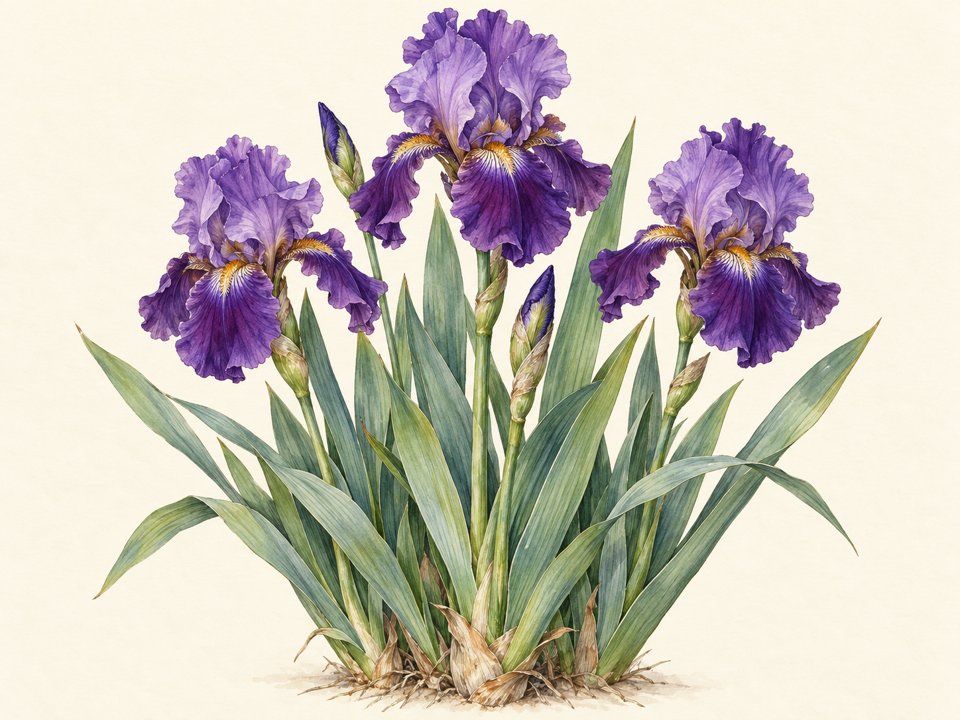
Purple Iris (Iris x germanica) is a bearded iris with sword-shaped leaves and fragrant spring blooms.
On this page
Its botanical name is Iris x germanica. It belongs to the low shrubs and perennials group.
Purple Iris (bearded iris) grows from rhizomes with sword-shaped leaves and large, fragrant spring blooms. It needs full sun and well-drained soil. The rhizomes should sit near the soil surface to avoid rot.[1]
Light
Full sun to partial shade.[2]
Soil and drainage
Loam or sandy soil with good drainage; tolerates occasionally dry to very dry conditions.[2]
Height
1 to 4 ft tall depending on the cultivar, from dwarf to tall bearded types.[2]
When to Plant Purple Iris
Plant or divide Purple Iris rhizomes in late summer to early fall in Central Texas. Roots establish through fall. The plant blooms the following spring.
Set rhizomes shallow, with the tops near the soil surface.
If you would like a hand, the Texas Allied Landscape team can plant your Purple Iris and keep it thriving.
Planting
- Dig a hole twice as wide as the pot and no deeper, with sloping sides. Set the plant at the same depth it grew in its pot. Loosen any circling roots before backfilling.[3]
- For a new bed, clear grass and weeds first, roots and all.[3]
- For the site, it needs full sun and well-drained soil. The rhizomes should sit near the soil surface to avoid rot.[1]
- For timing, plant or divide Purple Iris rhizomes in late summer to early fall in Central Texas.
- Soak it well at planting and keep watering while the roots establish.[3] Once established, they love wet soil. They are native to Gulf Coast swamps. But they are flexible. They also grow in regularly watered garden beds and even tolerate drought once established.[4]
- Mulch 2 to 4 inches, kept a few inches away from the stems to prevent crown rot. It needs no staking or other support.[3]
Care Instructions for Your Purple Iris
Sunlight and soil
They love wet soil. They are native to Gulf Coast swamps. But they are flexible. They also grow in regularly watered garden beds and even tolerate drought once established.[4]
Fruit and flowers
Bearded iris bloom in April here. Louisiana iris blooms a bit later in spring, around Easter through early May depending on the year.[5]
Purple iris questions
What kind of iris is the "purple iris" in Texas gardens?
It is usually one of three kinds. There is purple bearded iris for dry sunny beds. There is cemetery iris, the old white-flag type. There is deep blue-purple Louisiana iris for wet spots. The care differs, so it pays to know which you have.[6]
Do Louisiana irises need wet soil?
They love wet soil. They are native to Gulf Coast swamps. But they are flexible. They also grow in regularly watered garden beds and even tolerate drought once established.[4]
When do purple irises bloom in Texas?
Bearded iris bloom in April here. Louisiana iris blooms a bit later in spring, around Easter through early May depending on the year.[5]
How is Louisiana iris care different from bearded iris?
They have opposite water needs. Louisiana wants consistent moisture and can take a bog. Bearded rots in wet soil and wants its rhizomes baking in the sun.[7]
Next step: Not sure which iris you have? Our horticulturalists can identify it and set the right bed conditions.
Let Texas Allied Landscape care for your Purple Iris
Purple Iris does best with steady, knowledgeable care. That means the right water, pruning at the right time, and a trained eye for stress. The horticulturists at Texas Allied Landscape care for plants like yours across the San Antonio area. They bring over 40 years of landscape experience.
In these community guides
Sources
- NC State Extension, "Iris x germanica"https://plants.ces.ncsu.edu/plants/iris-x-germanica/ab
- Iris x germanica (Bearded Iris), North Carolina Extension Gardener Plant Toolbox.https://plants.ces.ncsu.edu/plants/iris-x-germanica/abc
- Back to basics: Planting perennials, SAWS Garden Style San Antonio.https://www.gardenstylesanantonio.com/garden-articles/back-to-basics-planting-perennials/abcd
- Henderson County Master Gardeners, "Irises from Louisiana."https://txmg.org/hendersonmg/files/2018/10/Irises-from-Louisiana-Oct-21-2018.pdfabc
- Lufkin Daily News, "Iris in the garden."https://lufkindailynews.com/life/community_news/angelina-master-gardeners-iris-in-the-garden/article_7e408d9a-ab0f-5f28-a4ca-8eac867fccfb.htmlab
- Lufkin Daily News, "Iris in the garden."https://lufkindailynews.com/life/community_news/angelina-master-gardeners-iris-in-the-garden/article_7e408d9a-ab0f-5f28-a4ca-8eac867fccfb.html↑
- Greater New Orleans Iris Society, "Basic Louisiana Iris Culture."https://louisianairisgnois.com/wp-content/uploads/2025/02/Basic-Louisiana-Iris-Culture.pdf↑