
Property owners
Purple Trailing Lantana
- Plant
- Purple Trailing Lantana
- Botanical name
- Lantana montevidensis
- Group
- Ground cover
Purple Trailing Lantana (Lantana montevidensis): light, water, soil, size and care for San Antonio area landscapes.
On this page
Botanical name: Lantana montevidensis.
Light
Full sun.[^texassuperstar-trailing-lantana]
Soil and drainage
Strong tolerance of poor soils; this is not an instruction to plant in waterlogged soil.[^qa-cross-3]
Height
About 1 foot.
Spread
About 4 feet.
Foliage
Semi-evergreen foliage; a severe winter can still cost it leaves.
Water
Drought tolerance, not a permanent zero-water rule. If watering ever feels like a guessing game, our horticulturists can care for your Purple Trailing Lantana on a schedule that fits your yard.
Seasonal behavior
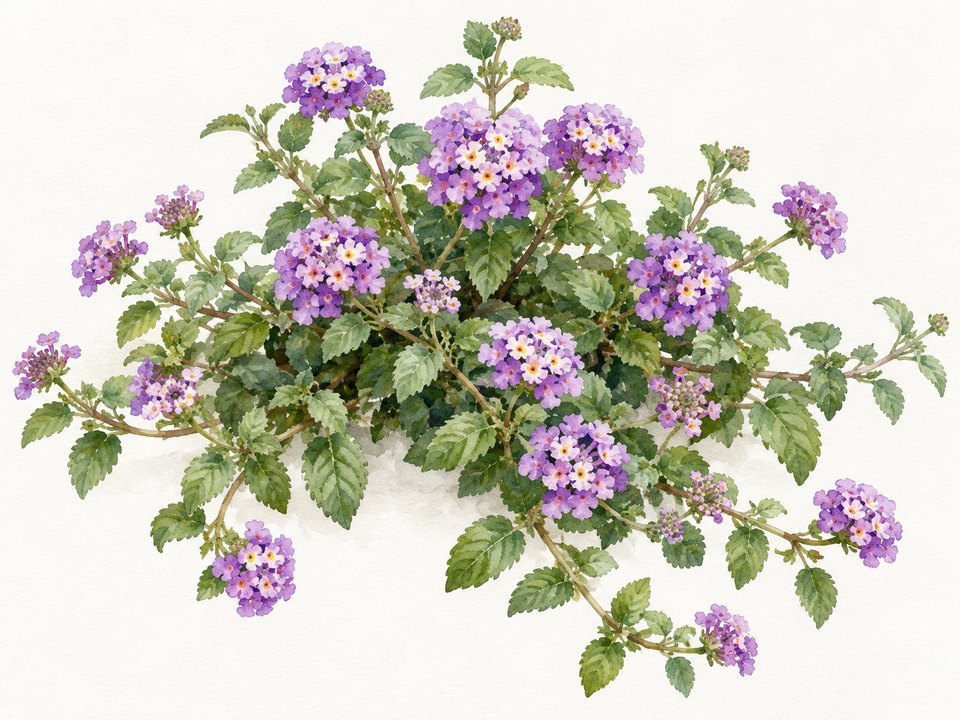
Trailing perennial; lavender, purple or white flowers spring through frost. Another source gives Zone 8b and about 1 foot tall by 4 feet wide; a hard winter may kill it.
When to Plant Purple Trailing Lantana
Purple Trailing Lantana is frost-tender, so plant it in spring after the last frost, around mid-March in San Antonio. It needs warm months ahead to establish, and it often dies back to the roots in winter.
If you would like a hand, the Texas Allied Landscape team can plant your Purple Trailing Lantana and keep it thriving.
Planting
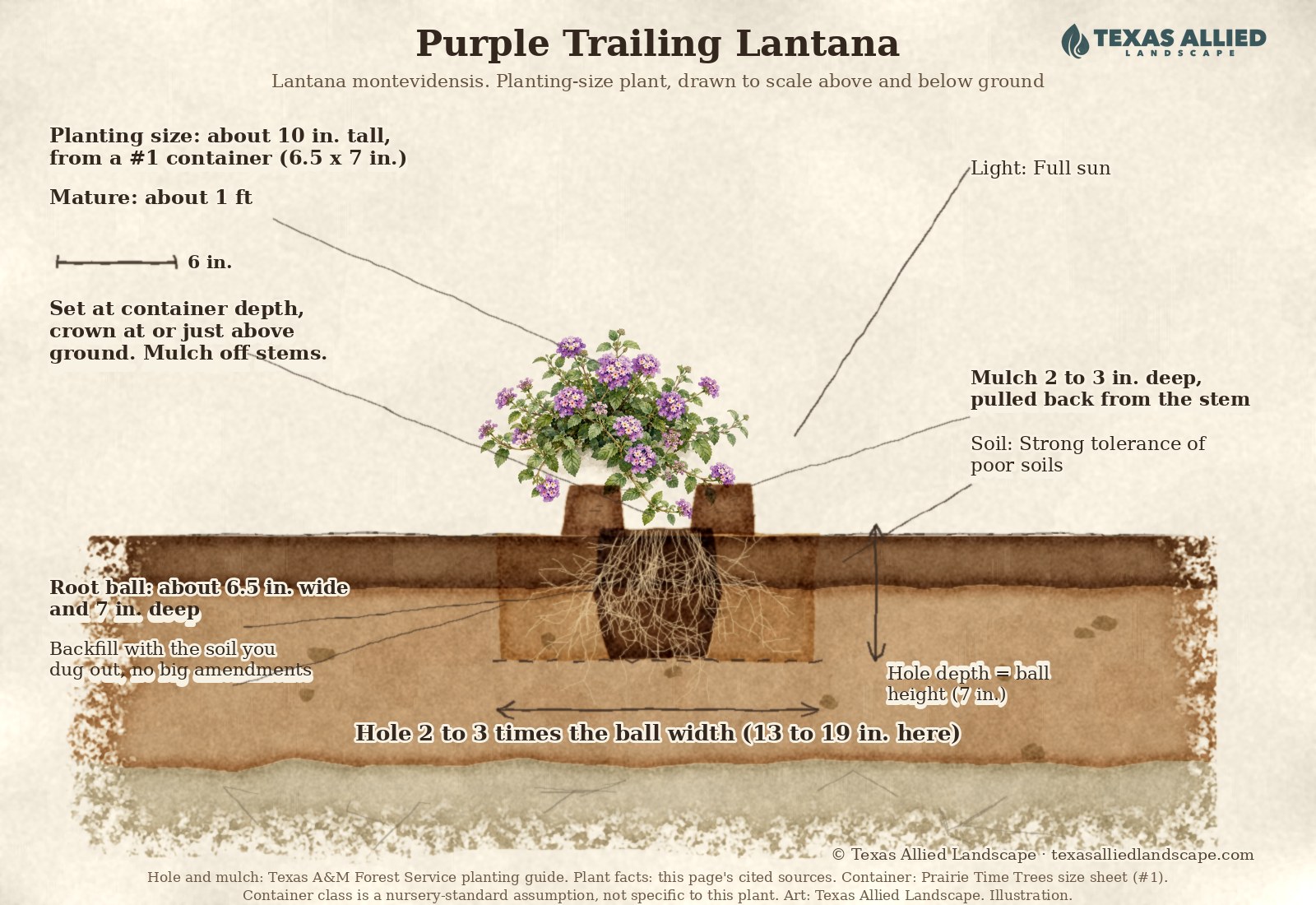
- Dig a hole twice as wide as the pot and no deeper, with sloping sides, and set the plant at the same depth it grew in its pot. Loosen any circling roots before backfilling.[1]
- For a new bed, clear grass and weeds first, roots and all.[1]
- Site: Full sun.
- Timing: Purple Trailing Lantana is frost-tender, so plant it in spring after the last frost, around mid-March in San Antonio.
- Soak it well at planting and keep watering while the roots establish.[1]
- Mulch 2 to 4 inches, kept a few inches away from the stems to prevent crown rot. It needs no staking or other support.[1]
What bloom season can I expect from trailing lantana?
Lavender, purple or white flowers from spring through frost.
Is trailing lantana safe to eat or handle without care?
That trailing lantana is toxic to humans, dogs, cats and horses if ingested, and that its leaves and sap can irritate skin. It recommends protective clothing and gloves when handling the plant. No safe dose or home-treatment advice is established here.[^qa-matched-6]
Let Texas Allied Landscape care for your Purple Trailing Lantana
Purple Trailing Lantana does best with steady, knowledgeable care: the right water, pruning at the right time, and a trained eye for stress. The horticulturists at Texas Allied Landscape care for plants like yours across the San Antonio area, backed by over 40 years of landscape experience.
In these community guides
- Art in progress
Homestead Landscaping
Share your Homestead address, survey and yard ideas with Texas Allied Landscape. We help prepare a clear plan for…

Illustration. Illustration based on reference photos of Rogers Ranch - Point Bluff and other neighborhoods. Not a single literal view. Rogers Ranch Landscaping
Plan your Rogers Ranch landscape with lawn, tree and irrigation guidance. Get help with the review package, approved…
Illustration. Illustration based on reference photos of Shavano Rogers Ranch - Crosstimber. Not a single literal view. Crosstimber Landscaping
Plan your Crosstimber plants, shade and irrigation. Get help matching your lot rules, preparing the review package and…
Care Instructions for Your Purple Trailing Lantana
How to Water a Purple Trailing Lantana
Drought tolerance, not a permanent zero-water rule.
Sunlight
Full sun.[^texassuperstar-trailing-lantana]
Soil and drainage
Strong tolerance of poor soils; this is not an instruction to plant in waterlogged soil.[^qa-cross-3]
Mature height and spread
About 1 foot. About 4 feet.
Normal seasonal behavior
Trailing perennial; lavender, purple or white flowers spring through frost. Another source gives Zone 8b and about 1 foot tall by 4 feet wide; a hard winter may kill it.
Trailing lantana questions
Is trailing lantana a perennial in Central Texas?
Root-hardy, yes - Lantana montevidensis freezes to the ground in a hard winter but comes back from the roots in spring, and in mild winters it keeps blooming nearly year-round.[2]
How does trailing lantana spread?
By long trailing stems that root where they touch - one plant can drape 3-6 ft over a wall or bank, which makes it a great groundcover for sunny slopes.[3]
Does trailing lantana need full sun?
Yes - the purple bloom show depends on full, hot sun, and it thrives on reflected heat from walls and pavement that would fry fussier plants.[4]
How much water does trailing lantana need?
Very little once established - water to get it rooted the first season, then it is one of the most drought-tolerant bloomers in the landscape.[5]
Next step: Our horticulturalists can shear it back in late winter and keep its edges in bounds.
Sources
- Back to basics: Planting perennials, SAWS Garden Style San Antonio.https://www.gardenstylesanantonio.com/garden-articles/back-to-basics-planting-perennials/abcd
- The Spruce, "How to Grow and Care for Trailing Lantana."https://www.thespruce.com/trailing-lantana-care-guide-8663180↑
- North Carolina Extension Gardener Plant Toolbox, "Lantana montevidensis."https://plants.ces.ncsu.edu/plants/lantana-montevidensis/↑
- The Spruce, "How to Grow and Care for Trailing Lantana."https://www.thespruce.com/trailing-lantana-care-guide-8663180↑
- North Carolina Extension Gardener Plant Toolbox, "Lantana montevidensis."https://plants.ces.ncsu.edu/plants/lantana-montevidensis/↑