
Property owners
Russian Sage
- Plant
- Russian Sage
- Botanical name
- Perovskia atriplicifolia
- Group
- Medium shrubs and perennials
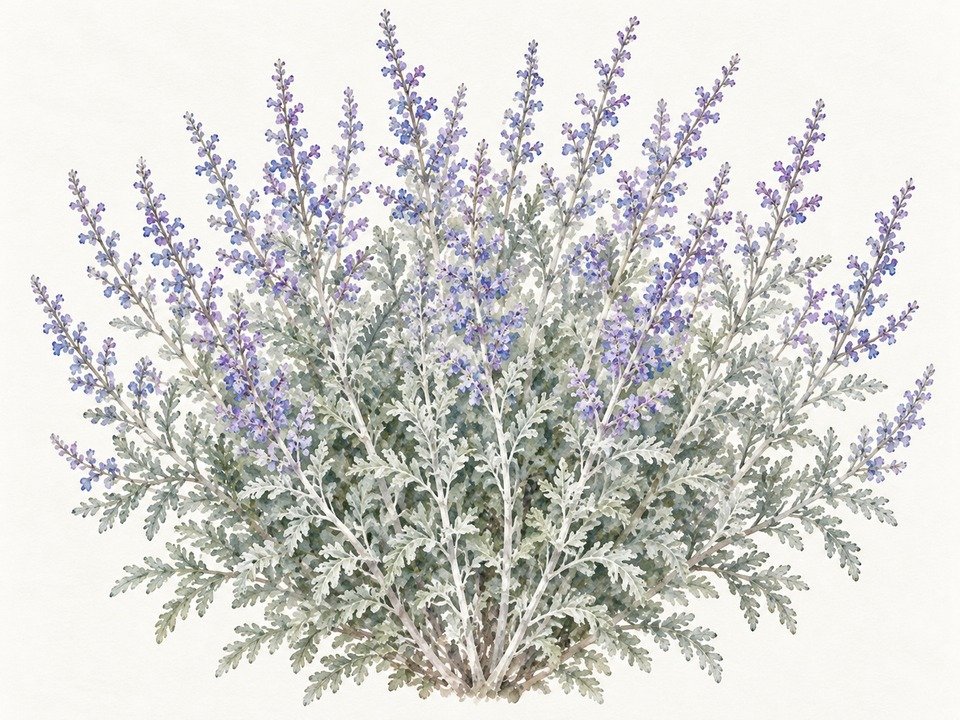
Russian Sage throws a haze of lavender-blue bloom from late summer into fall.
On this page
Botanical name: Perovskia atriplicifolia.
Plant group: Medium shrubs and perennials.
Light
Full sun - the more sun, the sturdier the stems and the heavier the bloom.[1]
Soil and drainage
Well-drained, poor to moderately fertile soil - it tolerates dry, chalky ground and dislikes rich, wet beds.[2]
Height
3-4 feet, with upright silvery stems.[2]
Spread
2-3 feet, spacing about 18-24 inches apart.[1]
Foliage
Finely divided, aromatic gray-green leaves on square silvery-white stems; deciduous.[1]
Water
Low - a drought-tolerant subshrub once established.[3]
Pruning
Cut stems back hard in late winter, to about 6-12 inches; it blooms on new wood.[3]
Seasonal behavior
An airy haze of lavender-blue flowers from late summer into fall, blooming up to two months and drawing pollinators the whole time.[1][3]
When to Plant Russian Sage
Plant Russian Sage in early spring in Central Texas, setting it at the same depth it grew in the pot.[1]
If you would like a hand, the Texas Allied Landscape team can plant your Russian Sage and keep it thriving.
Planting
- Dig a hole twice as wide as the pot and no deeper, with sloping sides, and set the plant at the same depth it grew in its pot. Loosen any circling roots before backfilling.[4]
- For a new bed, clear grass and weeds first, roots and all.[4]
- Site: Full sun - the more sun, the sturdier the stems and the heavier the bloom.[1]
- Soil: Well-drained, poor to moderately fertile soil - it tolerates dry, chalky ground and dislikes rich, wet beds.[2]
- Timing: Plant Russian Sage in early spring in Central Texas, setting it at the same depth it grew in the pot.[1]
- Soak it well at planting and keep watering while the roots establish.[4]
- Mulch 2 to 4 inches, kept a few inches away from the stems to prevent crown rot. It needs no staking or other support.[4]
Care Instructions for Your Russian Sage
Sunlight
Full sun - the more sun, the sturdier the stems and the heavier the bloom.[1]
Soil and drainage
Well-drained, poor to moderately fertile soil - it tolerates dry, chalky ground and dislikes rich, wet beds.[2]
Mature height and spread
3-4 feet, with upright silvery stems.[2] 2-3 feet, spacing about 18-24 inches apart.[1]
Pruning
Cut stems back hard in late winter, to about 6-12 inches; it blooms on new wood.[3]
Normal seasonal behavior
An airy haze of lavender-blue flowers from late summer into fall, blooming up to two months and drawing pollinators the whole time.[1][3]
Russian sage questions
Is Russian sage a sage?
Not really - it is Salvia yangii now (formerly Perovskia), an aromatic subshrub, but the look and toughness earned the name.[5]
When do I cut back Russian sage?
Late winter, hard - down to 6-12 inches. It blooms on new growth, so the hard cut means more flowers, not fewer.[6]
Next step: Our horticulturalists can do the late-winter cutback with your other perennials.
Why is my Russian sage flopping?
Too much shade, too rich a soil, or too much water - it wants full blazing sun and lean, dry ground.[7]
Is Russian sage drought tolerant?
Very - it handles dry, chalky soil and coastal conditions, and overwatering is the main way to lose it.[8]
Let Texas Allied Landscape care for your Russian Sage
Russian Sage does best with steady, knowledgeable care: the right water, pruning at the right time, and a trained eye for stress. The horticulturists at Texas Allied Landscape care for plants like yours across the San Antonio area, backed by over 40 years of landscape experience.
In these community guides
Sources
- University of Wisconsin Extension, "Russian Sage."https://hort.extension.wisc.edu/articles/russian-sage-perovskia-atriplicifolia/abcdefghij
- Royal Horticultural Society, "Salvia yangii."https://www.rhs.org.uk/plants/383623/salvia-yangii-pe/detailsabcde
- Gardeners' World, "How to grow Russian sage."https://www.gardenersworld.com/how-to/grow-plants/russian-sage/abcdef
- Back to basics: Planting perennials, SAWS Garden Style San Antonio.https://www.gardenstylesanantonio.com/garden-articles/back-to-basics-planting-perennials/abcd
- University of Wisconsin Extension, "Russian Sage."https://hort.extension.wisc.edu/articles/russian-sage-perovskia-atriplicifolia/↑
- Gardeners' World, "How to grow Russian sage."https://www.gardenersworld.com/how-to/grow-plants/russian-sage/↑
- Royal Horticultural Society, "Salvia yangii."https://www.rhs.org.uk/plants/383623/salvia-yangii-pe/details↑
- Royal Horticultural Society, "Salvia yangii."https://www.rhs.org.uk/plants/383623/salvia-yangii-pe/details↑