
Property owners
Texas Sedum
- Plant
- Texas Sedum
- Botanical name
- Sedum texanum
- Group
- Ground cover
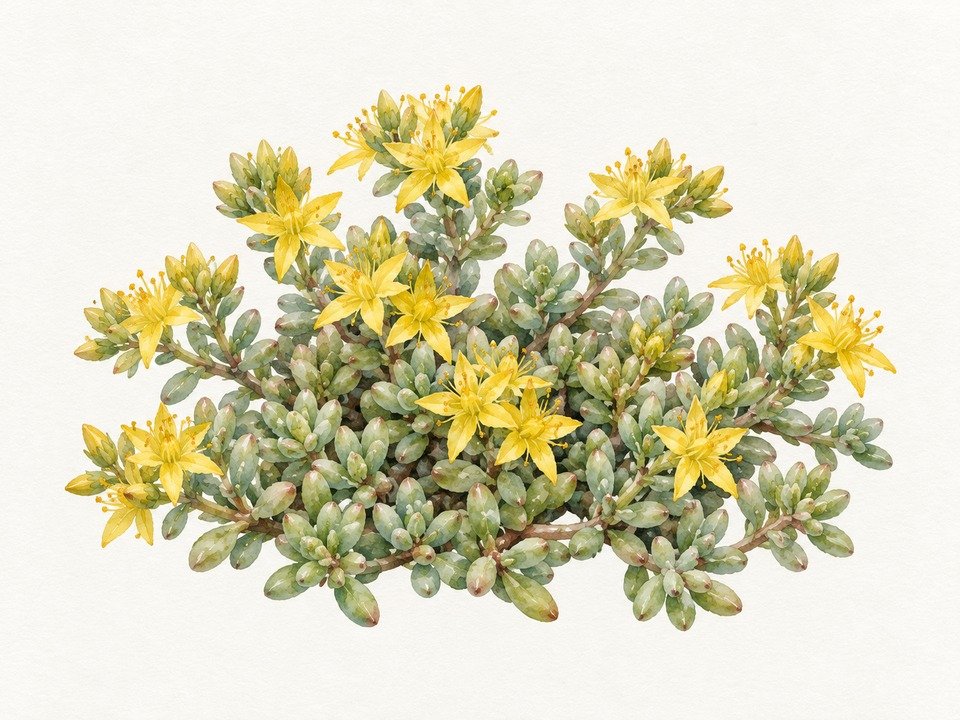
Texas Sedum is a native succulent groundcover for hot, dry, low-traffic spots.
On this page
Botanical name: Sedum texanum.
Plant group: Ground cover.
Light
Full sun to light shade; in strong sun the fleshy leaves take on reddish tones.[1]
Soil and drainage
Sand or sandy soil is its native home, often on coastal clay dunes under cacti and shrubs. It does not tolerate wet soil - drainage is the one rule.[2]
Height
A few inches tall - a low, sprawling succulent.[3]
Spread
Spreads into mats; the leaves fall off and root readily, which is how it colonizes.[3]
Foliage
Succulent green leaves on sprawling stems, often blushing red in sun.[1]
Water
Very low - thick water-storing leaves make it resilient to neglect and irregular watering.[1]
Pruning
None needed; tidy stray mats by hand if it wanders.
Seasonal behavior
Blooms on and off through the year with rosy-yellow flowers and bright yellow stamens at the stem tips.[2]
When to Plant Texas Sedum
Plant Texas Sedum in spring or fall in Central Texas, when it can root in without extreme heat or a hard freeze.[2]
If you would like a hand, the Texas Allied Landscape team can plant your Texas Sedum and keep it thriving.
Planting
- Dig a hole twice as wide as the pot and no deeper, with sloping sides, and set the plant at the same depth it grew in its pot. Loosen any circling roots before backfilling.[4]
- For a new bed, clear grass and weeds first, roots and all.[4]
- Site: Full sun to light shade; in strong sun the fleshy leaves take on reddish tones.[1]
- Soil: Sand or sandy soil is its native home, often on coastal clay dunes under cacti and shrubs. It does not tolerate wet soil - drainage is the one rule.[2]
- Timing: Plant Texas Sedum in spring or fall in Central Texas, when it can root in without extreme heat or a hard freeze.[2]
- Soak it well at planting and keep watering while the roots establish.[4] Once established: Very low - thick water-storing leaves make it resilient to neglect and irregular watering.[1]
- Mulch 2 to 4 inches, kept a few inches away from the stems to prevent crown rot. It needs no staking or other support.[4]
Care Instructions for Your Texas Sedum
Sunlight
Full sun to light shade; in strong sun the fleshy leaves take on reddish tones.[1]
Soil and drainage
Sand or sandy soil is its native home, often on coastal clay dunes under cacti and shrubs. It does not tolerate wet soil - drainage is the one rule.[2]
Mature height and spread
A few inches tall - a low, sprawling succulent.[3] Spreads into mats; the leaves fall off and root readily, which is how it colonizes.[3]
Pruning
None needed; tidy stray mats by hand if it wanders.
Normal seasonal behavior
Blooms on and off through the year with rosy-yellow flowers and bright yellow stamens at the stem tips.[2]
Texas sedum questions
Is Texas sedum a native plant?
Yes - Sedum texanum (now also called Lenophyllum texanum) is native to southern Texas and Mexico, growing on sand and coastal clay dunes.[5]
How much water does Texas sedum need?
Very little - its succulent leaves store water, and wet soil is the one thing it will not tolerate.[6]
Does Texas sedum spread?
Steadily - the fleshy leaves drop off and root where they land, so it forms widening mats over time.[7]
Next step: Our horticulturalists can edge it seasonally to keep the mat where you want it.
Where should I plant Texas sedum?
Rock gardens, containers and low-traffic groundcover spots with sharp drainage and sun to light shade.[8]
Let Texas Allied Landscape care for your Texas Sedum
Texas Sedum does best with steady, knowledgeable care: the right water, pruning at the right time, and a trained eye for stress. The horticulturists at Texas Allied Landscape care for plants like yours across the San Antonio area, backed by over 40 years of landscape experience.
In these community guides
Sources
- Botanapp, "Coastal stonecrop (Lenophyllum texanum)."https://botanapp.com/plant/lenophyllum-texanumabcdefg
- Native Plant Society of Texas, "Lenophyllum texanum."https://www.npsot.org/posts/native-plant/lenophyllum-texanum/abcdefg
- LLIFLE Encyclopedia of Succulents, "Sedum texanum."https://llifle.info/Encyclopedia/SUCCULENTS/Family/Crassulaceae/32147/Sedum_texanumabcd
- Back to basics: Planting perennials, SAWS Garden Style San Antonio.https://www.gardenstylesanantonio.com/garden-articles/back-to-basics-planting-perennials/abcd
- Native Plant Society of Texas, "Lenophyllum texanum."https://www.npsot.org/posts/native-plant/lenophyllum-texanum/↑
- Native Plant Society of Texas, "Lenophyllum texanum."https://www.npsot.org/posts/native-plant/lenophyllum-texanum/↑
- LLIFLE Encyclopedia of Succulents, "Sedum texanum."https://llifle.info/Encyclopedia/SUCCULENTS/Family/Crassulaceae/32147/Sedum_texanum↑
- Botanapp, "Coastal stonecrop (Lenophyllum texanum)."https://botanapp.com/plant/lenophyllum-texanum↑