
Property owners
Texas Wisteria
- Plant
- Texas Wisteria
- Botanical name
- Wisteria frutescens
- Group
- Vines
Sourced light, soil, water and identity details for native Texas Wisteria.
On this page
Its botanical name is Wisteria frutescens. It is also called American Wisteria. Check the botanical label: this is not Chinese Wisteria, Wisteria sinensis.[1][2]
Light, soil and water
Sun to shade is listed, with a sunny site preferred for growth. It has medium water use. It prefers rich, moist to moderately moist, neutral to slightly acid soil. It can turn yellow from poor nutrient uptake in alkaline soil. That is an important caution for limestone-based yards.[1]
Size and support
It is a woody, deciduous climbing vine about 25 to 30 feet long. It is less aggressive than Asian wisteria, but it still becomes a large vine. Give it a support suited to that size.[1]
Flowers
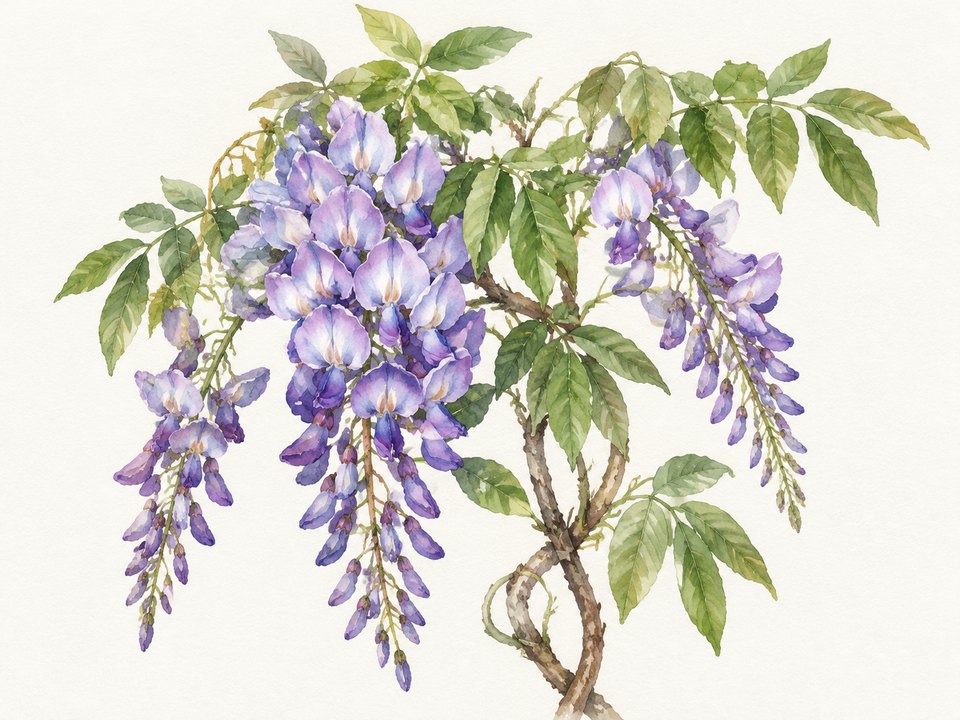
Lilac to bluish-purple flower clusters appear after the leaves and bloom on new wood. The profile lists May and June, with some cultivars repeating in summer and fall. Plants grown from seed can take years to bloom, so first-year bloom is not guaranteed.[1]
Tell it from Asian wisteria
Texas Wisteria leaves out before flowering and has smooth seed pods. Asian species generally bloom before leafing out and have fuzzy pods.[2]
When to Plant Texas Wisteria
Plant Texas Wisteria in fall or spring in Central Texas, when cooler weather lets the roots establish before the vine has to support top growth through summer heat.[3]
If you would like a hand, the Texas Allied Landscape team can plant your Texas Wisteria and keep it thriving.
Planting
- Dig a hole twice as wide as the pot and no deeper, with sloping sides. Set the plant at the same depth it grew in its pot. Loosen any circling roots before backfilling.[4]
- Support: Plant it at the base of whatever it should climb, such as a trellis, fence or arbor, so it can take hold from the start.
- Soil: It can turn yellow from poor nutrient uptake in alkaline soil. That is an important caution for limestone-based yards.[1]
- Timing: Plant Texas Wisteria in fall or spring in Central Texas, when cooler weather lets the roots establish before the vine has to support top growth through summer heat.[3]
- Soak it well at planting and keep watering while the roots establish.[4]
- Mulch 2 to 4 inches, kept a few inches away from the stems to prevent crown rot.[4]
Care Instructions for Your Texas Wisteria
Sunlight, soil and water
Sun to shade is listed, with a sunny site preferred for growth. It has medium water use. It prefers rich, moist to moderately moist, neutral to slightly acid soil. It can turn yellow from poor nutrient uptake in alkaline soil. That is an important caution for limestone-based yards.[1]
Flowers
Lilac to bluish-purple flower clusters appear after the leaves and bloom on new wood. The profile lists May and June, with some cultivars repeating in summer and fall. Plants grown from seed can take years to bloom, so first-year bloom is not guaranteed.[1]
Texas wisteria questions
Is Texas wisteria invasive like Chinese wisteria?
No. Wisteria frutescens is our well-behaved American native. It is far less aggressive than the Asian wisterias.[5]
When does Texas wisteria bloom?
It blooms in spring, with fragrant purple clusters after the leaves emerge. It can rebloom lightly in summer.[6]
How strong a support does Texas wisteria need?
It needs a real one. It is a woody vine that gets heavy, so give it a sturdy arbor, pergola or fence.[7]
Next step: Our horticulturalists can train and prune it so it flowers hard without swallowing the structure.
How do I get more flowers on my wisteria?
Give it full sun and a firm pruning hand. Cut the long whips back after bloom and again in winter.[8]
Let Texas Allied Landscape care for your Texas Wisteria
Texas Wisteria does best with steady, knowledgeable care. That means the right water, pruning at the right time, and a trained eye for stress. The horticulturists at Texas Allied Landscape care for plants like yours across the San Antonio area. They are backed by over 40 years of landscape experience.
In these community guides
Sources
- Wisteria frutescens, Lady Bird Johnson Wildflower Center.https://www.wildflower.org/plants/result.php?id_plant=WIFRabcdefgh
- All Wisteria Are Not Created Equally, Travis County Master Gardeners, May 10, 2022.https://travis-tx.tamu.edu/2022/05/10/all-wisteria-are-not-created-equally-by-gayleen-rabakukk/ab
- October Gardening Checklist, Travis County AgriLife Extension.https://travis-tx.tamu.edu/about-2/horticulture/monthly-gardening-calendar-for-austin-area/october-gardening-checklist-for-austin-and-central-texas/ab
- Back to basics: Planting perennials, SAWS Garden Style San Antonio.https://www.gardenstylesanantonio.com/garden-articles/back-to-basics-planting-perennials/abc
- Native Plant Society of Texas, "Wisteria frutescens."https://www.npsot.org/posts/native-plant/wisteria-frutescens/↑
- City of Austin Watershed Protection plant guide, "Wisteria, Texas."https://www.austintexas.gov/watershed-protection/plant-guide/wisteria-texas↑
- NC State Extension, "Wisteria frutescens."https://plants.ces.ncsu.edu/plants/wisteria-frutescens/↑
- NC State Extension, "Wisteria frutescens."https://plants.ces.ncsu.edu/plants/wisteria-frutescens/↑