
Property owners
Venus Maidenhair Fern
- Plant
- Venus Maidenhair Fern
- Botanical name
- Adiantum capillus-veneris
- Group
- Ground cover
Venus Maidenhair Fern brings Hill Country seep elegance to deep shade.
On this page
Botanical name: Adiantum capillus-veneris.
Plant group: Ferns.
Light
Deep shade - in the wild it grows on shaded limestone ledges and canyon seeps, never in sun.[1]
Soil and drainage
Moist, humus-rich soil that never dries out; in the Hill Country it roots in damp pockets of limestone near seeps and springs.[2]
Height
6-12 inches, fronds arising in clusters from creeping rhizomes.[3]
Spread
Spreads slowly by creeping rhizomes; where moisture is constant it forms thick, lush blankets.[1]
Foliage
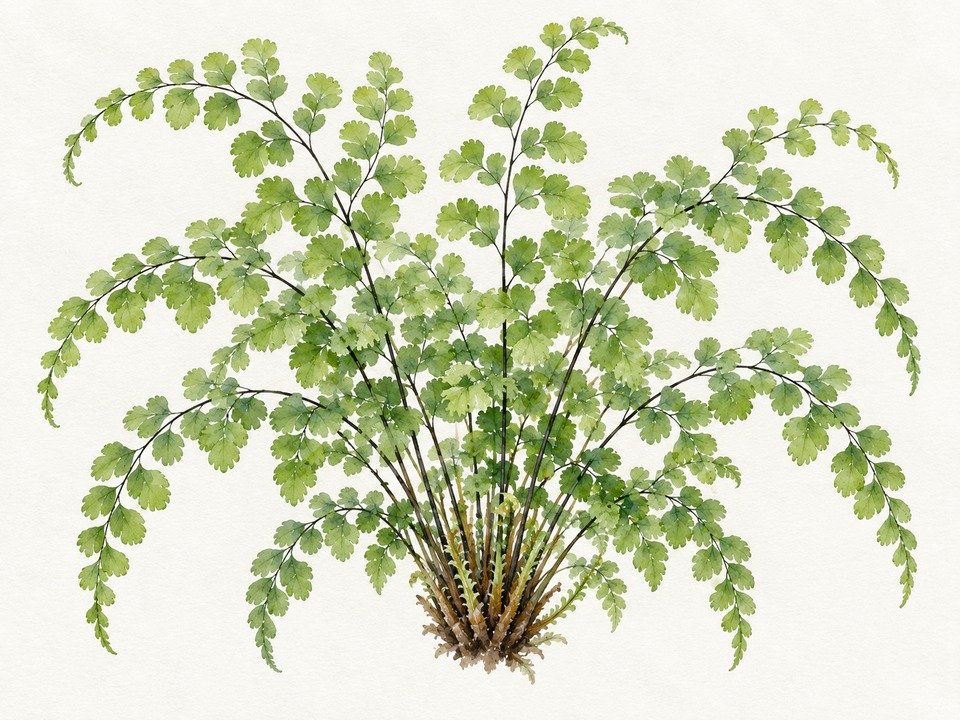
The most delicate fern we grow - fan-shaped leaflets on wiry black stems, lacy and graceful.[3]
Water
Constant moisture and humidity - keep the soil moist but not soaking between waterings; compost helps hold it. Dry air plus dry soil crisps the fronds fast.[4]
Pruning
Just snip out dead or crisped fronds; if the roots stayed moist it resprouts fresh.[4]
Seasonal behavior
Evergreen in a protected, moist, frost-free spot; a hard freeze takes the fronds but it returns from the rhizomes in spring.[5]
When to Plant Venus Maidenhair Fern
Plant Venus Maidenhair Fern in spring so it has the long warm season to root into its spot before winter.[3]
If you would like a hand, the Texas Allied Landscape team can plant your Venus Maidenhair Fern and keep it thriving.
Planting
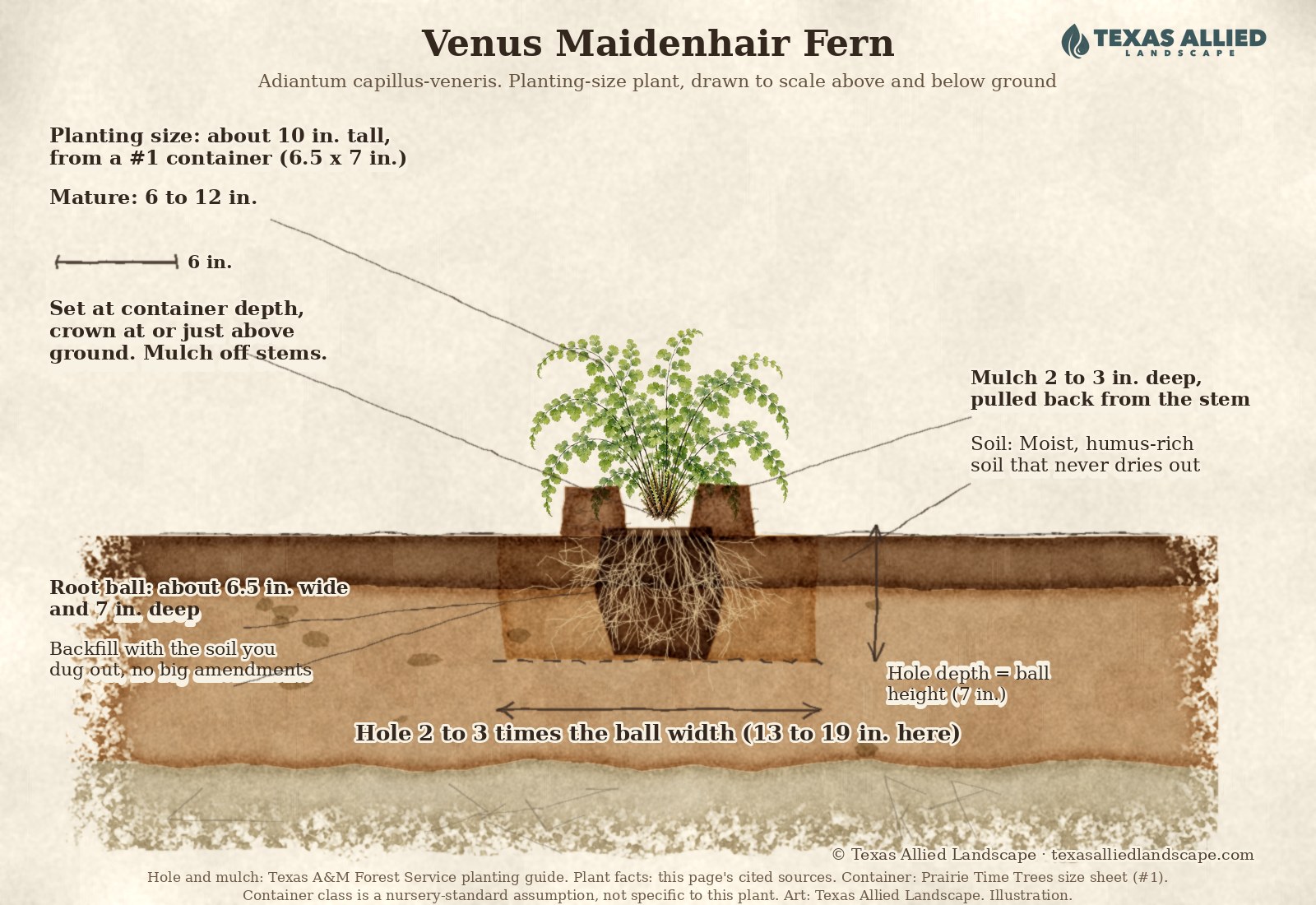
- Dig a hole twice as wide as the pot and no deeper, with sloping sides, and set the plant at the same depth it grew in its pot. Loosen any circling roots before backfilling.[6]
- For a new bed, clear grass and weeds first, roots and all.[6]
- Site: Deep shade - in the wild it grows on shaded limestone ledges and canyon seeps, never in sun.[1]
- Timing: Plant Venus Maidenhair Fern in spring so it has the long warm season to root into its spot before winter.[3]
- Soak it well at planting and keep watering while the roots establish.[6]
- Mulch 2 to 4 inches, kept a few inches away from the stems to prevent crown rot. It needs no staking or other support.[6]
Care Instructions for Your Venus Maidenhair Fern
Sunlight
Deep shade - in the wild it grows on shaded limestone ledges and canyon seeps, never in sun.[1]
Soil and drainage
Moist, humus-rich soil that never dries out; in the Hill Country it roots in damp pockets of limestone near seeps and springs.[2]
Mature height and spread
6-12 inches, fronds arising in clusters from creeping rhizomes.[3] Spreads slowly by creeping rhizomes; where moisture is constant it forms thick, lush blankets.[1]
Pruning
Just snip out dead or crisped fronds; if the roots stayed moist it resprouts fresh.[4]
Normal seasonal behavior
Evergreen in a protected, moist, frost-free spot; a hard freeze takes the fronds but it returns from the rhizomes in spring.[5]
Maidenhair fern questions
Does a fern really grow in the Texas Hill Country?
Yes - southern maidenhair (Adiantum capillus-veneris) is native to Hill Country seeps and sheltered limestone grottos, delicate black-stemmed fronds and all.[7]
Where can I grow maidenhair fern in my yard?
Deep shade with constant moisture - a shaded bed against a wall, near a hose bib or by a pond edge. It collapses fast in sun or dry soil.[8]
Why did my maidenhair fern crisp up?
Dry air or dry soil - even a day or two of drought toasts the fronds. Cut the dead fronds; if the roots stayed moist it resprouts.[9]
Next step: Our horticulturalists can place maidenhair where irrigation and shade keep it lush, or suggest a tougher fern look.
Is maidenhair fern evergreen?
In a protected, moist, frost-free spot it can stay green through a mild winter; a hard freeze takes the fronds, but it returns from the rhizomes.[10]
Let Texas Allied Landscape care for your Venus Maidenhair Fern
Venus Maidenhair Fern does best with steady, knowledgeable care: the right water, pruning at the right time, and a trained eye for stress. The horticulturists at Texas Allied Landscape care for plants like yours across the San Antonio area, backed by over 40 years of landscape experience.
In these community guides
Sources
- Native Plant Society of Texas, "The Texas Hill Country is fern habitat too."https://www.npsot.org/posts/the-texas-hill-country-is-fern-habitat-too/abcde
- Lady Bird Johnson Wildflower Center, Mr. Smarty Plants, "Transplanting Maidenhair Fern."https://www.wildflower.org/expert/show.php?frontpage=true&id=7607ab
- Lady Bird Johnson Wildflower Center, "Adiantum capillus-veneris."https://www.wildflower.org/plants/result.php?id_plant=adcaabcde
- Lady Bird Johnson Wildflower Center, Mr. Smarty Plants, "Dieback of river fern and maidenhair fern."https://www.wildflower.org/expert/show.php?frontpage=true&id=11185abcd
- Native Plant Society of Texas, "Adiantum capillus-veneris."https://www.npsot.org/posts/native-plant/adiantum-capillus-veneris/ab
- Back to basics: Planting perennials, SAWS Garden Style San Antonio.https://www.gardenstylesanantonio.com/garden-articles/back-to-basics-planting-perennials/abcd
- Native Plant Society of Texas, "The Texas Hill Country is fern habitat too."https://www.npsot.org/posts/the-texas-hill-country-is-fern-habitat-too/↑
- Native Plant Society of Texas, "Adiantum capillus-veneris."https://www.npsot.org/posts/native-plant/adiantum-capillus-veneris/↑
- Lady Bird Johnson Wildflower Center, "Adiantum capillus-veneris."https://www.wildflower.org/plants/result.php?id_plant=adca↑
- Native Plant Society of Texas, "Adiantum capillus-veneris."https://www.npsot.org/posts/native-plant/adiantum-capillus-veneris/↑