
Property owners
White Rain Lily
- Plant
- White Rain Lily
- Botanical name
- Zephyranthes chlorosolen
- Group
- Low shrubs and perennials
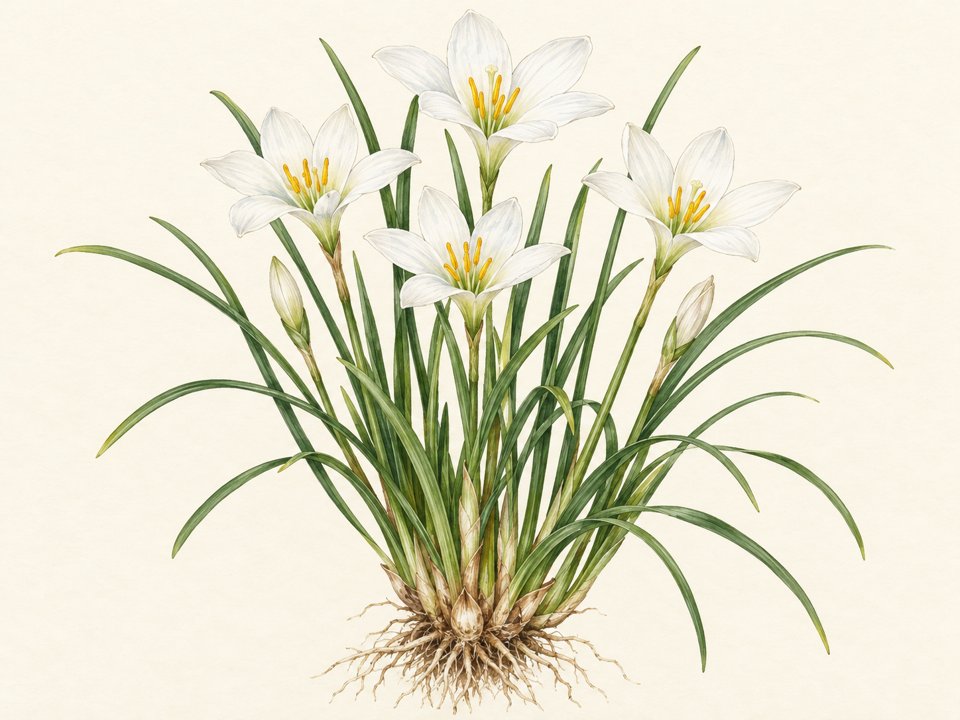
White Rain Lily (Zephyranthes chlorosolen) is a native bulb with fragrant white blooms after rains.
On this page
Its botanical name is Zephyranthes chlorosolen. It belongs to the low shrubs and perennials group.
White Rain Lily (evening rain lily) is a small native bulb with grassy leaves and fragrant white crocus-like flowers that open in the evening, often a few days after rains. It grows in sun to part shade in well-drained soil and needs little care.[1]
Light
Sun to part shade.[2]
Height
Up to about 1 ft tall.[2]
When to Plant White Rain Lily
Plant White Rain Lily bulbs in fall or early spring in Central Texas. Fall planting follows the same season as other spring-blooming bulbs. It lets roots settle in before bloom time.[3]
If you would like a hand, the Texas Allied Landscape team can plant your White Rain Lily and keep it thriving.
Planting
- Dig a hole twice as wide as the pot and no deeper, with sloping sides. Set the plant at the same depth it grew in its pot. Loosen any circling roots before backfilling.[4]
- For a new bed, clear grass and weeds first, roots and all.[4]
- For the site, it grows in sun to part shade in well-drained soil and needs little care.[1]
- For timing, fall planting follows the same season as other spring-blooming bulbs. It lets roots settle in before bloom time.[3]
- Soak it well at planting and keep watering while the roots establish.[4]
- Mulch 2 to 4 inches, kept a few inches away from the stems to prevent crown rot. It needs no staking or other support.[4]
Care Instructions for Your White Rain Lily
How to Water a White Rain Lily
Planting
It grows in full sun to light shade as an edging, in rock gardens, or scattered through groundcover. The grassy foliage disappears politely between bloom flushes.[5]
Fruit and flowers
They are triggered by rainstorms. A good soaking after dry weather brings up the white crocus-like flowers within days, sometimes several times a season.[6]
White rain lily questions
Why do rain lilies bloom after rain?
They are triggered by rainstorms. A good soaking after dry weather brings up the white crocus-like flowers within days, sometimes several times a season.[6]
Are rain lilies perennial in Texas?
Yes. Zephyranthes candida is a tough little bulb that comes back and multiplies for decades with zero care. It tolerates both drought and soggy spells.[7]
Where should I plant rain lilies?
It grows in full sun to light shade as an edging, in rock gardens, or scattered through groundcover. The grassy foliage disappears politely between bloom flushes.[5]
Do rain lilies need dividing?
Divide them only every several years if the clump stops blooming well. Dig and split the bulbs after bloom. Mostly you just leave them alone.[8]
Next step: Our horticulturalists can tuck rain lily bulbs along walks and beds for surprise blooms after every storm.
Let Texas Allied Landscape care for your White Rain Lily
White Rain Lily does best with steady, knowledgeable care. That means the right water, pruning at the right time, and a trained eye for stress. The horticulturists at Texas Allied Landscape care for plants like yours across the San Antonio area. They bring over 40 years of landscape experience.
In these community guides
Sources
- Lady Bird Johnson Wildflower Center, "Zephyranthes chlorosolen"https://www.wildflower.org/plants/result.php?id_plant=ZECHab
- Zephyranthes chlorosolen (White Rain Lily), Lady Bird Johnson Wildflower Center.https://www.wildflower.org/plants/result.php?id_plant=ZECHab
- October Gardening Checklist, Travis County AgriLife Extension.https://travis-tx.tamu.edu/about-2/horticulture/monthly-gardening-calendar-for-austin-area/october-gardening-checklist-for-austin-and-central-texas/ab
- Back to basics: Planting perennials, SAWS Garden Style San Antonio.https://www.gardenstylesanantonio.com/garden-articles/back-to-basics-planting-perennials/abcd
- North Carolina Extension Gardener Plant Toolbox, "Zephyranthes candida."https://plants.ces.ncsu.edu/plants/zephyranthes-candida/ab
- Tyler Morning Telegraph, "Rain lilies spring up for summer color."https://tylerpaper.com/2015/07/15/rain-lilies-spring-up-for-summer-color-2/ab
- UC Davis Arboretum All-Stars, "Argentine Rain Lily."https://arboretum.ucdavis.edu/all-stars/argentine-rain-lily↑
- Tyler Morning Telegraph, "Rain lilies spring up for summer color."https://tylerpaper.com/2015/07/15/rain-lilies-spring-up-for-summer-color-2/↑