
Property owners
Blackfoot Daisy
- Plant
- Blackfoot Daisy
- Botanical name
- Melampodium leucanthum
- Group
- Low shrubs and perennials
Blackfoot Daisy (Melampodium leucanthum): light, water, soil, size and care for San Antonio area landscapes.
On this page
Its botanical name is Melampodium leucanthum.
Light
Soil and drainage
It likes dry, rocky, calcareous soils such as limestone, caliche and gravel. Survival requires excellent drainage. In San Antonio clay soils it can be extremely short-lived.
Height
It seldom grows over 6 inches tall, though it occasionally reaches 1 to 2 feet.
Spread
It forms clumps 1 to 2 feet across.
Foliage
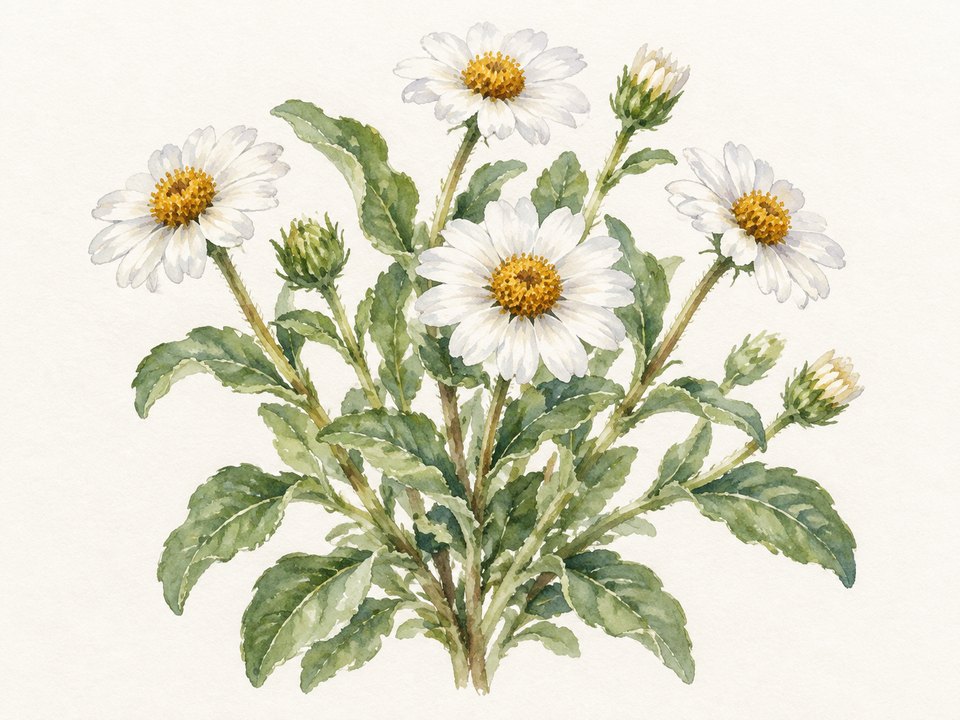
It is a deciduous mounding perennial with narrow green leaves.
Water
It needs little water. Once established, it needs only occasional water. If watering ever feels like a guessing game, our horticulturists can care for your Blackfoot Daisy on a schedule that fits your yard.
Pruning
Older plants can be trimmed back by 5 inches in early spring to encourage dense growth.
Seasonal behavior
It blooms with creamy-white daisy flowers from March through fall. It is sturdy in rock gardens, and it tolerates heat and drought.
Why did my blackfoot daisy die after one season in clay soil?
It can be extremely short-lived in San Antonio clay soils. Survival requires excellent drainage. Site and soil, not illness, are the usual cause.
When to Plant Blackfoot Daisy
Plant Blackfoot Daisy in fall or early spring in Central Texas. A fall planting establishes roots through the cool season and is ready to grow and bloom the following year. Spring planting works too if you water through the first summer.[3]
If you would like a hand, the Texas Allied Landscape team can plant your Blackfoot Daisy and keep it thriving.
Planting
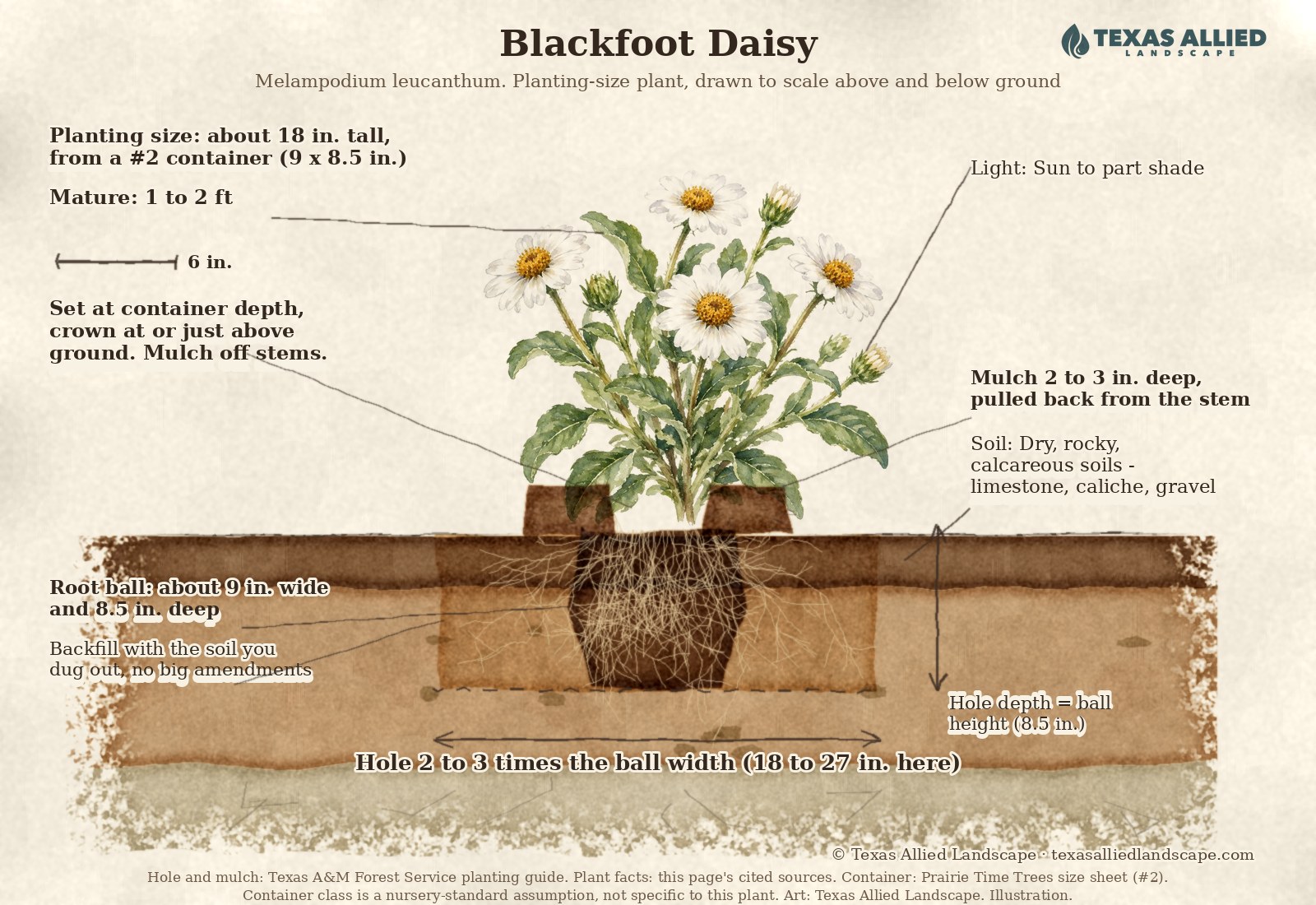
- Dig a hole twice as wide as the pot and no deeper, with sloping sides. Set the plant at the same depth it grew in its pot. Loosen any circling roots before backfilling.[4]
- For a new bed, clear grass and weeds first, roots and all.[4]
- Site: It grows in sun to part shade.[1][2]
- Timing: A fall planting establishes roots through the cool season and is ready to grow and bloom the following year. Spring planting works too if you water through the first summer.[3]
- Soak it well at planting and keep watering while the roots establish.[4]
- Add 2 to 4 inches of mulch, kept a few inches away from the stems to prevent crown rot. It needs no staking or other support.[4]
Care Instructions for Your Blackfoot Daisy
How to Water a Blackfoot Daisy
It needs little water. Once established, it needs only occasional water.
Sunlight
It grows in sun to part shade.[1][2]
Soil and drainage
It likes dry, rocky, calcareous soils such as limestone, caliche and gravel. Survival requires excellent drainage. In San Antonio clay soils it can be extremely short-lived.
Mature height and spread
It seldom grows over 6 inches tall, though it occasionally reaches 1 to 2 feet. It forms clumps 1 to 2 feet across.
Pruning
Older plants can be trimmed back by 5 inches in early spring to encourage dense growth.
Normal seasonal behavior
It blooms with creamy-white daisy flowers from March through fall. It is sturdy in rock gardens, and it tolerates heat and drought.
Blackfoot daisy questions
Is blackfoot daisy a Texas native?
Yes. It is a true Chihuahuan desert native of West and Central Texas. That is why it laughs at our heat, drought, deer and rocky alkaline soil.[5]
Why did my blackfoot daisy die over winter?
The usual cause is wet feet, not cold. It rots in soil that stays damp, especially in winter. Plant it in gravelly, sharply drained ground and it is reliably perennial here.[6]
How long do blackfoot daisies bloom?
They bloom from spring through frost. That is a long season of white daisies on a tidy 1-foot mound. The honey-scented flowers draw pollinators constantly.[7]
Should I trim blackfoot daisy?
A light shear after each big bloom flush keeps it compact and blooming. Without it the mound gets leggy and opens up in the middle.[8]
Next step: Our horticulturalists can time the shearings with your regular bed care.
Let Texas Allied Landscape care for your Blackfoot Daisy
Blackfoot Daisy does best with steady, knowledgeable care. That means the right water, pruning at the right time, and a trained eye for stress. The horticulturists at Texas Allied Landscape care for plants like yours across the San Antonio area. They are backed by over 40 years of landscape experience.
In these community guides
- Art in progress
Cordillera Ranch Landscaping
Bring your address, survey and yard ideas. We check the right guideline set, plan planting and irrigation, prepare the…

Illustration. Illustration based on reference photos of Johnson Ranch. Not a single literal view. Johnson Ranch Landscaping
Share your Johnson Ranch address, survey and yard ideas. Texas Allied Landscape can help plan planting, irrigation and…
Sources
- Melampodium leucanthum (Blackfoot daisy), Lady Bird Johnson Wildflower Center Native Plants Database.https://www.wildflower.org/plants/result.php?id_plant=mele2abc
- Blackfoot Daisy, San Antonio Water System Garden Style San Antonio.https://www.gardenstylesanantonio.com/plants/blackfoot-daisy/abc
- October Gardening Checklist, Travis County AgriLife Extension.https://travis-tx.tamu.edu/about-2/horticulture/monthly-gardening-calendar-for-austin-area/october-gardening-checklist-for-austin-and-central-texas/ab
- Back to basics: Planting perennials, SAWS Garden Style San Antonio.https://www.gardenstylesanantonio.com/garden-articles/back-to-basics-planting-perennials/abcd
- Native Plant Society of Texas, "Melampodium leucanthum."https://www.npsot.org/posts/native-plant/melampodium-leucanthum/↑
- City of Austin Grow Green plant guide, "Daisy, Blackfoot."https://www.austintexas.gov/watershed-protection/plant-guide/daisy-blackfoot↑
- Lindheimer Chapter, Native Plant Society of Texas, "Plant Care - Blackfoot Daisy."https://lindheimerchapternpsot.org/?page_id=942↑
- City of Austin Grow Green plant guide, "Daisy, Blackfoot."https://www.austintexas.gov/watershed-protection/plant-guide/daisy-blackfoot↑