
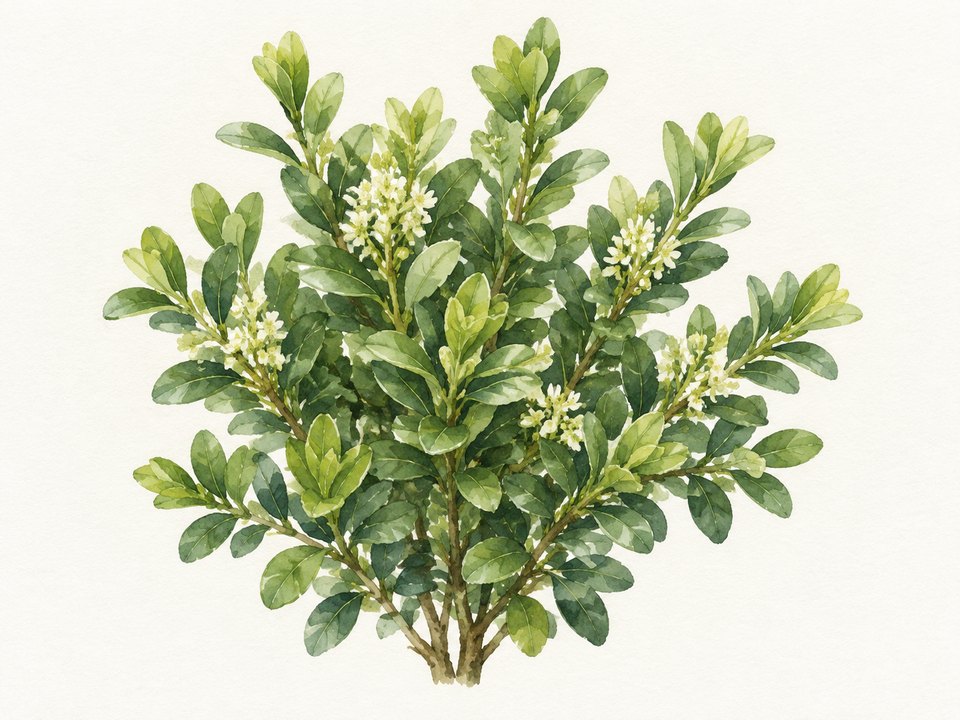
Property owners
Boxwood
- Plant
- Boxwood
- Botanical name
- Buxus microphylla
- Group
- Medium shrubs and perennials
Boxwood (Buxus microphylla): light, water, soil, size and care for San Antonio area landscapes.
On this page
Its botanical name is Buxus microphylla.
Light
It needs full sun to light shade. Provide some protection from wind and winter weather. The foliage can bronze orangish-brown under extremes on some varieties per NC State.[1]
Soil and drainage
It likes moist, cool, well-drained soil. It is adaptable to various soil types. It has shallow roots, so mulch heavily to retain moisture per NC State.
Height
Its size depends on the cultivar. 'Wintergreen' is compact at 2-4 ft. 'Winter Gem' reaches 4-6 ft per NC State.
Foliage
It is an evergreen broadleaf per NC State.
Water
It is typically quite drought tolerant once established. Mulch heavily to retain moisture over the shallow roots per NC State. If watering ever feels like a guessing game, our horticulturists can care for your Boxwood on a schedule that fits your yard.
Pruning
It prunes exceptionally well. Do not prune until after the possibility of a late spring frost, to protect new growth per NC State.
Seasonal behavior
It is a slow-growing evergreen structure plant. It is deer and rabbit resistant per NC State. The Texas A&M plant clinic documents boxwood dieback (Colletotrichum theobromicola). Watch for tan dead twigs with black discoloration under the bark and scattered dead branches.[2]
When to Plant Boxwood
Plant Boxwood in fall or early spring in Central Texas. A fall planting establishes roots through the cool season. The plant is ready to grow and bloom the following year. Spring planting works too if you water through the first summer.[3]
If you would like a hand, the Texas Allied Landscape team can plant your Boxwood and keep it thriving.
Planting
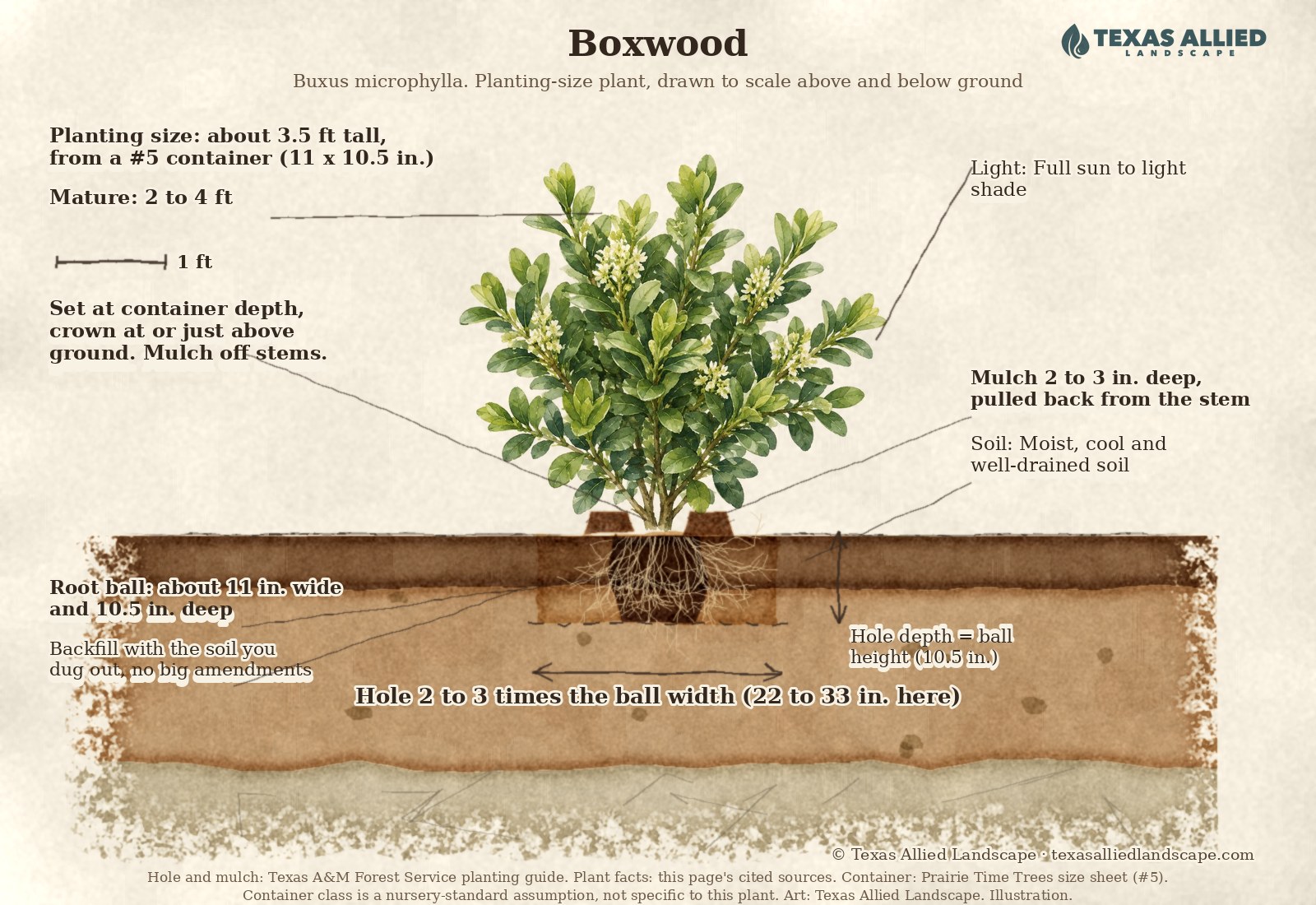
- Dig a hole twice as wide as the pot and no deeper, with sloping sides. Set the plant at the same depth it grew in its pot. Loosen any circling roots before backfilling.[4]
- For a new bed, clear grass and weeds first, roots and all.[4]
- For the site, it needs full sun to light shade. Provide some protection from wind and winter weather. The foliage can bronze orangish-brown under extremes on some varieties per NC State.[1]
- For timing, a fall planting establishes roots through the cool season. The plant is ready to grow and bloom the following year. Spring planting works too if you water through the first summer.[3]
- Soak it well at planting and keep watering while the roots establish.[4] Once established, a fall planting has roots set through the cool season. The plant is ready to grow and bloom the following year. Spring planting works too if you water through the first summer.[3]
- Mulch 2 to 4 inches, kept a few inches away from the stems to prevent crown rot. It needs no staking or other support.[4]
What are the dead tan branches in my boxwood?
Boxwood dieback (Colletotrichum theobromicola) shows randomly scattered tan, dead twigs and branches. It also shows black discoloration under the bark of dead tissue. Confirm with the county extension office or a diagnostic lab before treating.
Care Instructions for Your Boxwood
How to Water a Boxwood
It is typically quite drought tolerant once established. Mulch heavily to retain moisture over the shallow roots per NC State.
Sunlight
It needs full sun to light shade. Provide some protection from wind and winter weather. The foliage can bronze orangish-brown under extremes on some varieties per NC State.[1]
Soil and drainage
It likes moist, cool, well-drained soil. It is adaptable to various soil types. It has shallow roots, so mulch heavily to retain moisture per NC State.
Mature height and spread
Its size depends on the cultivar. 'Wintergreen' is compact at 2-4 ft. 'Winter Gem' reaches 4-6 ft per NC State.
Pruning
It prunes exceptionally well. Do not prune until after the possibility of a late spring frost, to protect new growth per NC State.
Normal seasonal behavior
It is a slow-growing evergreen structure plant. It is deer and rabbit resistant per NC State. The Texas A&M plant clinic documents boxwood dieback (Colletotrichum theobromicola). Watch for tan dead twigs with black discoloration under the bark and scattered dead branches.[2]
Boxwood questions
How often should I prune boxwood?
Once or twice a year is plenty. Do a light shaping in late spring after the first flush, and a touch-up in late summer if needed. Avoid hard cuts into old wood in late fall. New growth pushed then gets burned by frost.[5]
Next step: Our horticulturalists keep formal boxwood hedges crisp on a seasonal schedule.
Why are my boxwood's leaves turning bronze in winter?
Winter bronzing is normal on many varieties. Cold, wind and sun pull color from the foliage. It greens back up in spring. Persistent yellowing with thin growth points to drainage or root issues instead.[6]
How much sun does boxwood take in Texas?
Morning sun with afternoon shade is the sweet spot in Central Texas. Boxwood handles full shade, but all-day summer sun scorches it here even when the same plant thrives in full sun up north.[7]
Why are the insides of my boxwoods dying?
Dense shearing grows a shell of leaves that shades out the interior, so the inside goes bare. The fix is thinning, not more shearing. Remove some stems to let light in. Water stress and root disease cause similar dieback, so check soil moisture first.[8]
Let Texas Allied Landscape care for your Boxwood
Boxwood does best with steady, knowledgeable care. That means the right water, pruning at the right time, and a trained eye for stress. The horticulturists at Texas Allied Landscape care for plants like yours across the San Antonio area. They bring over 40 years of landscape experience.
In these community guides
- Art in progress
Cordillera Ranch Landscaping
Bring your address, survey and yard ideas. We check the right guideline set, plan planting and irrigation, prepare the…

Illustration. Illustration based on reference photos of Johnson Ranch. Not a single literal view. Johnson Ranch Landscaping
Share your Johnson Ranch address, survey and yard ideas. Texas Allied Landscape can help plan planting, irrigation and…
Sources
- Buxus microphylla (Littleleaf Box, Littleleaf Boxwood), North Carolina Extension Gardener Plant Toolbox.https://plants.ces.ncsu.edu/plants/buxus-microphylla/abc
- Boxwood dieback, Texas Plant Disease Diagnostic Lab - Texas A&M AgriLife Extension.https://plantclinic.tamu.edu/calendar2018/bwood_dieback/ab
- October Gardening Checklist, Travis County AgriLife Extension.https://travis-tx.tamu.edu/about-2/horticulture/monthly-gardening-calendar-for-austin-area/october-gardening-checklist-for-austin-and-central-texas/abc
- Back to basics: Planting perennials, SAWS Garden Style San Antonio.https://www.gardenstylesanantonio.com/garden-articles/back-to-basics-planting-perennials/abcd
- Saunders Brothers, "Boxwood Guide."https://www.saundersbrothers.com/_ccLib/attachments/about/Boxwood%2BGuide%2B-%2B7th%2BEdition.pdf↑
- Treeland Nursery (Dallas-Fort Worth), "Winter Gem Boxwood."https://www.tree-land.com/products/winter-gem-boxwood↑
- Conservation Garden Park, "Winter Gem Boxwood."https://conservationgardenpark.jvwcd.gov/plants/1864/winter-gem-boxwood↑
- Garden Guides, "Winter Gem Boxwood Pruning."https://www.gardenguides.com/info_8585755_winter-gem-boxwood-pruning/↑