
Property owners
Butterfly Vine
- Plant
- Butterfly Vine
- Botanical name
- Mascagnia macroptera
- Group
- Vines
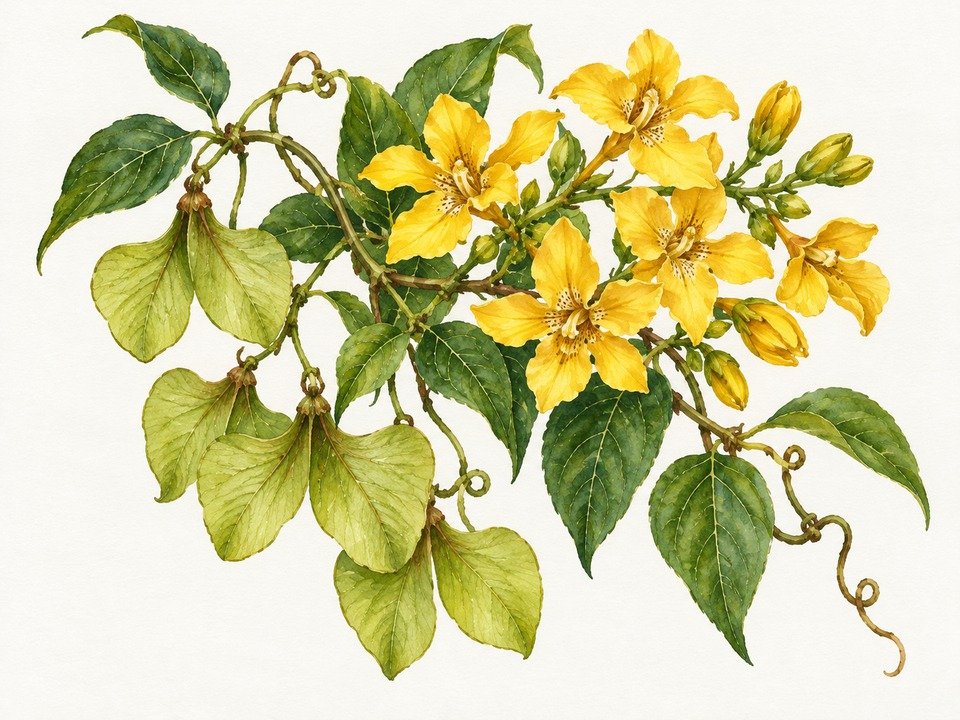
Butterfly Vine covers fences with yellow bloom and butterfly seed pods.
On this page
Its botanical name is Mascagnia macroptera.
It belongs to the vines group.
Light
It grows in sun to partial shade. The most flowers come in full sun, but it performs in light shade too.[1]
Soil and drainage
It prefers rich, well-drained soil.[1]
Height
It climbs 15-20 feet up a fence or trellis. Without support it twines on itself into a mound. You can keep that mound as a shrub or groundcover.[1][2]
Spread
It is a vigorous, heat-loving twining vine. It is far better mannered than trumpet creeper and easy to keep on a fence.[2]
Foliage
Its leaves are glossy dark green. It is evergreen in mild winters. After a cold one it dies back and resprouts in spring.[1]
Water
It needs moderate water to establish. Then it is very drought tolerant. Water to get it going, then give it little care beyond shaping.[3]
Pruning
Prune to shape or contain it as needed. It takes shearing well and can even be kept as a dwarf shrub.[3]
Seasonal behavior
It shows bright yellow orchid-shaped flowers from May to September, often with a second flush in fall. Then come the namesake seed pods. They look like chartreuse butterflies that dry tan.[2][3] It is deer resistant, and bees love it.[4]
When to Plant Butterfly Vine
Plant Butterfly Vine in spring after the last freeze. It is frost-tender when young and wants a warm season to establish.[1]
If you would like a hand, the Texas Allied Landscape team can plant your Butterfly Vine and keep it thriving.
Planting
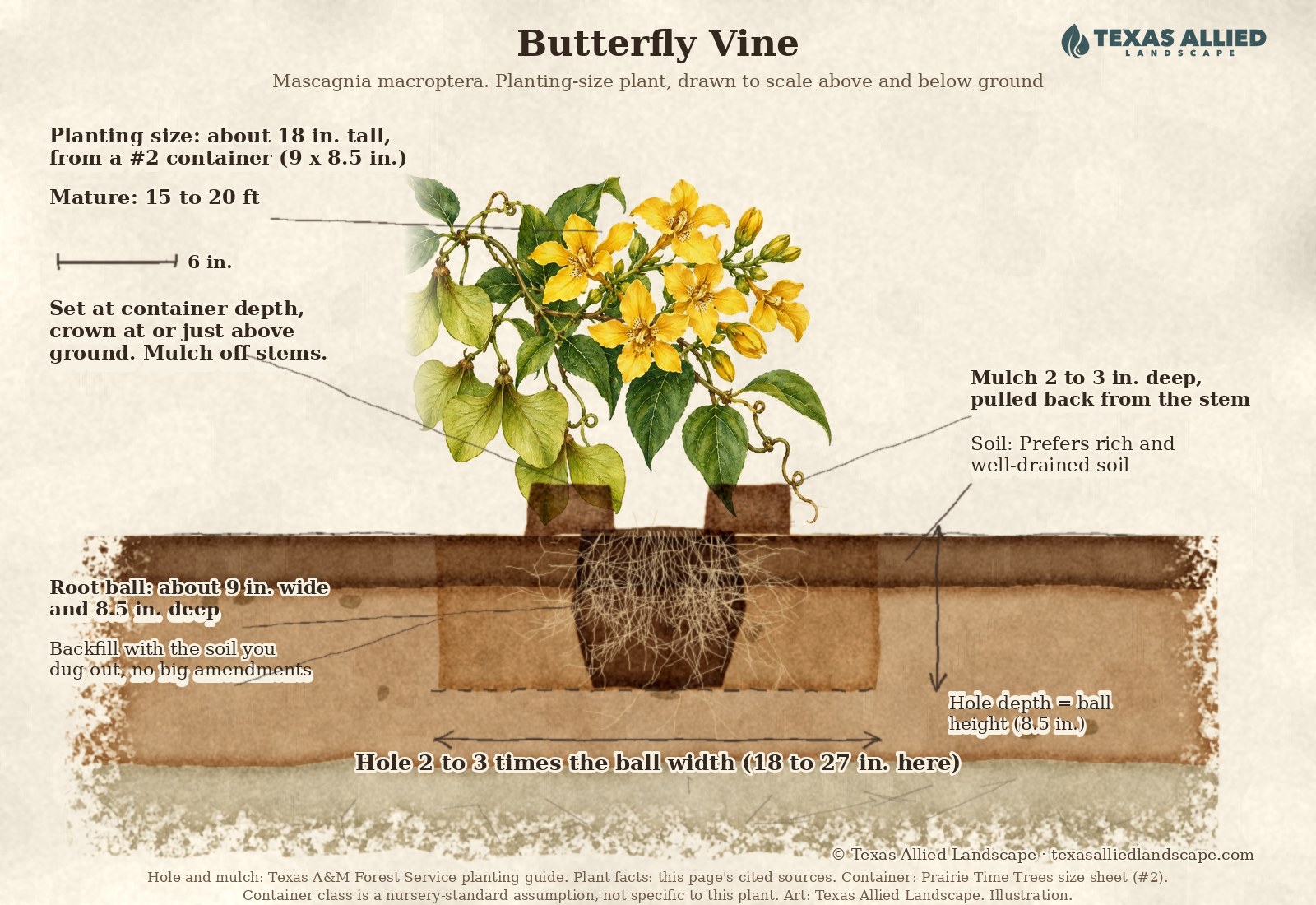
- Dig a hole twice as wide as the pot and no deeper, with sloping sides. Set the plant at the same depth it grew in its pot. Loosen any circling roots before backfilling.[5]
- Support: It climbs 15-20 feet up a fence or trellis. Without support it twines on itself into a mound. You can keep that mound as a shrub or groundcover.[1][2]
- Site: It grows in sun to partial shade. The most flowers come in full sun, but it performs in light shade too.[1]
- Soil: It prefers rich, well-drained soil.[1]
- Timing: Plant Butterfly Vine in spring after the last freeze. It is frost-tender when young and wants a warm season to establish.[1]
- Soak it well at planting and keep watering while the roots establish.[5] Once established: It needs moderate water to establish, then it is very drought tolerant. Water to get it going, then give it little care beyond shaping.[3]
- Mulch 2 to 4 inches, kept a few inches away from the stems to prevent crown rot.[5]
Care Instructions for Your Butterfly Vine
Sunlight
It grows in sun to partial shade. The most flowers come in full sun, but it performs in light shade too.[1]
Soil and drainage
It prefers rich, well-drained soil.[1]
Mature height and spread
It climbs 15-20 feet up a fence or trellis. Without support it twines on itself into a mound. You can keep that mound as a shrub or groundcover.[1][2] It is a vigorous, heat-loving twining vine. It is far better mannered than trumpet creeper and easy to keep on a fence.[2]
Pruning
Prune to shape or contain it as needed. It takes shearing well and can even be kept as a dwarf shrub.[3]
Normal seasonal behavior
It shows bright yellow orchid-shaped flowers from May to September, often with a second flush in fall. Then come the namesake seed pods. They look like chartreuse butterflies that dry tan.[2][3] It is deer resistant, and bees love it.[4]
Butterfly vine questions
Is butterfly vine good for Texas?
Yes. Mascagnia macroptera handles our heat and blooms yellow through summer and fall. Its seed pods look like green-brown butterflies, which is the name.[6]
Is butterfly vine a Texas native?
It is native to the tropical Americas. There are two similar species. The one usually sold (Mascagnia) is the better-behaved, more cold-tolerant one.[7]
Is butterfly vine cold hardy here?
It dies back in a freeze and returns from the roots in Central Texas. Plant it against a warm wall for the best overwintering odds.[8]
How big does butterfly vine get?
It is a manageable 8-15 ft vine. It is vigorous but much better mannered than trumpet creeper. It is easy to keep on a fence or trellis.[9]
Next step: Our horticulturalists can train a butterfly vine on your fence and keep it shaped with seasonal trims.
Let Texas Allied Landscape care for your Butterfly Vine
Butterfly Vine does best with steady, knowledgeable care. That means the right water, pruning at the right time, and a trained eye for stress. The horticulturists at Texas Allied Landscape care for plants like yours across the San Antonio area. They are backed by over 40 years of landscape experience.
In these community guides
Sources
- Texas A&M AgriLife Extension, Bexar County, "Yellow Butterfly Vine."https://bexar-tx.tamu.edu/homehort/archives-of-weekly-articles-davids-plant-of-the-week/yellow-butterfly-vine-mascagnia-macroptera/abcdefghijkl
- San Marcos Growers, "Stigmaphyllon and Mascagnia."https://www.smgrowers.com/info/Stigmaphyllon_Mascagnia.aspabcdefg
- Plant Answers, "Butterfly Vine."https://www.plantanswers.com/trees/butterfly.htmlabcdefg
- Central Texas Gardener, "Butterfly Vine."https://centraltexasgardener.org/resource/butterfly-vine/ab
- Back to basics: Planting perennials, SAWS Garden Style San Antonio.https://www.gardenstylesanantonio.com/garden-articles/back-to-basics-planting-perennials/abc
- Texas A&M AgriLife Extension, Bexar County, "Yellow Butterfly Vine."https://bexar-tx.tamu.edu/homehort/archives-of-weekly-articles-davids-plant-of-the-week/yellow-butterfly-vine-mascagnia-macroptera/↑
- San Marcos Growers, "Stigmaphyllon and Mascagnia."https://www.smgrowers.com/info/Stigmaphyllon_Mascagnia.asp↑
- Lady Bird Johnson Wildflower Center, Mr. Smarty Plants, "Butterfly vine."https://www.wildflower.org/expert/show.php?id=579↑
- Texas A&M AgriLife Extension, Bexar County, "Yellow Butterfly Vine."https://bexar-tx.tamu.edu/homehort/archives-of-weekly-articles-davids-plant-of-the-week/yellow-butterfly-vine-mascagnia-macroptera/↑