
Property owners
Century Plant
- Plant
- Century Plant
- Botanical name
- Agave americana
- Group
- Medium shrubs and perennials
Century Plant (Agave americana): light, water, soil, size and care for San Antonio area landscapes.
On this page
Botanical name: Agave americana.
Light
Soil and drainage
Dry, well-drained sandy loam, clay, rocky soils.
Height
Up to about 6 ft without the flower stalk; the bloom spike ranges 12-25+ ft.
Foliage
Evergreen; another source notes many specimens were lost in the severe cold of 2021.
Water
Low water use; another source tags Very Low/Low Water. If watering ever feels like a guessing game, our horticulturists can care for your Century Plant on a schedule that fits your yard.
Pruning
Keep aggressive offsets in check; pups can be removed or replanted; spines can be clipped near walkways.
Seasonal behavior
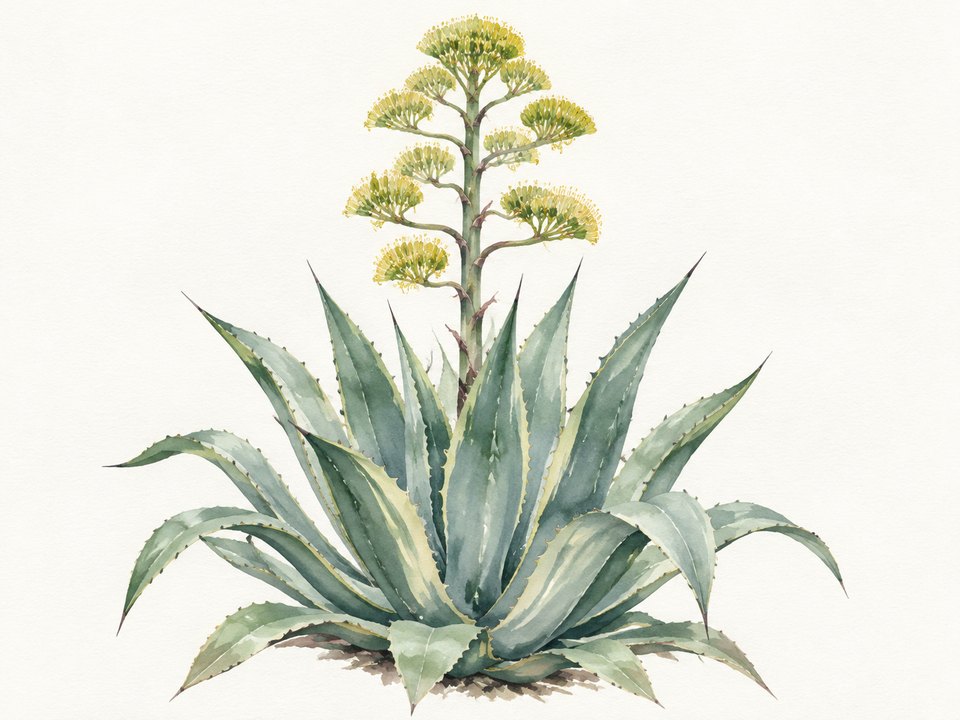
Monocarpic: each rosette stores energy for many seasons, sends up one giant 'death bloom' stalk, then dies while pups persist. Another source notes the bloom trigger is not well understood.[3]
When to Plant Century Plant
Plant Century Plant in spring through early fall, while the soil is warm. Drainage matters most going into winter: roots sitting in cold, wet soil rot, so a plant established long before winter handles the season better.
Avoid planting right before winter.
If you would like a hand, the Texas Allied Landscape team can plant your Century Plant and keep it thriving.
Planting
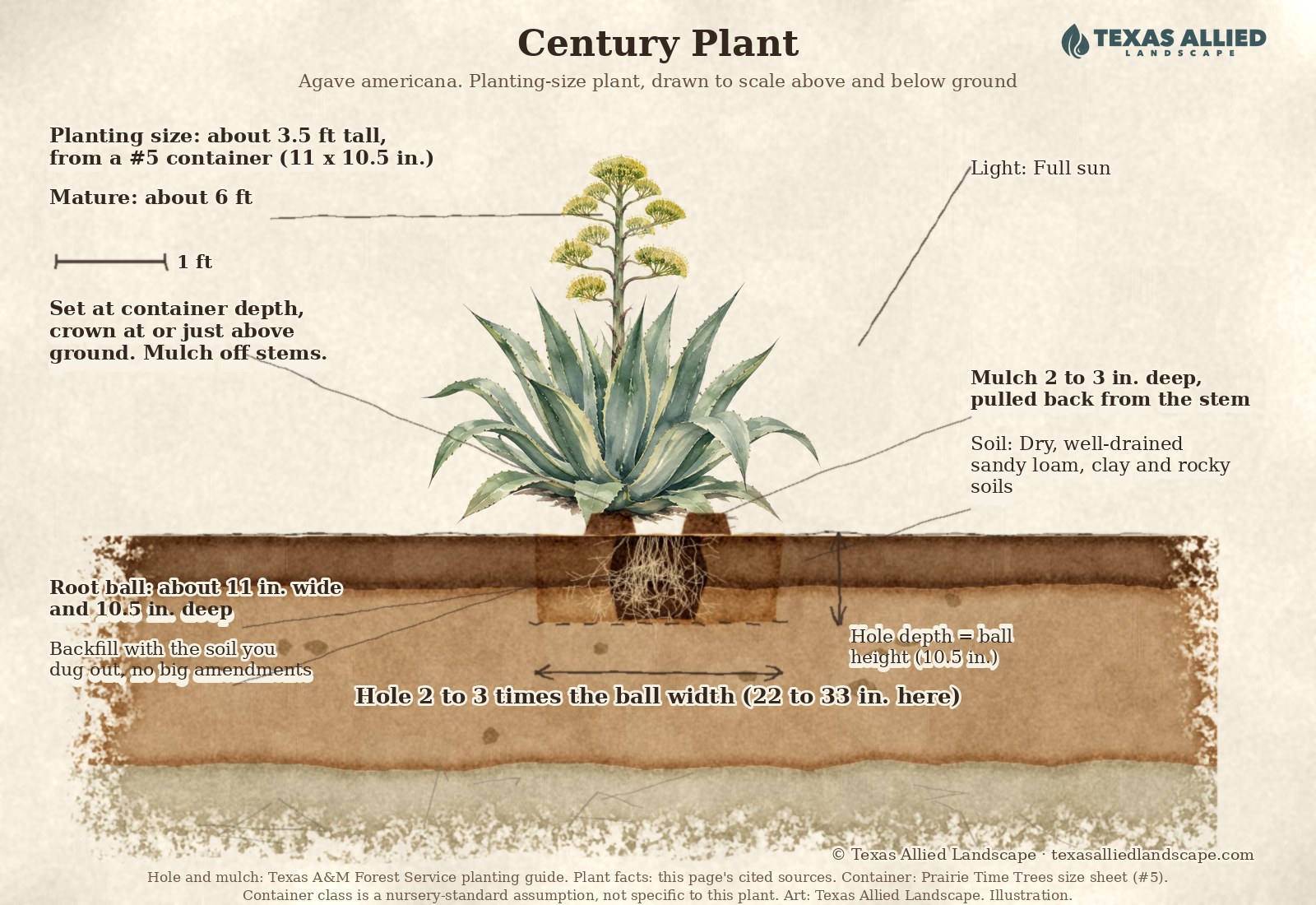
- Dig a hole twice as wide as the pot and no deeper, with sloping sides, and set the plant at the same depth it grew in its pot. Loosen any circling roots before backfilling.[4]
- For a new bed, clear grass and weeds first, roots and all.[4]
- Site: Full sun.[1][2]
- Timing: Plant Century Plant in spring through early fall, while the soil is warm.
- Soak it well at planting and keep watering while the roots establish.[4]
- Mulch 2 to 4 inches, kept a few inches away from the stems to prevent crown rot. It needs no staking or other support.[4]
Is my century plant really going to die after it blooms?
Yes - SAWS confirms century agave is monocarpic: after many seasons it sends up one huge bloom stalk and the mother rosette dies, but offsets (pups) live on and can be replanted.
Care Instructions for Your Century Plant
How to Water a Century Plant
Low water use; another source tags Very Low/Low Water.
Sunlight
Soil and drainage
Dry, well-drained sandy loam, clay, rocky soils.
Mature height and spread
Up to about 6 ft without the flower stalk; the bloom spike ranges 12-25+ ft.
Pruning
Keep aggressive offsets in check; pups can be removed or replanted; spines can be clipped near walkways.
Normal seasonal behavior
Monocarpic: each rosette stores energy for many seasons, sends up one giant 'death bloom' stalk, then dies while pups persist. Another source notes the bloom trigger is not well understood.[3]
Century plant questions
Does a century plant really die after it blooms?
Yes - the rosette that sends up the giant stalk (after 10 to 30 years, not a century) dies once flowering finishes. But the plant almost always leaves pups around its base, and those carry on.[5]
What do I do with all the pups around my agave?
Pull or dig them away from the mother plant with a bit of root, let the wound dry a day or two, and replant or pot them. They root easily. Left alone, the pups form an expanding colony.[6]
Next step: Our horticulturalists can remove and rehome large pup colonies - spines and sap make this a gloves-and-tools job.
Is century plant sap really dangerous?
It can be. The sap causes a burning rash on some people, and the leaf tips are genuinely sharp. Wear long sleeves, gloves and eye protection when trimming, and plant it away from walkways, play areas and driveways.[7]
How do I remove a dead century plant after it flowers?
Cut the stalk down once it dries, then remove the dead rosette in sections with a saw, working from the outside in. The leaves are thick, heavy and spined, so this is one of the few plants many homeowners hire out.[8]
Next step: Our crew can take out a spent century plant and clean up the pups in one visit.
Let Texas Allied Landscape care for your Century Plant
Century Plant does best with steady, knowledgeable care: the right water, pruning at the right time, and a trained eye for stress. The horticulturists at Texas Allied Landscape care for plants like yours across the San Antonio area, backed by over 40 years of landscape experience.
In these community guides
Illustration. Illustration based on reference photos of Arbors of Fair Oaks. Not a single literal view. Arbors of Fair Oaks Landscaping
Bring your address, unit and yard ideas. Texas Allied Landscape helps design the planting and irrigation, prepare the…

Illustration. Illustration based on reference photos of Redbird Ranch. Not a single literal view. Redbird Ranch Landscaping
Bring your survey and yard ideas. Texas Allied Landscape helps design planting and irrigation, prepare the review…
Sources
- Agave americana (American Century Plant), Lady Bird Johnson Wildflower Center.https://www.wildflower.org/plants/result.php?id_plant=agamabc
- Century Agave, San Antonio Water System - Garden Style San Antonio.https://www.gardenstylesanantonio.com/plants/century-agave/abc
- 'Til Death Do Us Bloom, San Antonio Water System - Garden Style San Antonio.https://www.gardenstylesanantonio.com/garden-articles/til-death-do-us-bloom/ab
- Back to basics: Planting perennials, SAWS Garden Style San Antonio.https://www.gardenstylesanantonio.com/garden-articles/back-to-basics-planting-perennials/abcd
- Native Plant Society of Texas, "Agave americana."https://www.npsot.org/posts/native-plant/agave-americana/↑
- Lady Bird Johnson Wildflower Center, Ask Mr. Smarty Plants on Agave americana pups.https://www.wildflower.org/expert/show.php?frontpage=true&id=4082↑
- Lady Bird Johnson Wildflower Center, Ask Mr. Smarty Plants on agave sap.https://www.wildflower.org/expert/show.php?frontpage=true&id=6228↑
- Lady Bird Johnson Wildflower Center, Ask Mr. Smarty Plants on agave removal.https://www.wildflower.org/expert/show.php?frontpage=true&id=4189↑