
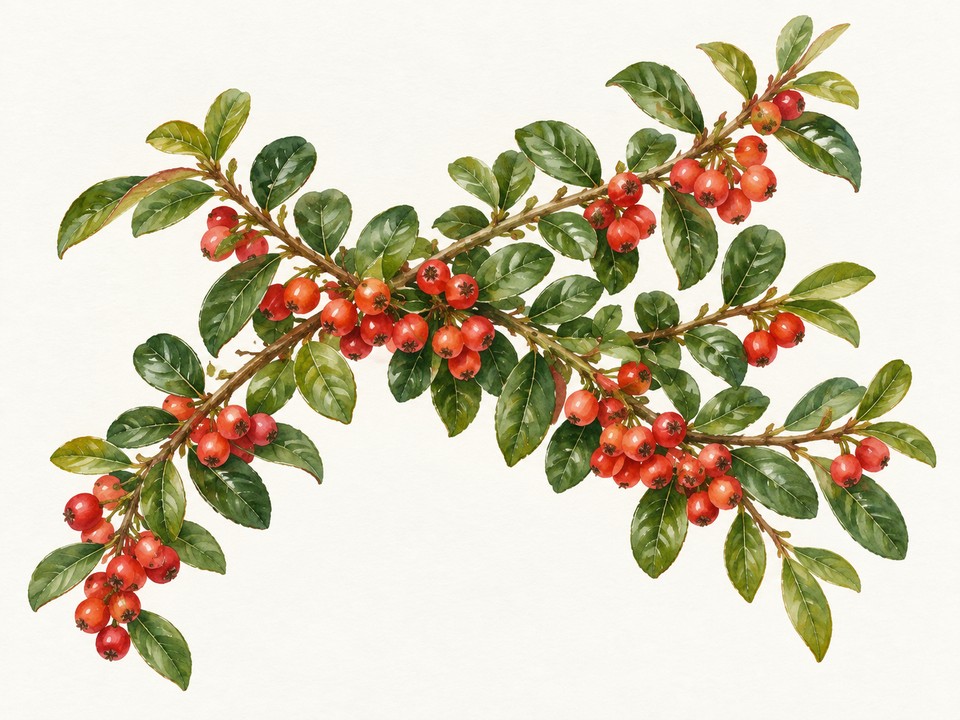
Property owners
Coral Beauty Cotoneaster
- Plant
- Coral Beauty Cotoneaster
- Botanical name
- Cotoneaster dammeri 'Coral Beauty'
- Cultivar
- 'Coral Beauty'
- Group
- Low shrubs and perennials
Sourced light, water, size and bloom details for Coral Beauty Cotoneaster.
On this page
Its botanical name is Cotoneaster 'Coral Beauty'. The North Carolina page below describes the closely related bearberry cotoneaster (Cotoneaster dammeri). Treat its details as a guide for this cultivar.[1]
Light, soil and water
It grows in full sun to partial shade. It prefers well-drained, loam-based soil but adapts to various soil types. It is drought tolerant once established. Occasional watering gives better fruit production.[1]
Size and habit
It is a low, spreading, evergreen to semi-evergreen shrub. It can reach about 1 foot tall and 6 feet wide. It roots where stems touch the ground and can form a thicket over time. It works on low banks and in rock gardens for erosion control.[1]
Flowers, fruit and color
Small white flowers open in May. Red fruit follows and stays into winter. The fall leaf color is reddish-bronze to purple.[1]
Maintenance and heat
Prune as needed to prevent a ragged look. NC State warns that in zones south of zone 7 the plant may struggle through hot summers. Check the planting spot and watering plan for San Antonio before ordering.[1]
When to Plant Coral Beauty Cotoneaster
Plant Coral Beauty Cotoneaster in fall or early spring in Central Texas. A fall planting grows roots through the cool season. The plant is ready to grow and bloom the next year. Spring planting works too if you water through the first summer.[2]
If you would like a hand, the Texas Allied Landscape team can plant your Coral Beauty Cotoneaster and keep it thriving.
Planting
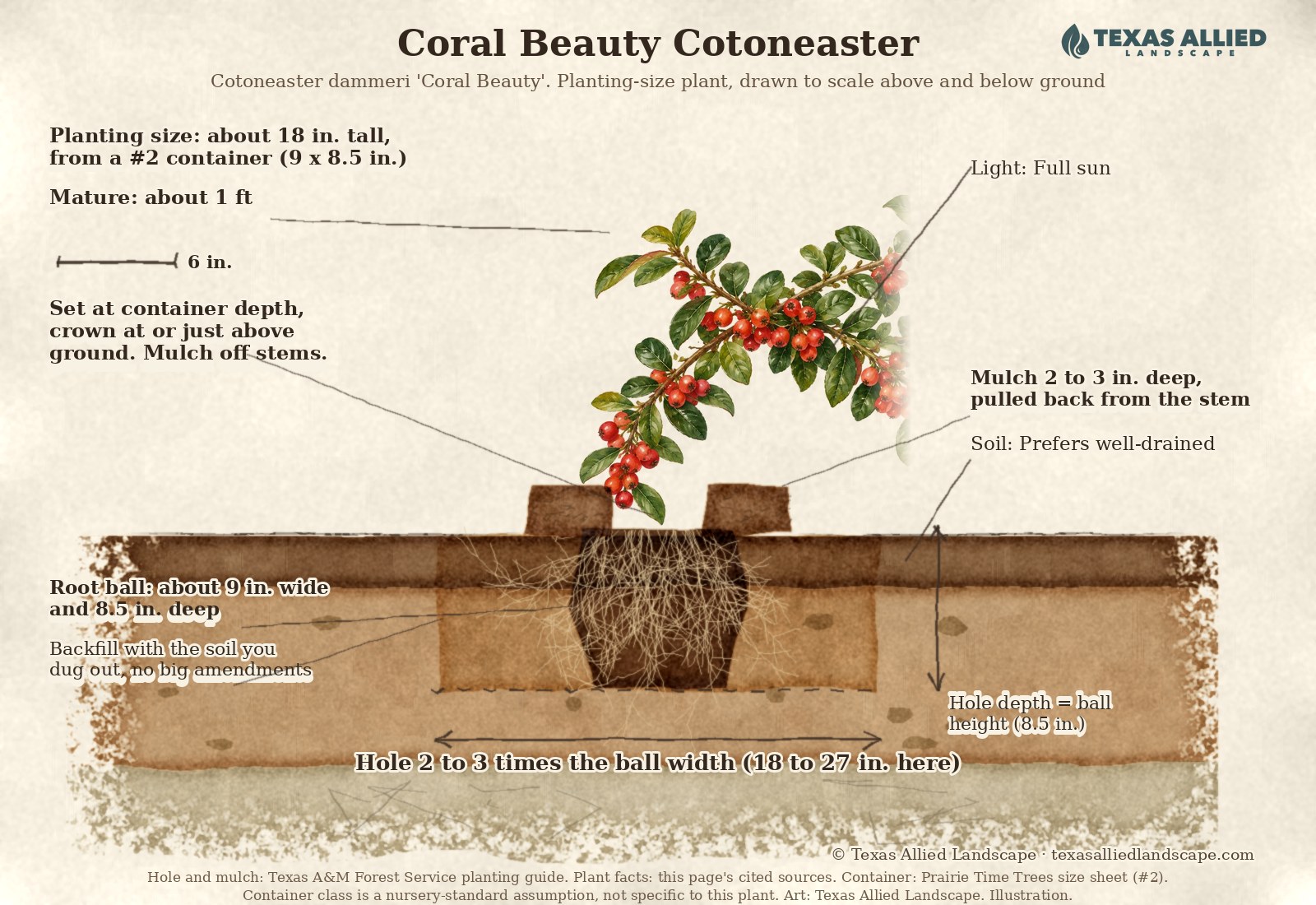
- Dig a hole twice as wide as the pot and no deeper, with sloping sides, and set the plant at the same depth it grew in its pot. Loosen any circling roots before backfilling.[3]
- For a new bed, clear grass and weeds first, roots and all.[3]
- For soil, it prefers well-drained, loam-based soil but adapts to various soil types. It is drought tolerant once established. Occasional watering gives better fruit production.[1]
- For timing, a fall planting grows roots through the cool season and is ready to grow and bloom the next year. Spring planting works too if you water through the first summer.[2]
- Soak it well at planting and keep watering while the roots establish.[3]
- Mulch 2 to 4 inches, kept a few inches away from the stems to prevent crown rot. It needs no staking or other support.[3]
Care Instructions for Your Coral Beauty Cotoneaster
Sunlight, soil and water
It grows in full sun to partial shade. It prefers well-drained, loam-based soil but adapts to various soil types. It is drought tolerant once established. Occasional watering gives better fruit production.[1]
Coral beauty cotoneaster questions
Is coral beauty cotoneaster a good groundcover?
Yes - it forms a glossy evergreen mat 1 to 2 ft tall, spreading 4 to 6 ft. It has white spring flowers and coral-red berries in fall.[4]
Can cotoneaster hold a slope?
That is a classic use for it. The spreading branches root as they go. They knit a soil-holding mat on banks that are too steep to mow.[5]
How much sun does coral beauty need?
It needs full sun to part shade, with decent drainage. It is adaptable and low-fuss once established.[6]
Do birds eat cotoneaster berries?
Yes - birds take the coral-red berries that color the mat in fall and winter.[7]
Next step: Our horticulturalists can plant a cotoneaster slope so it knits before erosion wins.
Let Texas Allied Landscape care for your Coral Beauty Cotoneaster
Coral Beauty Cotoneaster does best with steady, knowledgeable care: the right water, pruning at the right time, and a trained eye for stress. The horticulturists at Texas Allied Landscape care for plants like yours across the San Antonio area, backed by over 40 years of landscape experience.
In these community guides
Sources
- Cotoneaster dammeri, North Carolina Extension Gardener Plant Toolbox.https://plants.ces.ncsu.edu/plants/cotoneaster-dammeri/abcdefgh
- October Gardening Checklist, Travis County AgriLife Extension.https://travis-tx.tamu.edu/about-2/horticulture/monthly-gardening-calendar-for-austin-area/october-gardening-checklist-for-austin-and-central-texas/ab
- Back to basics: Planting perennials, SAWS Garden Style San Antonio.https://www.gardenstylesanantonio.com/garden-articles/back-to-basics-planting-perennials/abcd
- WSU Extension, "Coral Beauty Cotoneaster."https://www.pnwplants.wsu.edu/PlantDisplay.aspx?PlantID=738↑
- Almanac Planting Co., "Coral Beauty Cotoneaster."https://almanacplanting.com/products/coral-beauty-cotoneaster↑
- Hawkins Landscape Architecture, "Coral Beauty Cotoneaster."https://www.hawkinsla.com/new-blog/2016/10/17/coral-beauty-cotoneaster↑
- WSU Extension, "Coral Beauty Cotoneaster."https://www.pnwplants.wsu.edu/PlantDisplay.aspx?PlantID=738↑