
Property owners
Creeping Jenny
- Plant
- Creeping Jenny
- Botanical name
- Lysimachia nummularia
- Group
- Ground cover
Creeping Jenny (Lysimachia nummularia): light, water, soil, size and care for San Antonio area landscapes.
On this page
Its botanical name is Lysimachia nummularia.
Light
It grows in full sun to partial shade. Afternoon shade is suggested specifically for East Texas.[1]
Soil and drainage
It likes moist, humus-rich, well-drained soil.
Height
Henderson lists 4 to 6 inches in its characteristics. The text describes a 2 to 4 inch foliage mat.
Spread
Henderson lists 12 to 18 inches. It also warns that rooting stems can form larger colonies.
Foliage
It is semi-evergreen.[2]
Water
The East Texas profile rates it Medium to Wet. It performs best with moist soil. If watering ever feels like a guessing game, our horticulturists can care for your Creeping Jenny on a schedule that fits your yard.
Pruning
Monitor it and control unwanted spread.
Seasonal behavior
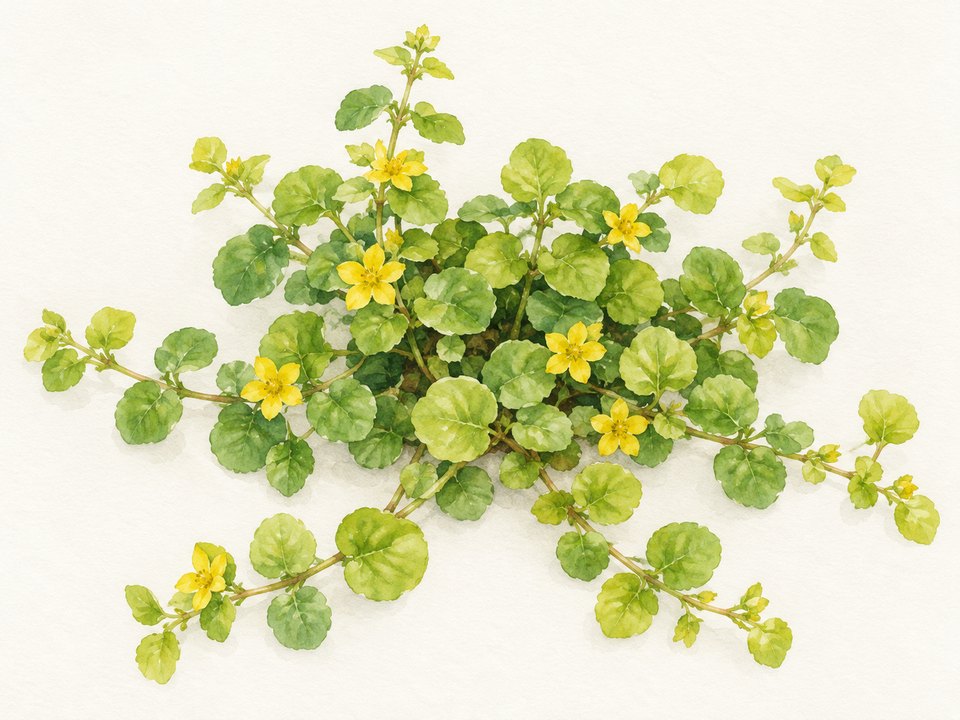
It spreads by rhizomes, self-seeding and rooting stems, and it can form large colonies. It blooms with yellow flowers in late spring to early summer.
When to Plant Creeping Jenny
Plant Creeping Jenny in fall or early spring in Central Texas. A fall planting establishes roots through the cool season and is ready to grow and bloom the following year. Spring planting works too if you water through the first summer.[3]
If you would like a hand, the Texas Allied Landscape team can plant your Creeping Jenny and keep it thriving.
Planting
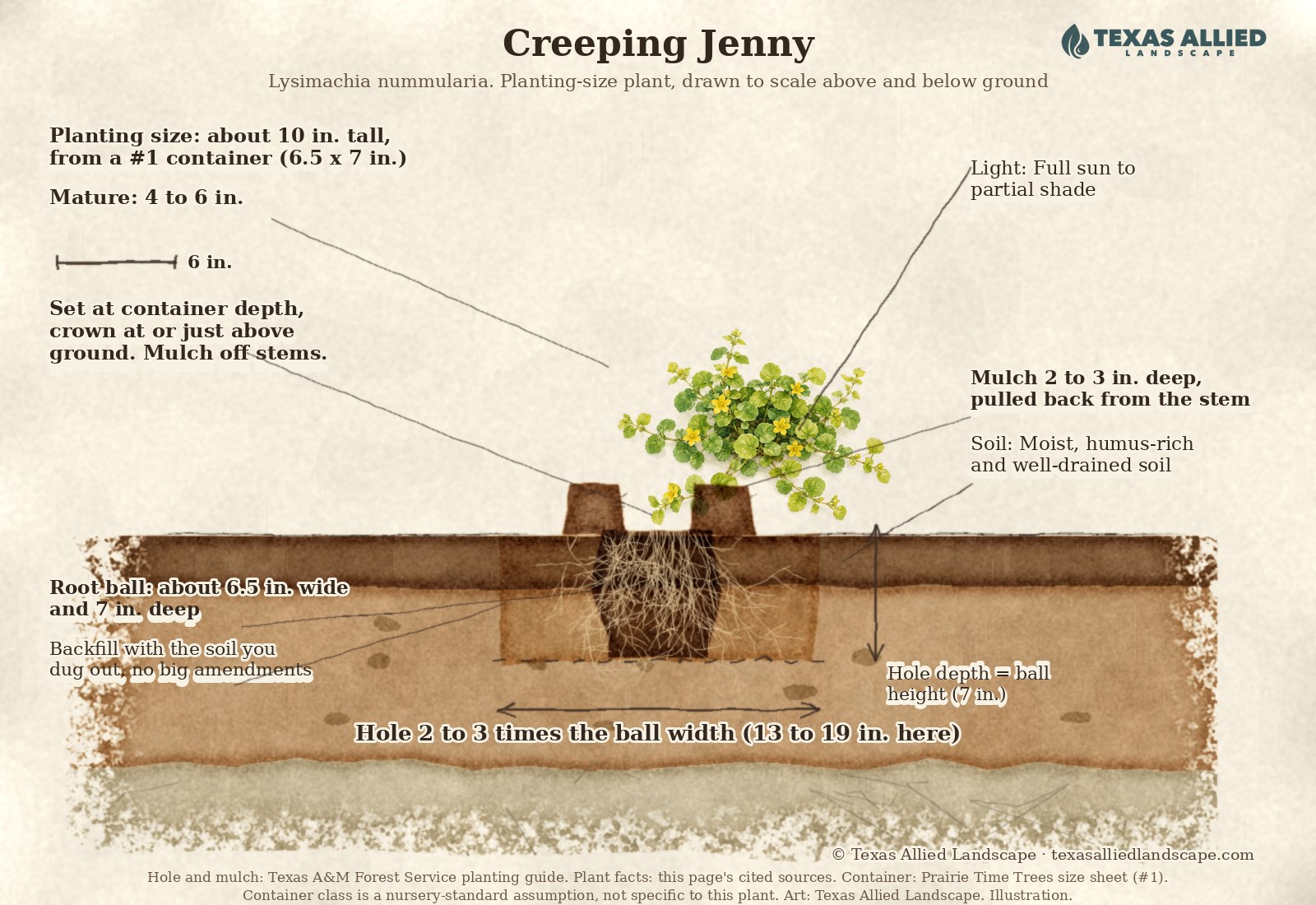
- Dig a hole twice as wide as the pot and no deeper, with sloping sides. Set the plant at the same depth it grew in its pot. Loosen any circling roots before backfilling.[4]
- For a new bed, clear grass and weeds first, roots and all.[4]
- Site: It grows in full sun to partial shade. Afternoon shade is suggested specifically for East Texas.[1]
- Timing: A fall planting establishes roots through the cool season and is ready to grow and bloom the following year. Spring planting works too if you water through the first summer.[3]
- Soak it well at planting and keep watering while the roots establish.[4] Once it is established, a fall planting is ready to grow and bloom the following year. Spring planting works too if you water through the first summer.[3]
- Add 2 to 4 inches of mulch, kept a few inches away from the stems to prevent crown rot. It needs no staking or other support.[4]
Why is creeping Jenny spreading beyond its planting area?
It spreads by rhizomes, self-seeding and stems that root as they go. It can form large colonies. Spreading beyond the planting area is normal for this plant.
Is creeping Jenny a good choice beside native plantings or a lawn?
Use caution. Another source describes aggressive spread and ecological threats in some areas. It discourages its use in borders or near lawns because it can be difficult to control. A container or another contained location is a better choice where escape is a concern.
Care Instructions for Your Creeping Jenny
How to Water a Creeping Jenny
The East Texas profile rates it Medium to Wet. It performs best with moist soil.
Sunlight
It grows in full sun to partial shade. Afternoon shade is suggested specifically for East Texas.[1]
Soil and drainage
It likes moist, humus-rich, well-drained soil.
Mature height and spread
Henderson lists 4 to 6 inches in its characteristics, and the text describes a 2 to 4 inch foliage mat. Henderson lists a spread of 12 to 18 inches. It warns that rooting stems can form larger colonies.
Pruning
Monitor it and control unwanted spread.
Normal seasonal behavior
It spreads by rhizomes, self-seeding and rooting stems, and it can form large colonies. It blooms with yellow flowers in late spring to early summer.
Creeping jenny questions
Sun or shade for creeping jenny?
Part shade is best here. Full sun scorches it in our summers unless it is kept wet.[5]
Is creeping jenny invasive?
It spreads fast in moist ground. It is great as a contained ground cover or spiller, but a nuisance in a wet bed.[6]
How much water does creeping jenny need?
It needs more water than most ground covers. It wilts fast when dry and loves damp spots.[7]
Is creeping jenny cold hardy here?
Yes. It may thin in a hard freeze, but it returns reliably in spring.[8]
Next step: Our horticulturalists can use it as a spiller where its spread stays contained.
Let Texas Allied Landscape care for your Creeping Jenny
Creeping Jenny does best with steady, knowledgeable care. That means the right water, pruning at the right time, and a trained eye for stress. The horticulturists at Texas Allied Landscape care for plants like yours across the San Antonio area. They are backed by over 40 years of landscape experience.
In these community guides

Illustration. Illustration based on reference photos of Crown Ridge Manor. Not a single literal view. Crown Ridge Manor Landscaping
Plan your Crown Ridge Manor yard, prepare the approval package and build to the written design. We check local and…

Illustration. Illustration based on reference photos of Sonterra. Not a single literal view. Sonterra Landscaping
Bring your Sonterra address and ideas. Texas Allied can design the yard, prepare the review package, build the approved…
Sources
- Creeping Jenny (Lysimachia nummularia), Texas Master Gardener Program (Henderson County).https://txmg.org/hendersonmg/plant-library/creeping-jenny/abc
- Lysimachia nummularia (Moneywort, Creeping Jenny), North Carolina Extension Gardener Plant Toolbox.https://plants.ces.ncsu.edu/plants/lysimachia-nummularia/↑
- October Gardening Checklist, Travis County AgriLife Extension.https://travis-tx.tamu.edu/about-2/horticulture/monthly-gardening-calendar-for-austin-area/october-gardening-checklist-for-austin-and-central-texas/abc
- Back to basics: Planting perennials, Garden Style San Antonio (San Antonio Water System).https://www.gardenstylesanantonio.com/garden-articles/back-to-basics-planting-perennials/abcd
- Texas Master Gardeners, "Creeping Jenny."https://txmg.org/hendersonmg/plant-library/creeping-jenny/↑
- NC State Extension, "Lysimachia nummularia."https://plants.ces.ncsu.edu/plants/lysimachia-nummularia/↑
- Texas Master Gardeners, "Creeping Jenny."https://txmg.org/hendersonmg/plant-library/creeping-jenny/↑
- University of Wisconsin Extension, "Golden Creeping Jenny."https://hort.extension.wisc.edu/articles/golden-creeping-jenny-lysimachia-nummularia-aurea/↑