
Property owners
Fatsia
- Plant
- Fatsia
- Botanical name
- Fatsia japonica
- Group
- Medium shrubs and perennials
Plant profile for Fatsia in San Antonio area landscapes.
On this page
Botanical name: Fatsia japonica.
Plant group: Medium shrubs and perennials.
Light
Part shade to deep shade.[1]
Soil and drainage
Moist, well-drained soil; too much moisture causes root rot.[1]
Height
6 ft or taller and 4 to 6 ft wide.[1]
When to Plant Fatsia
Plant fatsia in spring or fall; this shade shrub settles in fastest in mild weather with steady moisture.[2]
If you would like a hand, the Texas Allied Landscape team can plant your fatsia and keep it thriving.
Planting
- Dig a hole twice as wide as the pot and no deeper, with sloping sides, and set the plant at the same depth it grew in its pot. Loosen any circling roots before backfilling.[3]
- For a new bed, clear grass and weeds first, roots and all.[3]
- Give it room: 6-10 ft tall and wide in the ground, slowly - plan a big shaded corner, or keep it smaller in a large container.[4] Space plants for that full size, not the pot size.[3]
- Site: Its big tropical-looking leaves scorch in afternoon sun; it is one of the best bold foliage plants for deep shade.[2]
- Soak it well at planting and keep watering while the roots establish.[3]
- Mulch 2 to 4 inches, kept a few inches away from the stems to prevent crown rot. It needs no staking or other support.[3]
Care Instructions for Your Fatsia
How to Water a Fatsia
Sunlight and soil
Yes - part to full shade is required here. Its big tropical-looking leaves scorch in afternoon sun; it is one of the best bold foliage plants for deep shade.[2]
Growing in Central Texas
Generally yes - it handles our winters with some leaf damage in hard freezes, recovering in spring. A protected spot against a wall helps in the coldest years.[5]
Fruit and flowers
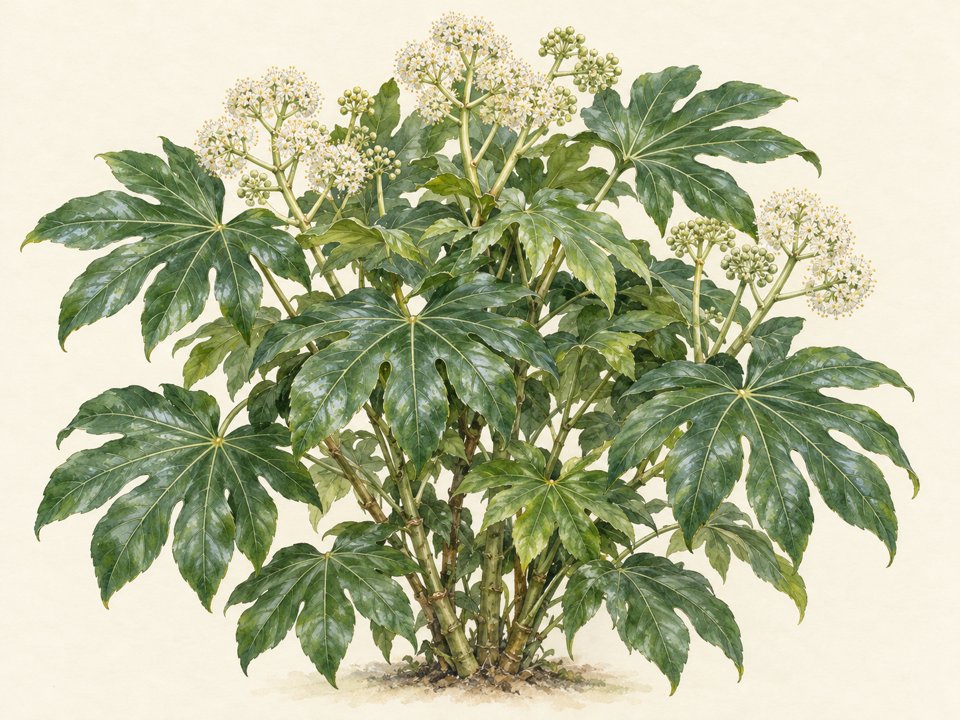
Yes - odd creamy white globes in late fall, followed by black berries. The huge glossy leaves are the main event.[6]
Fatsia questions
Does fatsia need shade in Texas?
Yes - part to full shade is required here. Its big tropical-looking leaves scorch in afternoon sun; it is one of the best bold foliage plants for deep shade.[2]
Is fatsia cold hardy in Central Texas?
Generally yes - it handles our winters with some leaf damage in hard freezes, recovering in spring. A protected spot against a wall helps in the coldest years.[5]
How big does fatsia get?
6-10 ft tall and wide in the ground, slowly - plan a big shaded corner, or keep it smaller in a large container.[4]
Does fatsia flower?
Yes - odd creamy white globes in late fall, followed by black berries. The huge glossy leaves are the main event.[6]
Next step: Our horticulturalists can place fatsia where its shade and shelter needs are met so the leaves stay pristine.
In these community guides
Sources
- Fatsia japonica (Fatsia), North Carolina Extension Gardener Plant Toolbox.https://plants.ces.ncsu.edu/plants/fatsia-japonica/abc
- Missouri Botanical Garden, "Fatsia japonica."https://www.missouribotanicalgarden.org/PlantFinder/PlantFinderDetails.aspx?%22=&taxonid=276608abcd
- Back to basics: Planting perennials, SAWS Garden Style San Antonio.https://www.gardenstylesanantonio.com/garden-articles/back-to-basics-planting-perennials/abcde
- Travis County Master Gardeners, "One Tough Plant: Japanese Aralia."https://travis-tx.tamu.edu/2022/01/28/one-tough-plant-japanese-aralia-by-yvonne-schneider/ab
- Travis County Master Gardeners, "One Tough Plant: Japanese Aralia."https://travis-tx.tamu.edu/2022/01/28/one-tough-plant-japanese-aralia-by-yvonne-schneider/ab
- Missouri Botanical Garden, "Fatsia japonica."https://www.missouribotanicalgarden.org/PlantFinder/PlantFinderDetails.aspx?%22=&taxonid=276608ab