
Property owners
Gayfeather
- Plant
- Gayfeather
- Genus
- Liatris
- Group
- Medium shrubs and perennials
Gayfeather: what is known about light, water, soil and care for San Antonio area landscapes.
On this page
Light
Soil and drainage
Calcareous, rocky, gravelly or sandy well-drained soils; too much water leads to root rot.
Height
1-3 ft.
Spread
1-1.5 ft.
Foliage
Deciduous.
Water
Low water use, high drought tolerance; L. punctata's long taproot makes it the most drought-tolerant gayfeather; another source lists Very Low. If watering ever feels like a guessing game, our horticulturists can care for your Gayfeather on a schedule that fits your yard.
Pruning
Winter cleanup.[4]
Seasonal behavior
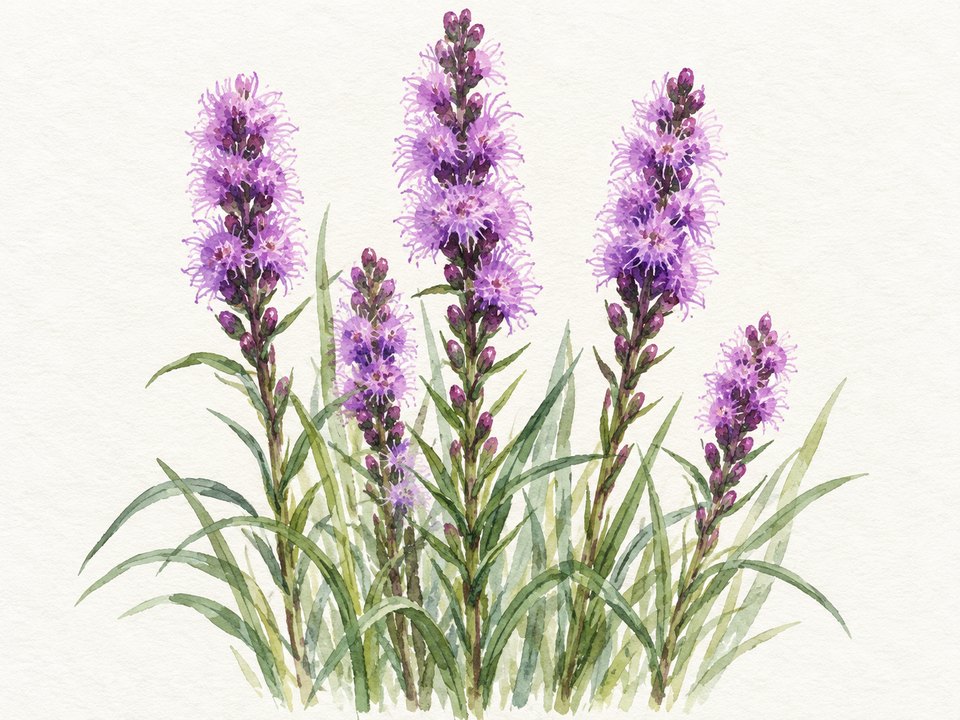
Purple flower spikes bloom from the top down August through fall; excellent cut flower; butterfly and monarch nectar source.
When to Plant Gayfeather
Plant Gayfeather in fall or early spring in Central Texas. A fall planting establishes roots through the cool season and is ready to grow and bloom the following year; spring planting works too if you water through the first summer.[5]
If you would like a hand, the Texas Allied Landscape team can plant your Gayfeather and keep it thriving.
Planting
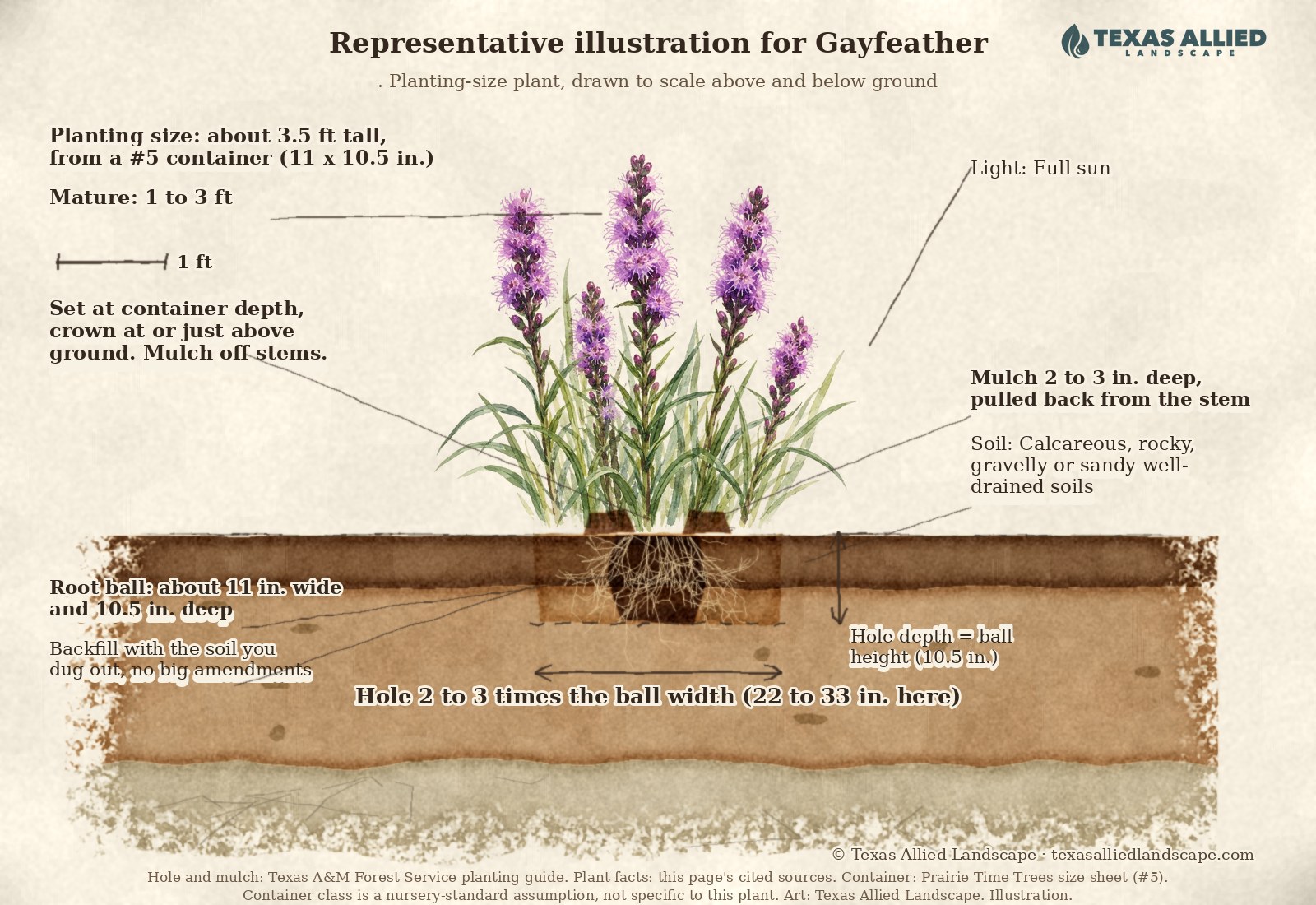
- Dig a hole twice as wide as the pot and no deeper, with sloping sides, and set the plant at the same depth it grew in its pot. Loosen any circling roots before backfilling.[6]
- For a new bed, clear grass and weeds first, roots and all.[6]
- Site: Full sun.[1][2][3]
- Timing: A fall planting establishes roots through the cool season and is ready to grow and bloom the following year; spring planting works too if you water through the first summer.[5]
- Soak it well at planting and keep watering while the roots establish.[6] Once established: Low water use, high drought tolerance; L. punctata's long taproot makes it the most drought-tolerant gayfeather; another source lists Very Low. Winter cleanup.[4]
- Mulch 2 to 4 inches, kept a few inches away from the stems to prevent crown rot. It needs no staking or other support.[6]
Which gayfeather grows here?
Three natives do: Liatris mucronata (the source’s Edwards Plateau listing), dotted gayfeather L. punctata and Carrizo gayfeather L. carrizana. The florist species L. spicata wants more water than a dry Hill Country bed provides.
Care Instructions for Your Gayfeather
How to Water a Gayfeather
Low water use, high drought tolerance; L. punctata's long taproot makes it the most drought-tolerant gayfeather; another source lists Very Low.
Sunlight
Soil and drainage
Calcareous, rocky, gravelly or sandy well-drained soils; too much water leads to root rot.
Mature height and spread
1-3 ft. 1-1.5 ft.
Pruning
Winter cleanup.[4]
Normal seasonal behavior
Purple flower spikes bloom from the top down August through fall; excellent cut flower; butterfly and monarch nectar source.
Gayfeather questions
Is gayfeather a Texas native?
Yes - Liatris mucronata and Liatris punctata are both Texas native gayfeathers.[7]
When does gayfeather bloom?
Late summer into fall - purple spikes that open top-down, right when migrating monarchs need them.[8]
Is gayfeather drought tolerant?
Very - it grows from a deep corm and thrives in lean, dry, rocky soil.[9]
Why do gayfeather spikes bloom from the top down?
That is their party trick - most spike flowers open bottom-up, liatris opens top-down, and pollinators work every floret.[10]
Next step: Our horticulturalists can mass it in a sunny bed for the late-summer show.
Let Texas Allied Landscape care for your Gayfeather
Gayfeather does best with steady, knowledgeable care: the right water, pruning at the right time, and a trained eye for stress. The horticulturists at Texas Allied Landscape care for plants like yours across the San Antonio area, backed by over 40 years of landscape experience.
In these community guides
- Art in progress
Cordillera Ranch Landscaping
Bring your address, survey and yard ideas. We check the right guideline set, plan planting and irrigation, prepare the…

Illustration. Illustration based on reference photos of Johnson Ranch. Not a single literal view. Johnson Ranch Landscaping
Share your Johnson Ranch address, survey and yard ideas. Texas Allied Landscape can help plan planting, irrigation and…
Sources
- Liatris punctata var. mucronata (Texas gayfeather), Lady Bird Johnson Wildflower Center.https://www.wildflower.org/plants/result.php?id_plant=LIPUM2abc
- Liatris punctata (Dotted blazing star), Lady Bird Johnson Wildflower Center.https://www.wildflower.org/plants/result.php?id_plant=lipuabc
- Gayfeather, City of Austin Watershed Protection Grow Green.https://www.austintexas.gov/watershed-protection/plant-guide/gayfeatherabc
- Gayfeather, San Antonio Water System - Garden Style San Antonio.https://www.gardenstylesanantonio.com/plants/gayfeather/abc
- October Gardening Checklist, Travis County AgriLife Extension.https://travis-tx.tamu.edu/about-2/horticulture/monthly-gardening-calendar-for-austin-area/october-gardening-checklist-for-austin-and-central-texas/ab
- Back to basics: Planting perennials, SAWS Garden Style San Antonio.https://www.gardenstylesanantonio.com/garden-articles/back-to-basics-planting-perennials/abcd
- Native Plant Society of Texas, "Liatris punctata."https://www.npsot.org/posts/native-plant/liatris-punctata/↑
- City of Austin Grow Green plant guide, "Gayfeather."https://www.austintexas.gov/department/grow-green/plant-guide/gayfeather↑
- Native Plant Society of Texas, "Liatris punctata."https://www.npsot.org/posts/native-plant/liatris-punctata/↑
- Lady Bird Johnson Wildflower Center, "Liatris punctata."https://www.wildflower.org/plants/result.php?id_plant=LIPUM2↑