
Property owners
Pomegranate
- Plant
- Pomegranate
- Botanical name
- Punica granatum
- Group
- Large shrubs and small trees
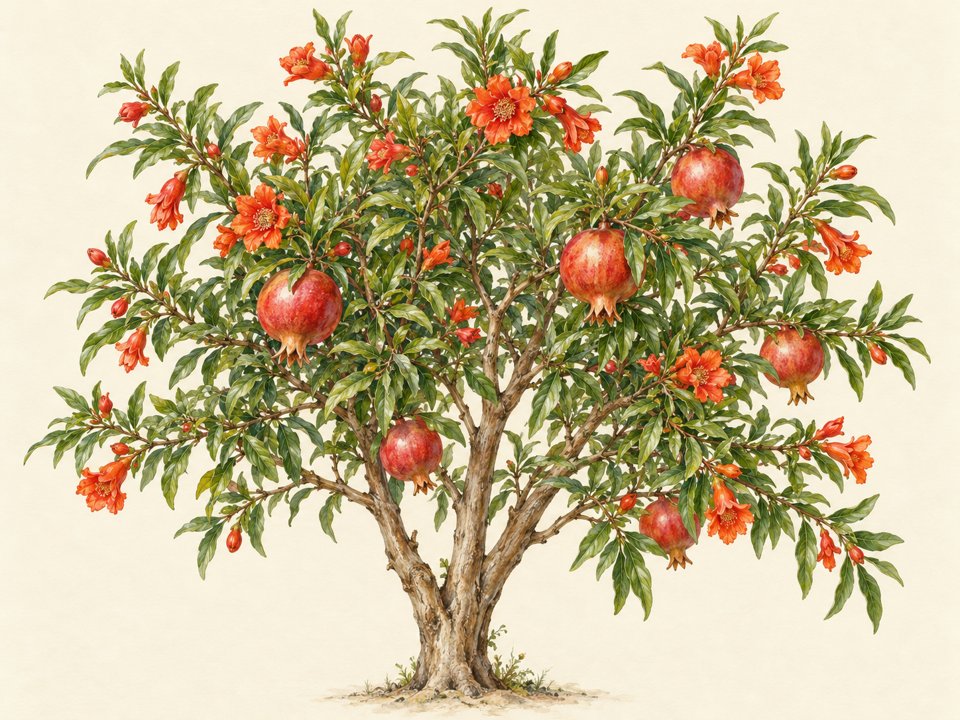
Pomegranate (Punica granatum) is a deciduous shrub or small tree with orange-red flowers and edible fruit for full sun.
On this page
Its botanical name is Punica granatum.
It belongs to the large shrubs and small trees group.
Pomegranate is a deciduous large shrub or small tree. It has showy orange-red flowers followed by edible fruit. It needs full sun. It tolerates heat and drought once established. It can suffer damage in hard freezes.[1]
Light
Full sun to part shade.[2]
Soil and drainage
Tolerates all soil types as long as drainage and moisture are good; drought tolerant.[2]
Height
10 to 12 ft tall and 8 to 10 ft wide.[2]
When to Plant Pomegranate
Fall, October through November, and late winter into early spring are the best times to plant Pomegranate in Central Texas. The cooler months give the roots time to establish before summer heat.[3]
Container-grown shrubs can go in at other times if you keep up with watering. Avoid planting in the peak of summer.
If you would like a hand, the Texas Allied Landscape team can plant your Pomegranate and keep it thriving.
Planting
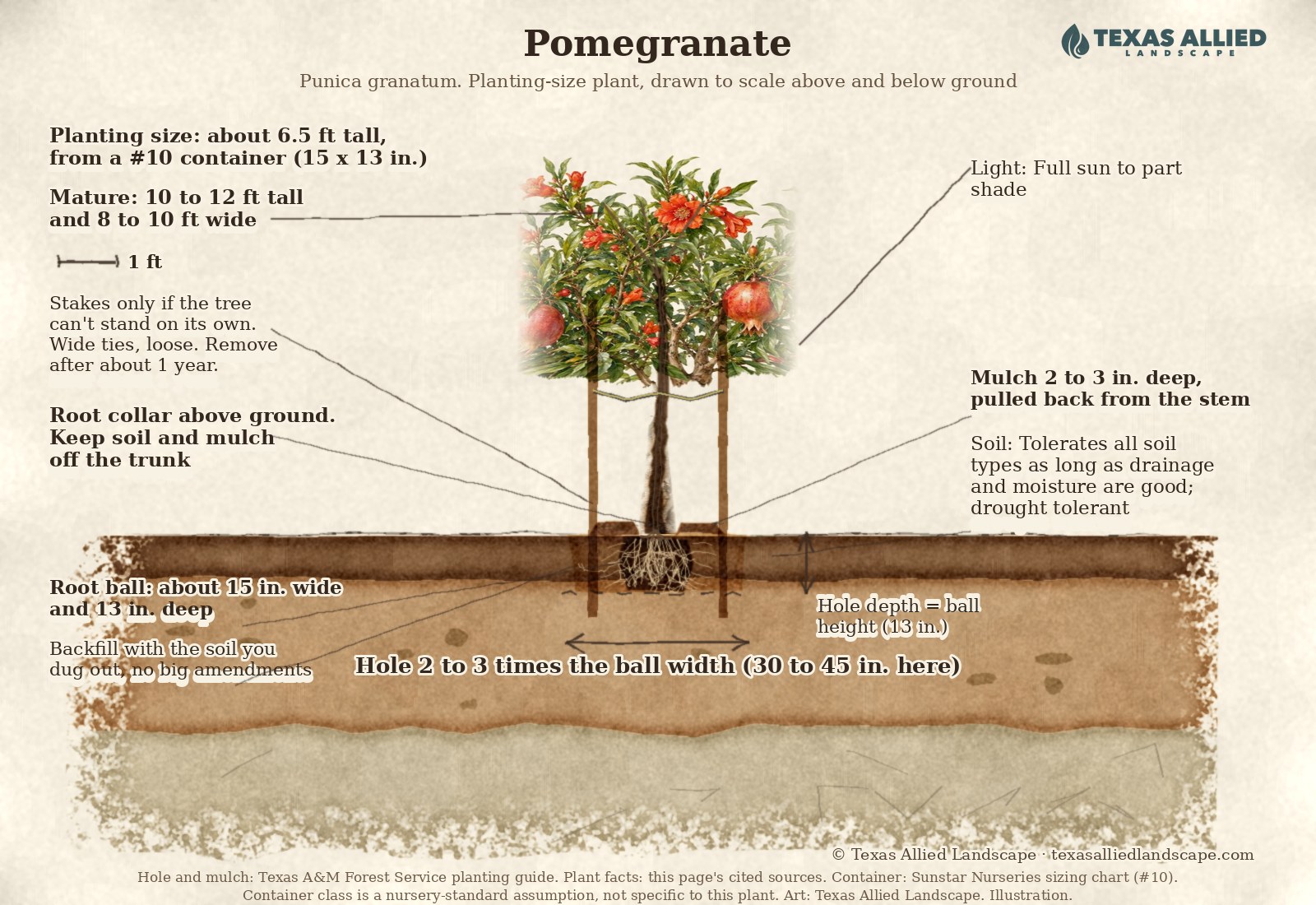
- Dig a hole at least twice as wide as the root ball and no deeper. A square hole keeps the roots from settling too deep. It also lets them grow out into the surrounding soil.[4]
- Fill the empty hole with water and check the drainage. If it takes longer than 24 hours to drain, choose another spot. Roots sitting under water will kill the tree.[4]
- Set the tree with the root collar (the flare just above the roots) level with or slightly above the ground. Carry it by the container or root ball, never the trunk. Take off all wire, twine, containers and bags before backfilling.[4]
- Backfill with the same soil that came out of the hole. Do not add amendments. Settle it with water rather than packing it down.[4]
- For the site and soil, it needs full sun. It tolerates heat and drought once established. It can suffer damage in hard freezes.[1] Yes, they are one of the easiest fruit trees for Texas. They love our hot, dry summers and tolerate our alkaline soils.[5]
- Water for at least the first two years, without overwatering. A thorough soaking beats light, frequent watering.[4]
- Mulch 2 to 3 inches deep, out to the drip line and up to but not touching the trunk. Stake only if the tree cannot stand on its own, and take stakes off within a year. Most trees need no support. Do not fertilize during the first growing season.[4]
Care Instructions for Your Pomegranate
How to Water a Pomegranate
Growing in Central Texas
Yes. They are one of the easiest fruit trees for Texas. They love our hot, dry summers and tolerate our alkaline soils.[5]
Winter and cold
Mostly yes. Some varieties handle 10°F. Others are damaged around 18°F. In a record freeze it may die back and resprout from the roots.[6]
Pomegranate questions
Do pomegranates grow well in Texas?
Yes. They are one of the easiest fruit trees for Texas. They love our hot, dry summers and tolerate our alkaline soils.[5]
Is pomegranate cold hardy here?
Mostly yes. Some varieties handle 10°F. Others are damaged around 18°F. In a record freeze it may die back and resprout from the roots.[6]
When are pomegranates ripe?
In fall. The fruit colors up, and the skin may begin to split slightly. Unlike many fruits, pomegranates do not ripen off the tree. Wait for full color.[7]
How big does a pomegranate get?
It reaches 12-20 ft as a multi-trunked, fountain-shaped shrub or small tree. You can also keep it sheared smaller. Full sun gives the best fruit.[8]
Next step: Our horticulturalists can prune your pomegranate each winter for shape and heavier fruit set.
Let Texas Allied Landscape care for your Pomegranate
Pomegranate does best with steady, knowledgeable care. That means the right water, pruning at the right time, and a trained eye for stress. The horticulturists at Texas Allied Landscape care for plants like yours across the San Antonio area. They bring over 40 years of landscape experience.
In these community guides
Sources
- Texas A&M AgriLife Extension, "Pomegranate"https://aggie-hort.tamu.edu/fruit-nut/files/2015/04/pomegranates_2015.pdfab
- Punica granatum (Pomegranate), North Carolina Extension Gardener Plant Toolbox.https://plants.ces.ncsu.edu/plants/punica-granatum/abc
- October Gardening Checklist, Travis County AgriLife Extension.https://travis-tx.tamu.edu/about-2/horticulture/monthly-gardening-calendar-for-austin-area/october-gardening-checklist-for-austin-and-central-texas/↑
- Planting, Texas A&M Forest Service.https://tfsweb.tamu.edu/trees/tree-care/planting/abcdef
- Texas A&M AgriLife, "Pomegranates: Texas Fruit and Nut Production."https://mytexas.ag.tamu.edu/publications/pomegranates-texas-fruit-and-nut-production/abc
- Texas A&M AgriLife, "Pomegranates: Texas Fruit and Nut Production."https://mytexas.ag.tamu.edu/publications/pomegranates-texas-fruit-and-nut-production/ab
- The Natural Gardener, "Pomegranates."https://tngaustin.com/pomegranates/↑
- The Natural Gardener, "Pomegranates."https://tngaustin.com/pomegranates/↑