
Property owners
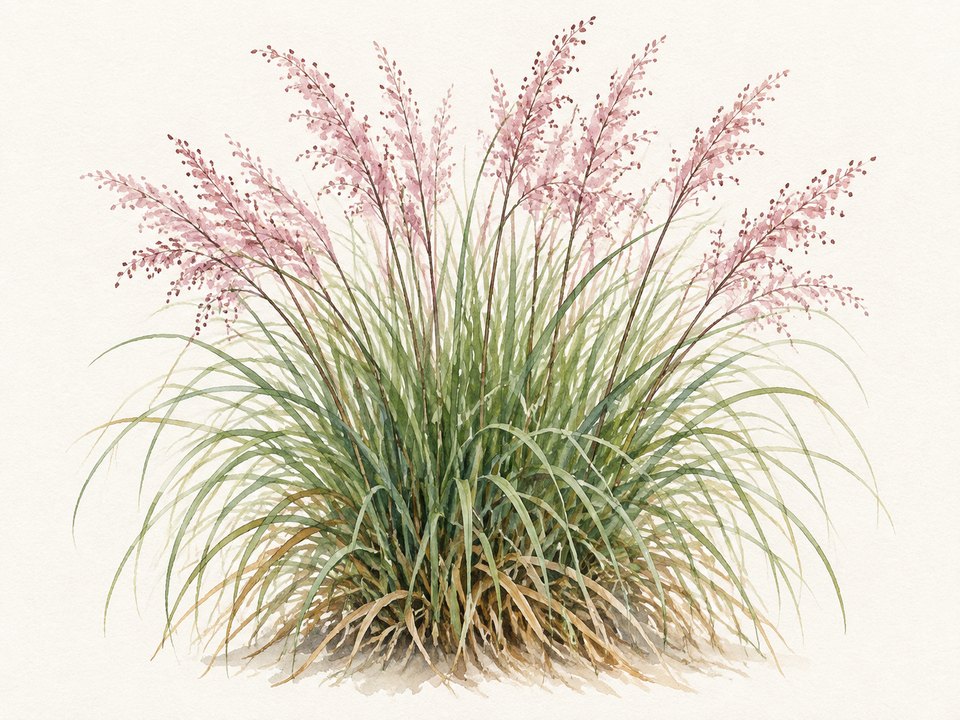
Seep Muhly
- Plant
- Seep Muhly
- Botanical name
- Muhlenbergia reverchonii
- Group
- Ornamental grasses
Seep Muhly (Muhlenbergia reverchonii): light, water, soil, size and care for San Antonio area landscapes.
On this page
Botanical name: Muhlenbergia reverchonii.
Light
Full sun.[1]
Soil and drainage
Thin, well-drained soils; thrives where rain drains across bare rock.
Height
Up to 3 feet tall.
Spread
1 to 2 feet wide.
Water
Low water; handles some of the toughest local growing conditions. If watering ever feels like a guessing game, our horticulturists can care for your Seep Muhly on a schedule that fits your yard.
Pruning
No maintenance required.
Seasonal behavior
Purple flower stalks show its kinship with the ornamental muhlys; older leaves form dense fibrous masses. Sold as seed and often used in prairie restoration; the Autumn Embers selection shows stronger color. Freeze-hardy and deer-resistant.
When to Plant Seep Muhly
Plant Seep Muhly in spring, after the last frost, through early summer. Warm-season grasses root actively as the soil warms, and spring planting gives a full growing season to establish before winter.[2]
Fall planting is possible for hardy ornamental grasses but riskier for a young plant heading into cold weather.
If you would like a hand, the Texas Allied Landscape team can plant your Seep Muhly and keep it thriving.
Planting
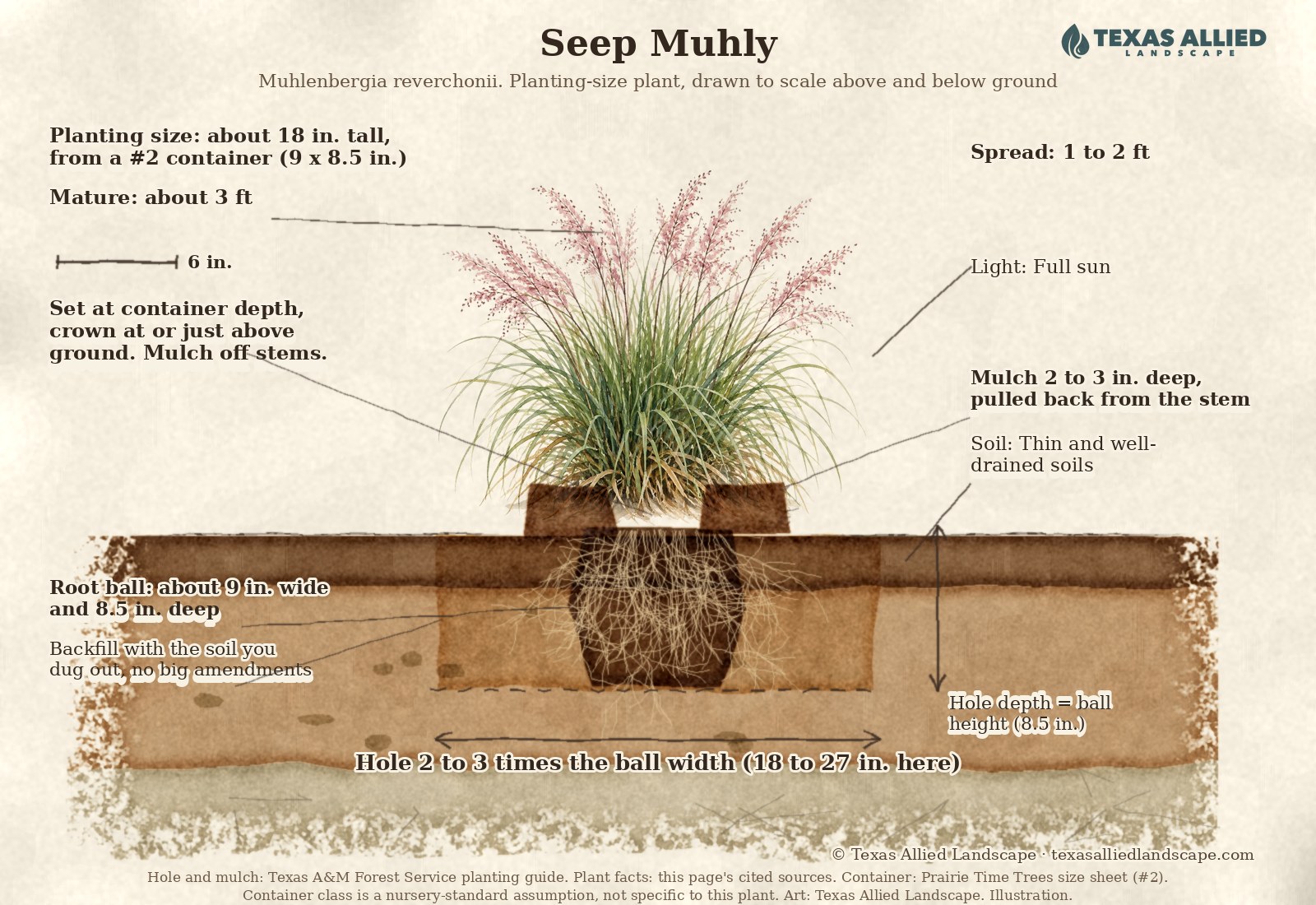
- Dig a hole twice as wide as the pot and no deeper, with sloping sides, and set the plant at the same depth it grew in its pot. Loosen any circling roots before backfilling.[3]
- For a new bed, clear grass and weeds first, roots and all.[3]
- Site: Full sun.[1]
- Timing: Warm-season grasses root actively as the soil warms, and spring planting gives a full growing season to establish before winter.[2]
- Soak it well at planting and keep watering while the roots establish.[3]
- Mulch 2 to 4 inches, kept a few inches away from the stems to prevent crown rot. It needs no staking or other support.[3]
Care Instructions for Your Seep Muhly
How to Water a Seep Muhly
Low water; handles some of the toughest local growing conditions.
Sunlight
Full sun.[1]
Soil and drainage
Thin, well-drained soils; thrives where rain drains across bare rock.
Mature height and spread
Up to 3 feet tall. 1 to 2 feet wide.
Pruning
No maintenance required.
Normal seasonal behavior
Purple flower stalks show its kinship with the ornamental muhlys; older leaves form dense fibrous masses. Sold as seed and often used in prairie restoration; the Autumn Embers selection shows stronger color. Freeze-hardy and deer-resistant.
Seep muhly questions
Is seep muhly a Texas native?
Yes - Muhlenbergia reverchonii is a Hill Country native, and its pink fall cloud is one of our best autumn shows.[4]
When does seep muhly bloom?
Fall - the green summer mound ignites into a pink-red haze in October.[5]
When do I cut back seep muhly?
Late winter, to a few inches, before new growth - one shearing a year is all it asks.[6]
Next step: Our horticulturalists can include it in your late-winter grass cutbacks.
How much water does seep muhly need?
Very little - full sun and dry, well-drained soil; too much water and fertilizer flop it.[7]
Let Texas Allied Landscape care for your Seep Muhly
Seep Muhly does best with steady, knowledgeable care: the right water, pruning at the right time, and a trained eye for stress. The horticulturists at Texas Allied Landscape care for plants like yours across the San Antonio area, backed by over 40 years of landscape experience.
In these community guides
- Art in progress
Cordillera Ranch Landscaping
Bring your address, survey and yard ideas. We check the right guideline set, plan planting and irrigation, prepare the…

Illustration. Illustration based on reference photos of Johnson Ranch. Not a single literal view. Johnson Ranch Landscaping
Share your Johnson Ranch address, survey and yard ideas. Texas Allied Landscape can help plan planting, irrigation and…
Sources
- Seep Muhly, SAWS Garden Style San Antonio.https://www.gardenstylesanantonio.com/plants/seep-muhly/abc
- October Gardening Checklist, Travis County AgriLife Extension.https://travis-tx.tamu.edu/about-2/horticulture/monthly-gardening-calendar-for-austin-area/october-gardening-checklist-for-austin-and-central-texas/ab
- Back to basics: Planting perennials, SAWS Garden Style San Antonio.https://www.gardenstylesanantonio.com/garden-articles/back-to-basics-planting-perennials/abcd
- Native Plant Society of Texas, "Muhlenbergia reverchonii."https://www.npsot.org/posts/native-plant/muhlenbergia-reverchonii/↑
- Missouri Botanical Garden, "Muhlenbergia reverchonii."https://www.missouribotanicalgarden.org/PlantFinder/PlantFinderDetails.aspx?taxonid=441395↑
- Missouri Botanical Garden, "Muhlenbergia reverchonii."https://www.missouribotanicalgarden.org/PlantFinder/PlantFinderDetails.aspx?taxonid=441395↑
- Arizona-Sonora Desert Museum, "Muhlenbergia reverchonii."https://www.desertmuseum.org/visit/sheets/Muhrev.pdf↑