
Property owners
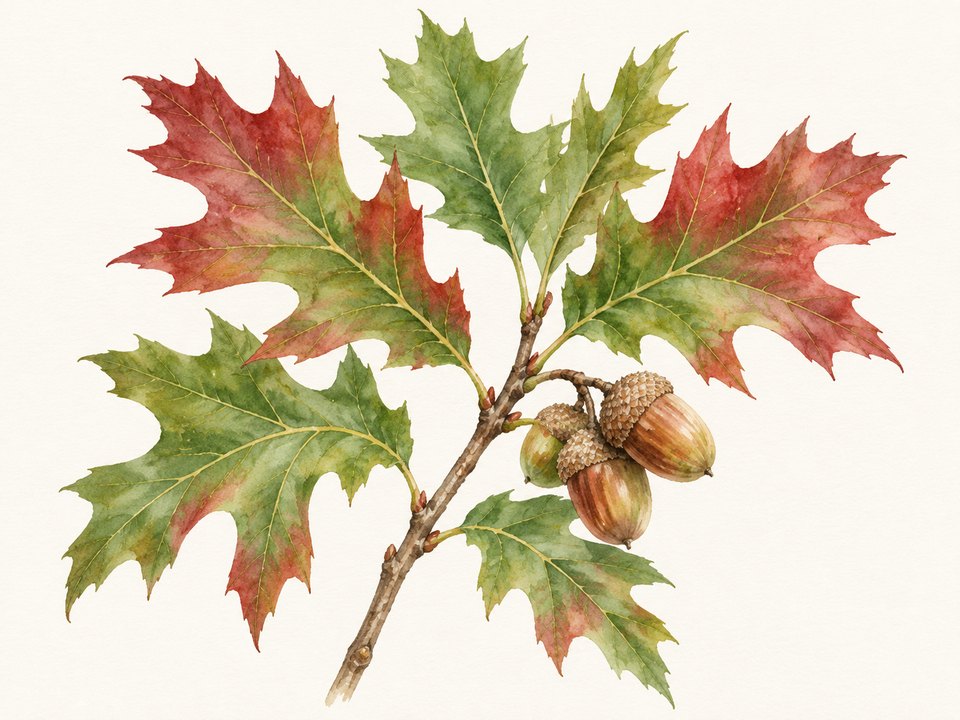
Texas Red Oak
- Plant
- Texas Red Oak
- Botanical name
- Quercus buckleyi
- Group
- Shade trees (street frontage)
Sourced light, soil, water and size details for Texas Red Oak, with oak-wilt precautions.
On this page
Its botanical name is Quercus buckleyi. This page describes Texas Red Oak, not Shumard Red Oak.[1][2]
Light and soil
It grows in sun to part shade. It handles limestone-based soils and tolerates alkaline soil.[1]
Size
The Wildflower Center's description says up to 50 feet tall, while its size field lists up to 75 feet. SAWS lists 45 to 60 feet wide. Allow room for a large shade tree.[1][2]
Water
The plant profiles rate it low water. But SAWS warns that older trees suffered during recent droughts. Red oaks are less drought-tolerant than live oaks and some other native oaks.[1][2] If watering ever feels like a guessing game, our horticulturists can care for your Texas Red Oak on a schedule that fits your yard.
Foliage and seasonal behavior
It is deciduous, with red fall color. Expect tassels, acorns and heavy leaf litter.[2]
Oak-wilt caution
Red oaks are highly vulnerable to oak wilt. They can produce fungal mats that help spread it. Do not ignore unusual spring leaf drop.[2]
Pruning and oak wilt
Avoid routine pruning from February 1 through June 30. Paint every pruning cut and other wound immediately, in any season. Safety and storm-damage work can be exceptions. Ask a qualified arborist if the timing is uncertain.[^oak-pruning]
Let Texas Allied Landscape care for your Texas Red Oak
Texas Red Oak does best with steady, knowledgeable care. That means the right water, pruning at the right time, and a trained eye for stress. The horticulturists at Texas Allied Landscape care for plants like yours across the San Antonio area. They are backed by over 40 years of landscape experience.
In these community guides
Illustration. Illustration based on reference photos of Cibolo Trails. Not a single literal view. Cibolo Trails Landscaping
Bring your address, survey and yard ideas. We help check private-yard and common-area rules, prepare the review package…
Illustration. Illustration based on reference photos of The Dominion. Not a single literal view. The Dominion Landscaping
Plan your Dominion landscape with help on planting, irrigation and the ACC package. We check your lot's standards and…
Illustration. Illustration based on reference photos of Rogers Ranch - Point Bluff and other neighborhoods. Not a single literal view. Rogers Ranch Landscaping
Plan your Rogers Ranch landscape with lawn, tree and irrigation guidance. Get help with the review package, approved…
Illustration. Illustration based on reference photos of Shavano Rogers Ranch - Crosstimber. Not a single literal view. Crosstimber Landscaping
Plan your Crosstimber plants, shade and irrigation. Get help matching your lot rules, preparing the review package and…
Care Instructions for Your Texas Red Oak
Sunlight and soil
It grows in sun to part shade. It handles limestone-based soils and tolerates alkaline soil.[1]
Mature height and spread
The Wildflower Center's description says up to 50 feet tall, while its size field lists up to 75 feet. SAWS lists 45 to 60 feet wide. Allow room for a large shade tree.[1][2]
Pruning and oak wilt
Avoid routine pruning from February 1 through June 30. Paint every pruning cut and other wound immediately, in any season. Safety and storm-damage work can be exceptions. Ask a qualified arborist if the timing is uncertain.[^oak-pruning]
Normal seasonal behavior
It is deciduous, with red fall color. Expect tassels, acorns and heavy leaf litter.[2]
Texas red oak questions
Does Texas red oak get red fall color in Texas?
Yes. Quercus buckleyi is our most reliable native oak for red fall color. It turns deep red to orange-red even in Central Texas alkaline soils.[3]
Is Texas red oak vulnerable to oak wilt?
Yes. Red oaks are the most susceptible group, and they do not recover once infected. Never prune them in spring when the beetles are active. Paint every cut, year-round.[4]
Next step: Our horticulturalists time oak pruning for the safe season and sanitize between cuts.
How fast does Texas red oak grow?
It grows moderately fast for an oak. It can add a couple of feet a year when young with good water. It matures around 30 to 40 feet in Central Texas landscapes.[5]
Can Texas red oak handle alkaline soil?
It is one of the few red oaks that can. It is native to the limestone Hill Country. Very high pH can still cause yellowing leaves in some sites.[6]
When to Plant Texas Red Oak
In Central Texas, the best time to plant Texas Red Oak is fall through late winter, roughly October through February. Cooler weather and fall rains let the roots establish before summer heat arrives.[7]
Container-grown trees can also go in the ground in spring. They can even go in during summer if you can commit to deep, regular watering through the first growing season. Spring and summer planting demand more from you and the tree.
If you would like a hand, the Texas Allied Landscape team can plant your Texas Red Oak and keep it thriving.
Planting
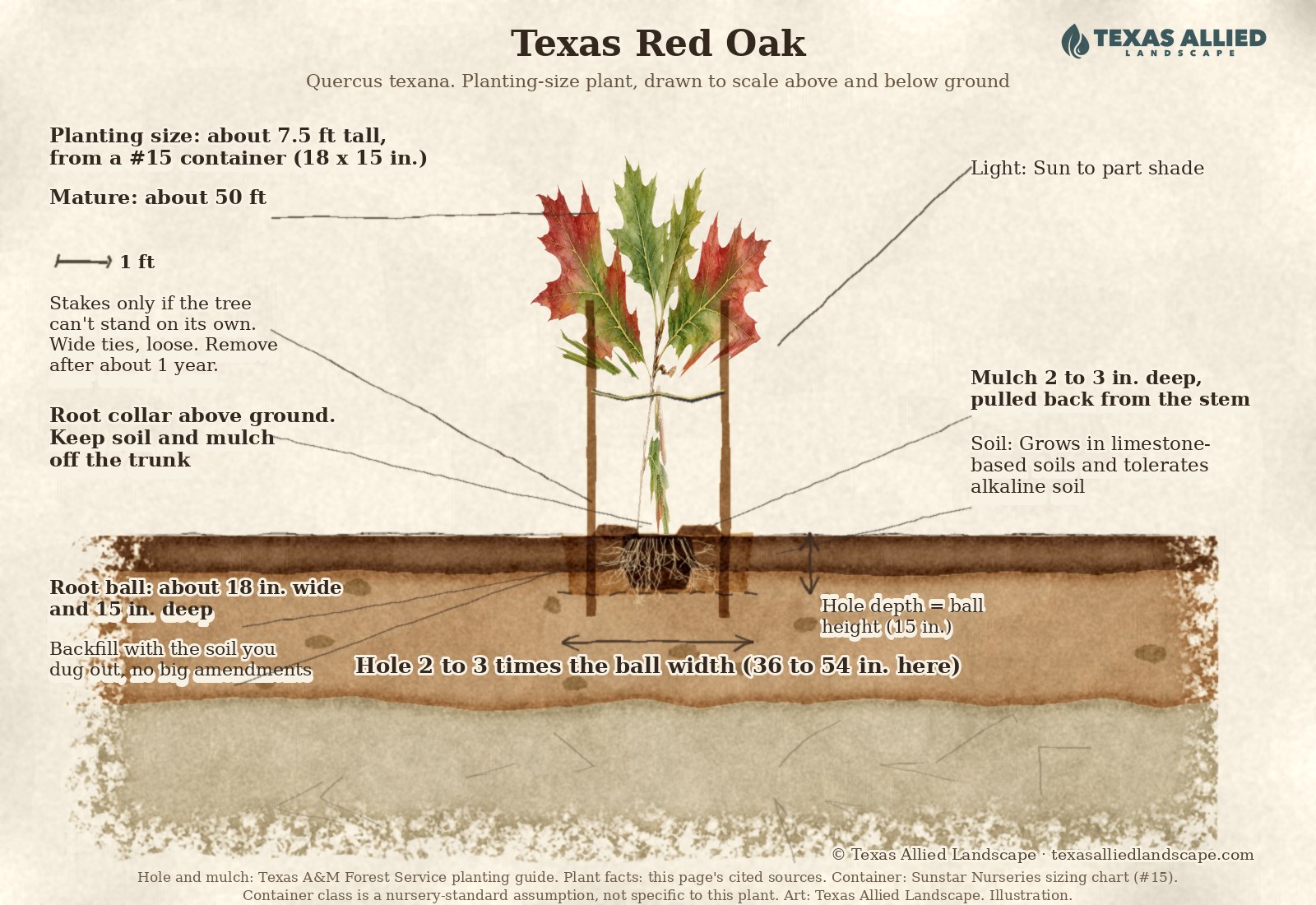
- Dig a hole at least twice as wide as the root ball and no deeper. A square hole keeps the roots from settling too deep while letting them grow out into the surrounding soil.[8]
- Fill the empty hole with water and check the drainage. If it takes longer than 24 hours to drain, choose another spot. Roots sitting under water will kill the tree.[8]
- Set it with the root collar (the flare just above the roots) level with or slightly above the ground. Take off all wire, twine, containers and bags before backfilling.[8]
- Backfill with the same soil that came out of the hole, without amendments. Settle the soil with water rather than packing it down.[8]
- Site and soil: It grows in sun to part shade. It handles limestone-based soils and tolerates alkaline soil.[1]
- Timing: In Central Texas, the best time to plant Texas Red Oak is fall through late winter, roughly October through February.
- Water it for at least the first two years, but do not overwater. A thorough soaking beats light, frequent watering.[8] Once it is established, it needs little water, according to the plant profiles. But SAWS warns that older trees suffered during recent droughts. Red oaks are less drought-tolerant than live oaks and some other native oaks.[1][2]
- Mulch 2 to 3 inches deep, out to the drip line and up to but not touching the trunk. Stake it only if it cannot stand on its own, and take the stakes off within a year. Most trees need no support. Do not fertilize during the first growing season.[8]
Sources
- Quercus buckleyi (Texas Red Oak), Lady Bird Johnson Wildflower Center.https://www.wildflower.org/plants/result.php?id_plant=qubu2abcdefghi
- Texas Red Oak, SAWS Garden Style San Antonio.https://www.gardenstylesanantonio.com/plants/texas-red-oak/abcdefghi
- PlantNative, "Texas Red Oak (Quercus buckleyi)."https://plantnative.org/native-plants/texas-red-oak-quercus-buckleyi.htm↑
- Texas Oak Wilt, "FAQ."https://texasoakwilt.org/faq↑
- The Spruce, "How to Grow and Care for a Red Oak Tree."https://www.thespruce.com/red-oak-growing-guide-5195395↑
- Lady Bird Johnson Wildflower Center, "Quercus buckleyi."https://www.wildflower.org/expert/show.php?frontpage=true&id=1835↑
- October Gardening Checklist, Travis County AgriLife Extension.https://travis-tx.tamu.edu/about-2/horticulture/monthly-gardening-calendar-for-austin-area/october-gardening-checklist-for-austin-and-central-texas/↑
- Planting, Texas A&M Forest Service.https://tfsweb.tamu.edu/trees/tree-care/planting/abcdef