
Property owners
Trumpet Vine
- Plant
- Trumpet Vine
- Botanical name
- Campsis radicans
- Group
- Vines
Trumpet Vine identification, seasonal flowers and aggressive-spread warnings.
On this page
Its botanical name is Campsis radicans. It is also called Trumpet Creeper.[1]
Spread and building caution
This native vine spreads aggressively. SAWS labels it invasive and says to avoid common fence lines and buildings. Aerial roots can damage wood, stone and brick. It can spread by suckers and layering. It can also reseed heavily in irrigated places. This is not a low-maintenance choice for a small yard.[1][2]
Light, soil and water
Full sun gives the most flowers. The Wildflower Center lists low water needs, high drought tolerance and varied well-drained soils, including limestone and caliche soils. Occasional deep water during drought can help keep existing vines leafy.[1]
Size and seasonal color
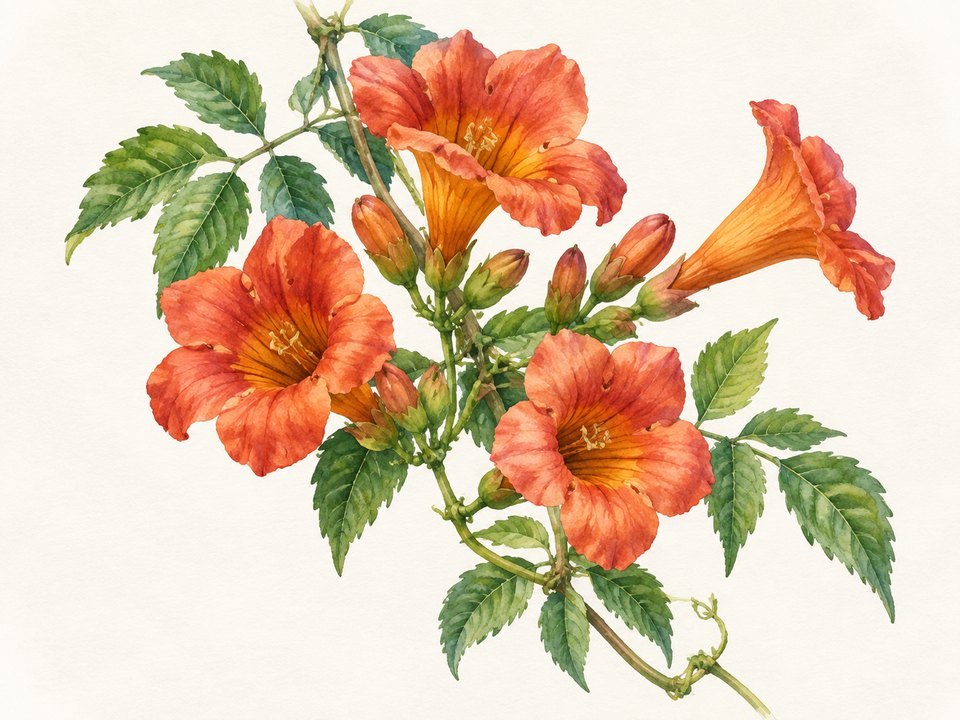
It is a deciduous vine, bare in winter. SAWS lists 20 to 30 feet tall; the Wildflower Center describes stems to about 35 feet. Orange-red trumpet flowers appear in summer and attract hummingbirds.[1][2]
Maintenance and safety
The Wildflower Center suggests mowing suckers to limit spread and winter pruning for bushier growth. SAWS warns that the vine remains difficult to contain. Sap can irritate skin, so wear gloves.[1][2]
When to Plant Trumpet Vine
Plant Trumpet Vine in fall or spring in Central Texas. Cooler weather lets the roots establish before the vine has to support top growth through summer heat.[3]
If you would like a hand, the Texas Allied Landscape team can plant your Trumpet Vine and keep it thriving.
Planting
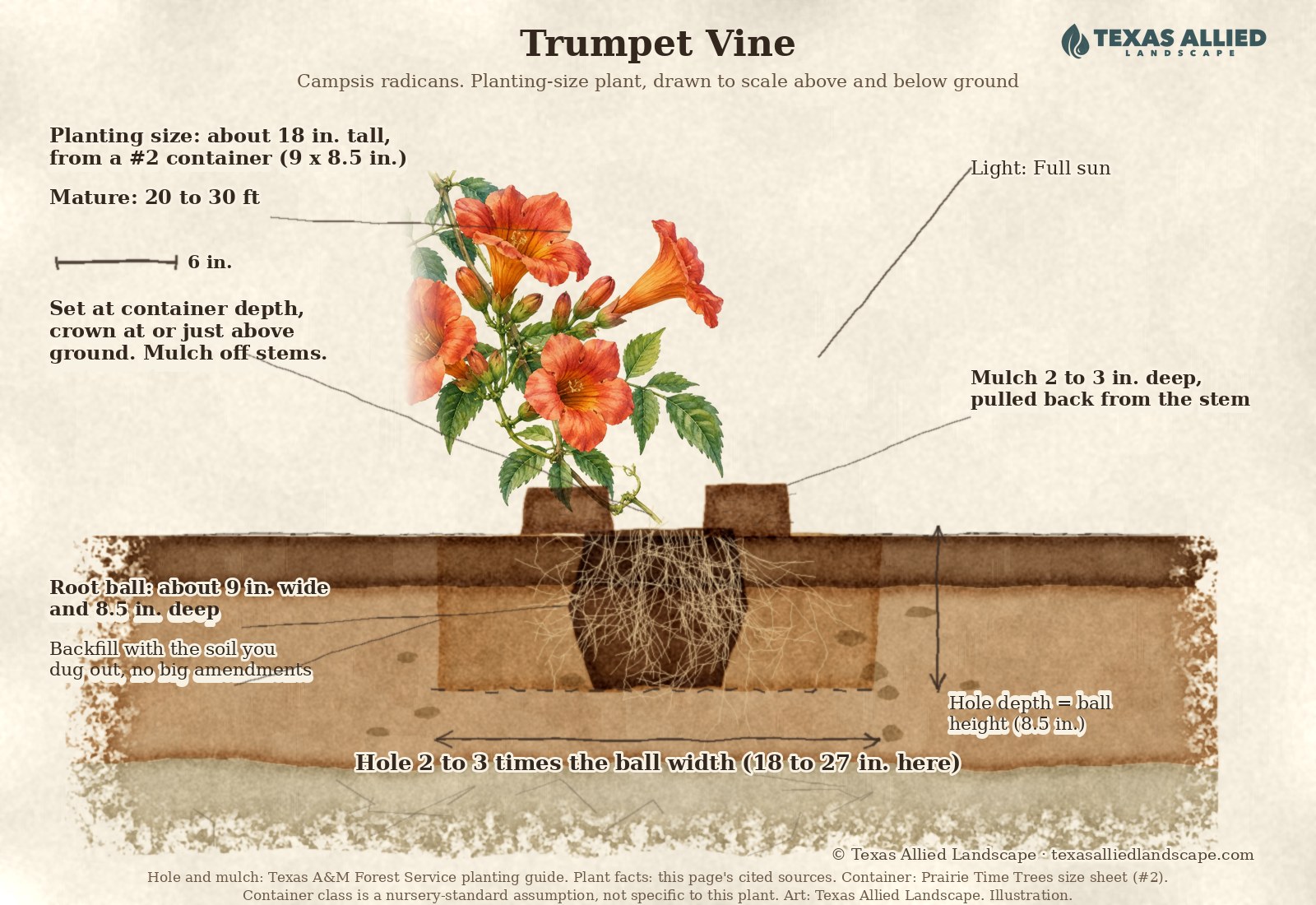
- Dig a hole twice as wide as the pot and no deeper, with sloping sides, and set the plant at the same depth it grew in its pot. Loosen any circling roots before backfilling.[4]
- Support: plant it at the base of whatever it should climb - a trellis, fence or arbor - so it can take hold from the start.
- Soil: The Wildflower Center lists low water needs, high drought tolerance and varied well-drained soils, including limestone and caliche soils. Occasional deep water during drought can help keep existing vines leafy.[1]
- Timing: Plant Trumpet Vine in fall or spring in Central Texas. Cooler weather lets the roots establish before the vine has to support top growth through summer heat.[3]
- Soak it well at planting and keep watering while the roots establish.[4]
- Mulch 2 to 4 inches, kept a few inches away from the stems to prevent crown rot.[4]
Care Instructions for Your Trumpet Vine
Sunlight, soil and water
Full sun gives the most flowers. The Wildflower Center lists low water needs, high drought tolerance and varied well-drained soils, including limestone and caliche soils. Occasional deep water during drought can help keep existing vines leafy.[1]
Trumpet vine questions
Is trumpet vine invasive in Texas?
It is native here, but very aggressive. Suckers and seeds spread it far beyond where you plant it. Give it a big, isolated trellis or expect to pull runners.[5]
Next step: Our horticulturalists can prune it hard and stay ahead of its suckers.
Do hummingbirds like trumpet vine?
They love it. The big orange-red trumpets are one of the best hummingbird flowers in a Texas summer.[6]
When do I prune trumpet vine?
Prune it in late winter, and prune hard. It blooms on new growth and tolerates being cut nearly to the framework.[7]
Why won't my trumpet vine bloom?
Too much shade or nitrogen is usually the cause, or the vine is just young. It can take a few years to flower, and then it blooms heavily in sun.[8]
Let Texas Allied Landscape care for your Trumpet Vine
Trumpet Vine does best with steady, knowledgeable care. That means the right water, pruning at the right time, and a trained eye for stress. The horticulturists at Texas Allied Landscape care for plants like yours across the San Antonio area. They are backed by over 40 years of landscape experience.
In these community guides
- Art in progress
Cordillera Ranch Landscaping
Bring your address, survey and yard ideas. We check the right guideline set, plan planting and irrigation, prepare the…
- Art in progress
Homestead Landscaping
Share your Homestead address, survey and yard ideas with Texas Allied Landscape. We help prepare a clear plan for…

Illustration. Illustration based on reference photos of Johnson Ranch. Not a single literal view. Johnson Ranch Landscaping
Share your Johnson Ranch address, survey and yard ideas. Texas Allied Landscape can help plan planting, irrigation and…
Sources
- Campsis radicans, Lady Bird Johnson Wildflower Center.https://www.wildflower.org/plants/result.php?id_plant=cara2abcdefgh
- Trumpet Creeper, SAWS Garden Style San Antonio.https://www.gardenstylesanantonio.com/plants/trumpet-creeper/abc
- October Gardening Checklist, Travis County AgriLife Extension.https://travis-tx.tamu.edu/about-2/horticulture/monthly-gardening-calendar-for-austin-area/october-gardening-checklist-for-austin-and-central-texas/ab
- Back to basics: Planting perennials, SAWS Garden Style San Antonio.https://www.gardenstylesanantonio.com/garden-articles/back-to-basics-planting-perennials/abc
- City of Austin Grow Green plant guide, "Trumpet Vine."https://www.austintexas.gov/watershed-protection/plant-guide/trumpet-vine↑
- Native Plant Society of Texas, "Campsis radicans."https://www.npsot.org/posts/native-plant/campsis-radicans/↑
- Iowa State Extension, "How do I prune trumpet vine?"https://yardandgarden.extension.iastate.edu/faq/how-do-i-prune-trumpet-vine↑
- Lady Bird Johnson Wildflower Center, "Campsis radicans."https://www.wildflower.org/expert/show.php?id=2213↑