
Property owners
Ashe Juniper
- Plant
- Ashe Juniper
- Botanical name
- Juniperus ashei
- Group
- Large shrubs and small trees
Sourced light, water, size and care details for Ashe Juniper.
On this page
Its botanical name is Juniperus ashei.
It belongs to the large trees group.
Light
Soil and drainage
It thrives in thin, rocky, alkaline Hill Country soils where almost nothing else grows. It is the native cedar of our hills.[3]
Height
It reaches 15-25 ft at maturity, sometimes more. It is a slow to medium grower.
Spread
It spreads 10-15 ft with a dense conical to rounded crown.
Foliage
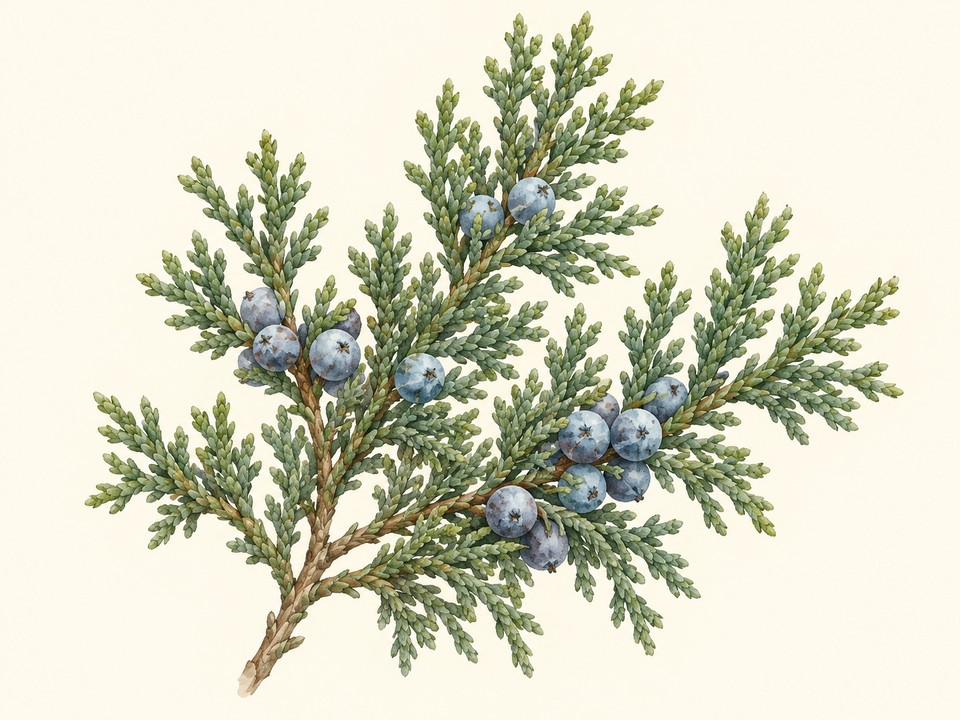
It is an evergreen conifer. It has dense gray-green scale foliage, shredding red-brown bark, and waxy blue "berries" (cones) on female trees.
Water
Its water needs are very low. Established trees need no irrigation at all in most years. If watering ever feels like a guessing game, our horticulturists can care for your Ashe Juniper on a schedule that fits your yard.[3]
Pruning
It needs little pruning. Remove dead lower limbs and thin lightly for a cleaner trunk line. Do not shear it. It will not regrow from bare wood.[1]
Seasonal behavior
It stays evergreen year-round. Male trees release clouds of yellow pollen in December and January. That is the "cedar fever" season.
When to Plant Ashe Juniper
Plant Ashe Juniper in fall or early spring in Central Texas. A fall planting establishes roots through the cool season and is ready to grow the following year. Spring planting works too if you water through the first summer.[4]
If you would like a hand, the Texas Allied Landscape team can plant your Ashe Juniper and keep it thriving.
Planting
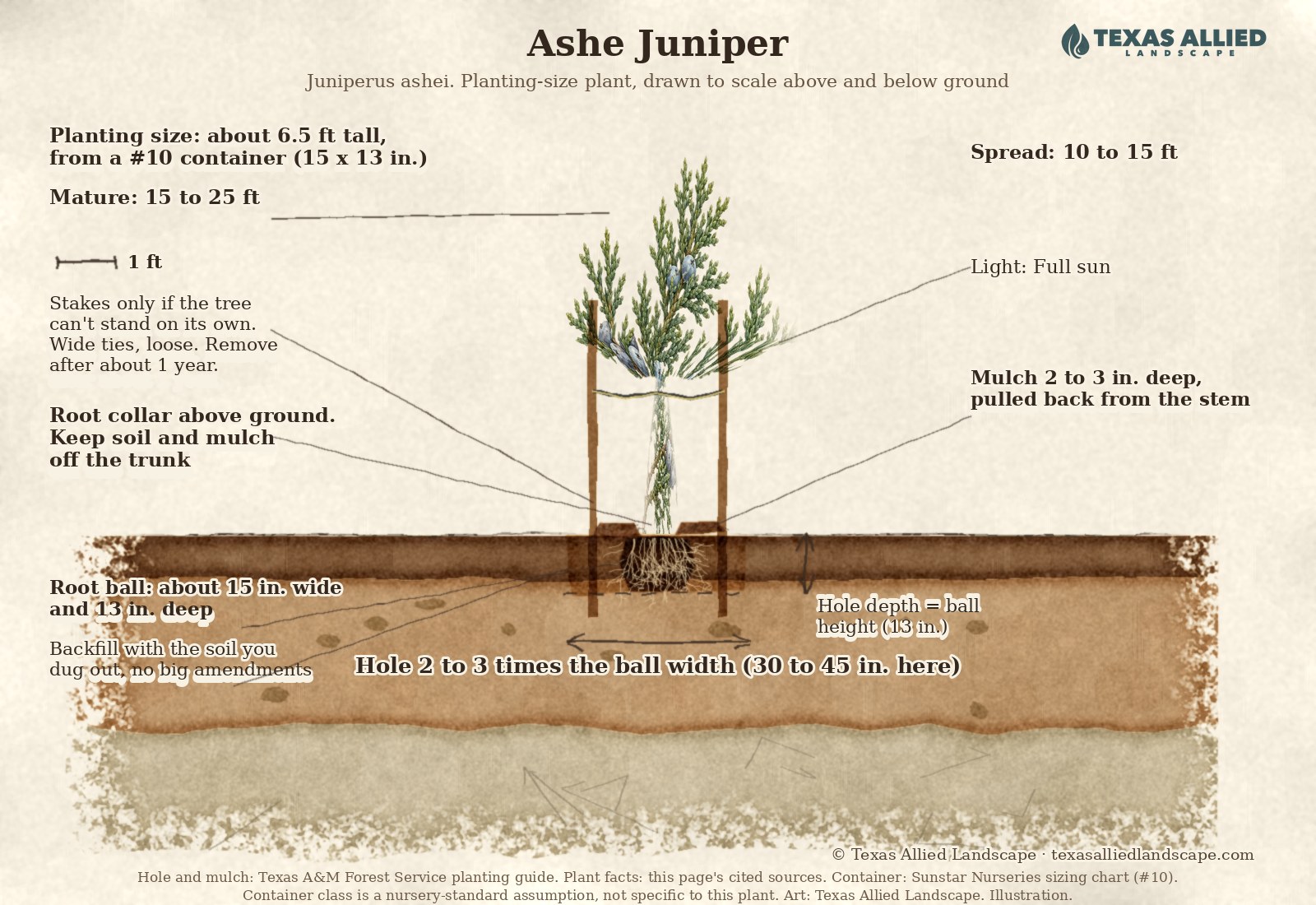
- Dig a hole at least twice as wide as the root ball and no deeper. A square hole keeps the roots from settling too deep while letting them grow out into the surrounding soil.[5]
- Fill the empty hole with water and check the drainage. If it takes longer than 24 hours to drain, choose another spot. Roots sitting under water will kill the tree.[5]
- Set it with the root collar (the flare just above the roots) level with or slightly above the ground, and take off all wire, twine, containers and bags before backfilling.[5]
- Backfill with the same soil that came out of the hole, without amendments, and settle it with water rather than packing it down.[5]
- Site and soil: It wants full sun.[1][2] It thrives in thin, rocky, alkaline Hill Country soils where almost nothing else grows. It is the native cedar of our hills.[3]
- Timing: A fall planting establishes roots through the cool season and is ready to grow the following year. Spring planting works too if you water through the first summer.[4]
- Water it for at least the first two years, but do not overwater. A thorough soaking beats light, frequent watering.[5] Once it is established, a fall planting is ready to grow the following year. Spring planting works too if you water through the first summer.[4]
- Mulch 2 to 3 inches deep, out to the drip line and up to but not touching the trunk. Stake it only if it cannot stand on its own, and take the stakes off within a year. Most trees need no support. Do not fertilize during the first growing season.[5]
Care Instructions for Your Ashe Juniper
Sunlight
Soil and drainage
It thrives in thin, rocky, alkaline Hill Country soils where almost nothing else grows. It is the native cedar of our hills.[3]
Mature height and spread
It reaches 15-25 ft at maturity, sometimes more, and it is a slow to medium grower. It spreads 10-15 ft with a dense conical to rounded crown.
Pruning
It needs little pruning. Remove dead lower limbs and thin lightly for a cleaner trunk line. Do not shear it. It will not regrow from bare wood.[1]
Normal seasonal behavior
It stays evergreen year-round. Male trees release clouds of yellow pollen in December and January. That is the "cedar fever" season.
Ashe juniper questions
Is Ashe juniper the "cedar" behind cedar fever?
Yes. Male Ashe junipers release heavy pollen in December and January, which triggers Central Texas "cedar fever." Female trees produce berries, not pollen.[6]
Should I remove the Ashe junipers on my lot?
Not automatically. Mature cedars shade hillsides, shelter wildlife (including golden-cheeked warbler habitat) and hold rocky soil. Clearing thick regrowth makes sense, and keeping legacy trees usually does too.[7]
Next step: Our horticulturalists can walk the lot and mark which to keep, thin or clear.
Why is my Ashe juniper turning brown?
Interior browning in fall is normal seasonal shed of old scale foliage. Whole-branch or top-down browning after a wet spell points to root rot. Cedars hate wet feet.[8]
Do Ashe junipers need watering?
Once established, essentially never. They are the most drought-proof tree in the Hill Country. Water only a newly planted one through its first two summers.[9]
Let Texas Allied Landscape care for your Ashe Juniper
Ashe Juniper does best with steady, knowledgeable care. That means the right water, pruning at the right time, and a trained eye for stress. The horticulturists at Texas Allied Landscape care for plants like yours across the San Antonio area. They are backed by over 40 years of landscape experience.
In these community guides
Sources
- FAQ on Managing Ashe Juniper, Hill Country Alliance.https://www.hillcountryalliance.org/wp-content/uploads/2016/09/FAQ-Managing-Ashe-Juniper_v2.pdfabcde
- Understanding Cedar in the Texas Hill Country, Hill Country Groundworks.https://hillcountrygroundworks.com/hill-country-cedar-guide/abc
- Hill Country Wildlife Management, Texas Parks and Wildlife.https://tpwd.texas.gov/landwater/land/habitats/hillcountry/habitat_management/abcde
- October Gardening Checklist, Travis County AgriLife Extension.https://travis-tx.tamu.edu/about-2/horticulture/monthly-gardening-calendar-for-austin-area/october-gardening-checklist-for-austin-and-central-texas/abc
- Planting, Texas A&M Forest Service.https://tfsweb.tamu.edu/trees/tree-care/planting/abcdef
- Hill Country Alliance, "FAQ on Managing Ashe Juniper."https://www.hillcountryalliance.org/wp-content/uploads/2016/09/FAQ-Managing-Ashe-Juniper_v2.pdf↑
- Texas Parks and Wildlife, "Hill Country Wildlife Management."https://tpwd.texas.gov/landwater/land/habitats/hillcountry/habitat_management/↑
- Hill Country Groundworks, "Understanding Cedar in the Texas Hill Country."https://hillcountrygroundworks.com/hill-country-cedar-guide/↑
- Hill Country Alliance, "FAQ on Managing Ashe Juniper."https://www.hillcountryalliance.org/wp-content/uploads/2016/09/FAQ-Managing-Ashe-Juniper_v2.pdf↑