
Property owners
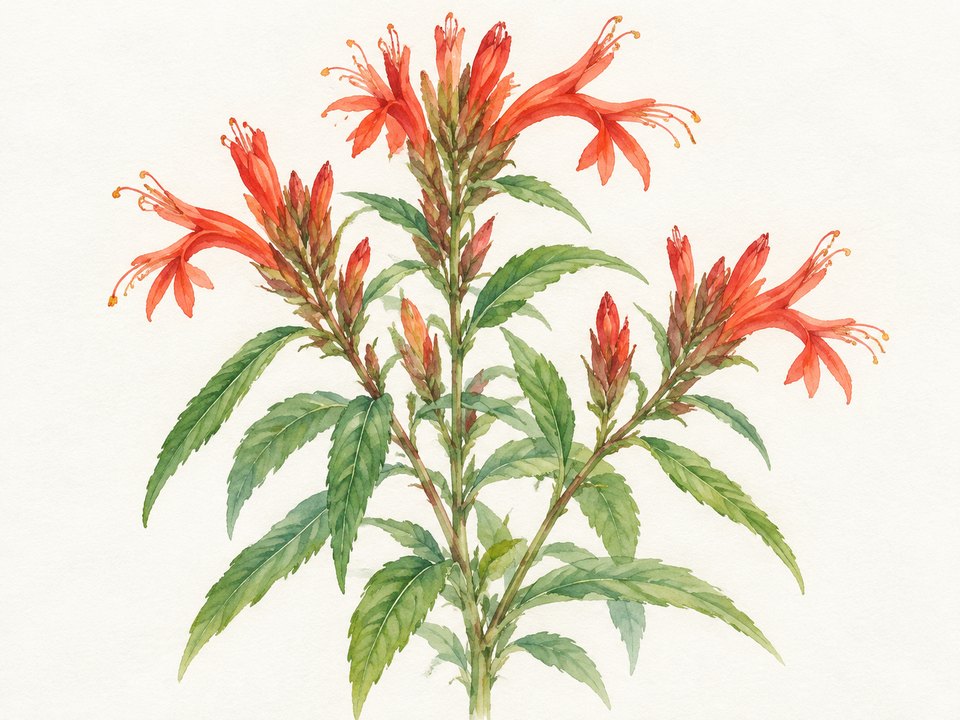
Flame Acanthus
- Plant
- Flame Acanthus
- Botanical name
- Anisacanthus quadrifidus var. wrightii
- Variety
- var. wrightii
- Group
- Medium shrubs and perennials
Flame Acanthus (Anisacanthus quadrifidus var. wrightii): light, water, soil, size and care for San Antonio area landscapes.
On this page
Botanical name: Anisacanthus quadrifidus var. wrightii.
Light
Soil and drainage
Well-drained sand, loam, clay, caliche, limestone; adapts to rocky slopes and thin dry soils.
Height
Normally no more than 3 ft but can reach 5 ft; another source lists 3-5 ft.[3]
Spread
3-4 ft.
Foliage
Deciduous.
Water
Low water use, high drought and heat tolerance; one source lists Very Low; another source says it needs no irrigation. If watering ever feels like a guessing game, our horticulturists can care for your Flame Acanthus on a schedule that fits your yard.
Pruning
Can be cut back in winter to keep a compact shape.
Seasonal behavior
Orange tube flowers June-October made for hummingbirds; deciduous rangy shrub.
Should I water flame acanthus?
Anisacanthus needs no irrigation or special attention once established; another source rates its drought tolerance high.
When to Plant Flame Acanthus
Plant Flame Acanthus in fall or early spring in Central Texas. A fall planting establishes roots through the cool season and is ready to grow and bloom the following year; spring planting works too if you water through the first summer.[4]
If you would like a hand, the Texas Allied Landscape team can plant your Flame Acanthus and keep it thriving.
Planting
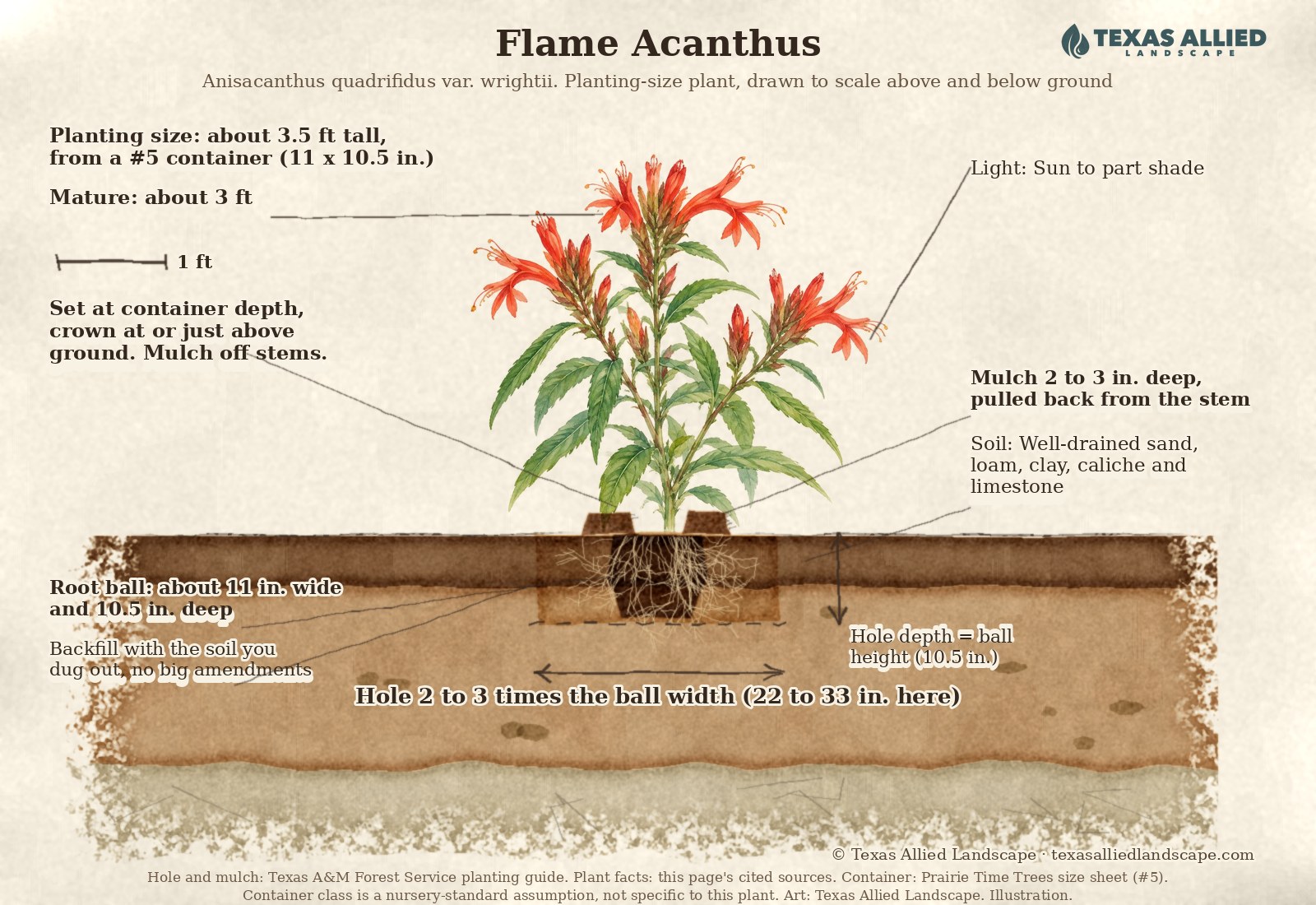
- Dig a hole at least twice as wide as the root ball and no deeper, so the roots can grow out into the surrounding soil.[5]
- Fill the empty hole with water and check the drainage. If it takes longer than 24 hours to drain, choose another spot: roots sitting under water will kill the plant.[5]
- Set it with the root collar (where the stems meet the roots) level with the ground, and take off the container and any twine or bags before backfilling.[5]
- Backfill with the same soil that came out of the hole, without amendments, and settle it with water rather than packing it down.[5]
- Site and soil: Sun to part shade; blooms best in sun.[1][2] Well-drained sand, loam, clay, caliche, limestone; adapts to rocky slopes and thin dry soils. Normally no more than 3 ft but can reach 5 ft; another source lists 3-5 ft.[3]
- Timing: A fall planting establishes roots through the cool season and is ready to grow and bloom the following year; spring planting works too if you water through the first summer.[4]
- Water regularly through the first growing season while roots establish, without overwatering: a thorough soaking beats light, frequent watering.[5]
- Mulch 2 to 3 inches deep, up to but not touching the stems. It needs no staking or other support. Do not fertilize during the first growing season.[5]
Care Instructions for Your Flame Acanthus
How to Water a Flame Acanthus
Low water use, high drought and heat tolerance; one source lists Very Low; another source says it needs no irrigation.
Sunlight
Sun to part shade; blooms best in sun.[1][2]
Soil and drainage
Well-drained sand, loam, clay, caliche, limestone; adapts to rocky slopes and thin dry soils.
Mature height and spread
Normally no more than 3 ft but can reach 5 ft; another source lists 3-5 ft.[3] 3-4 ft.
Pruning
Can be cut back in winter to keep a compact shape.
Normal seasonal behavior
Orange tube flowers June-October made for hummingbirds; deciduous rangy shrub.
Flame acanthus questions
Is flame acanthus a good hummingbird plant?
One of the best for Central Texas: the orange-red tubes bloom through the hottest part of summer exactly when hummingbirds need them most.[6]
Why isn't my flame acanthus blooming?
It wants full sun and lean, dry conditions. Shade, rich soil and extra water grow leaves instead of flowers. Blooms come on new growth, so a late-winter cutback does not cost you flowers.[7]
When do I cut back flame acanthus?
In late winter, cut the whole plant back by half or more - it blooms on new wood and stays compact that way. Untrimmed plants get lanky and woody.[8]
Next step: Our horticulturalists can do the late-winter cutback with your other salvias and native perennials.
Does flame acanthus lose its leaves in winter?
Yes, it is deciduous here - bare stems in winter are normal. Mark the spot so you do not dig it out by accident in spring.[9]
Let Texas Allied Landscape care for your Flame Acanthus
Flame Acanthus does best with steady, knowledgeable care: the right water, pruning at the right time, and a trained eye for stress. The horticulturists at Texas Allied Landscape care for plants like yours across the San Antonio area, backed by over 40 years of landscape experience.
In these community guides
Illustration. Illustration based on reference photos of Arbors of Fair Oaks. Not a single literal view. Arbors of Fair Oaks Landscaping
Bring your address, unit and yard ideas. Texas Allied Landscape helps design the planting and irrigation, prepare the…
- Art in progress
Cordillera Ranch Landscaping
Bring your address, survey and yard ideas. We check the right guideline set, plan planting and irrigation, prepare the…
- Art in progress
Homestead Landscaping
Share your Homestead address, survey and yard ideas with Texas Allied Landscape. We help prepare a clear plan for…

Illustration. Illustration based on reference photos of Johnson Ranch. Not a single literal view. Johnson Ranch Landscaping
Share your Johnson Ranch address, survey and yard ideas. Texas Allied Landscape can help plan planting, irrigation and…
Sources
- Anisacanthus quadrifidus var. wrightii (Flame acanthus), Lady Bird Johnson Wildflower Center.https://www.wildflower.org/plants/result.php?id_plant=anquwabc
- Flame Acanthus, San Antonio Water System - Garden Style San Antonio.https://www.gardenstylesanantonio.com/plants/flame-acanthus/abc
- Flame Acanthus, City of Austin Watershed Protection Grow Green.https://www.austintexas.gov/watershed-protection/plant-guide/flame-acanthusabc
- October Gardening Checklist, Travis County AgriLife Extension.https://travis-tx.tamu.edu/about-2/horticulture/monthly-gardening-calendar-for-austin-area/october-gardening-checklist-for-austin-and-central-texas/ab
- Tree Care - Planting, Texas A&M Forest Service.https://tfsweb.tamu.edu/trees/tree-care/planting/abcdef
- Native Plant Society of Texas, "Flame Acanthus - a N.I.C.E. plant for a hot summer."https://www.npsot.org/posts/flame-acanthus-a-n-i-c-e-plant-for-a-hot-summer/↑
- City of Austin Grow Green plant guide, "Flame Acanthus."https://www.austintexas.gov/watershed-protection/plant-guide/flame-acanthus↑
- Native Plant Society of Texas, "Flame Acanthus - a N.I.C.E. plant for a hot summer."https://www.npsot.org/posts/flame-acanthus-a-n-i-c-e-plant-for-a-hot-summer/↑
- Texas Tech University Plant Database, "Flame Acanthus."https://www.depts.ttu.edu/plantresources/Pages/directories/landscape-info-sheets/herbaceous-info/Anisacanthus_quadrifidusvarwrightii.php↑