
Property owners
Lacebark Elm
- Plant
- Lacebark Elm
- Botanical name
- Ulmus parvifolia
- Group
- Shade trees
Lacebark Elm: planting and care guidance for Central Texas landscapes.
On this page
Light
Full sun to part shade.[1]
Soil and drainage
Well-drained soil, though it tolerates moist sites and adapts to a variety of soil textures and pH.[1]
Height
40 to 50 ft tall and 35 to 50 ft wide.[1]
When to Plant Lacebark Elm
In Central Texas, the best time to plant Lacebark Elm is fall through late winter. That means roughly October through February. Cooler weather and fall rains let the roots establish before summer heat arrives.[2]
Container-grown trees can also go in the ground in spring. Summer planting can work too if you can commit to deep, regular watering through the first growing season. Spring and summer planting demand more from you and the tree.
If you would like a hand, the Texas Allied Landscape team can plant your Lacebark Elm and keep it thriving.
Planting
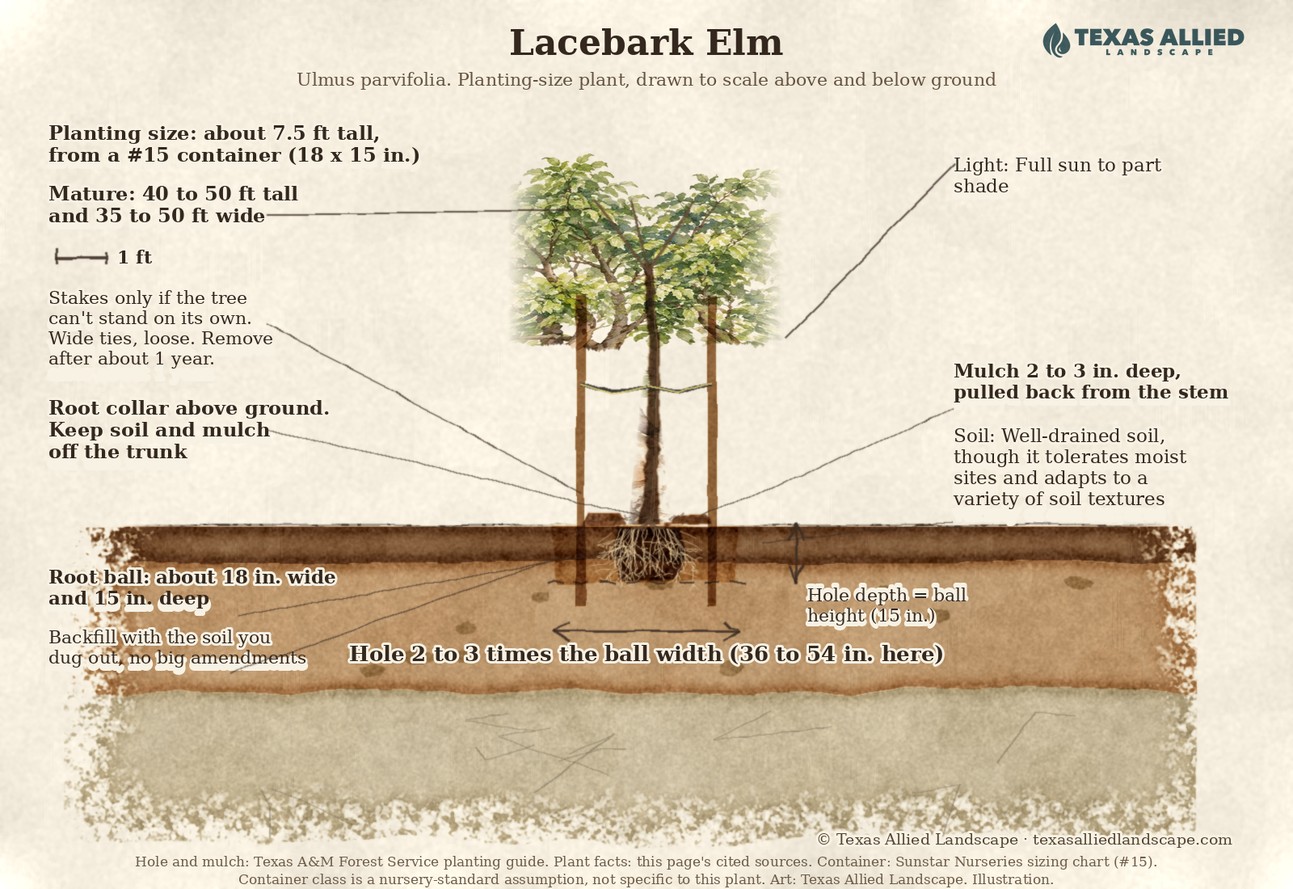
- Dig a hole at least twice as wide as the root ball and no deeper. A square hole keeps the roots from settling too deep. It also lets them grow out into the surrounding soil.[3]
- Fill the empty hole with water and check the drainage. If it takes longer than 24 hours to drain, choose another spot. Roots sitting under water will kill the tree.[3]
- Set the tree with the root collar (the flare just above the roots) level with or slightly above the ground. Carry it by the container or root ball, never the trunk. Take off all wire, twine, containers and bags before backfilling.[3]
- Backfill with the same soil that came out of the hole, without amendments. Settle it with water rather than packing it down.[3]
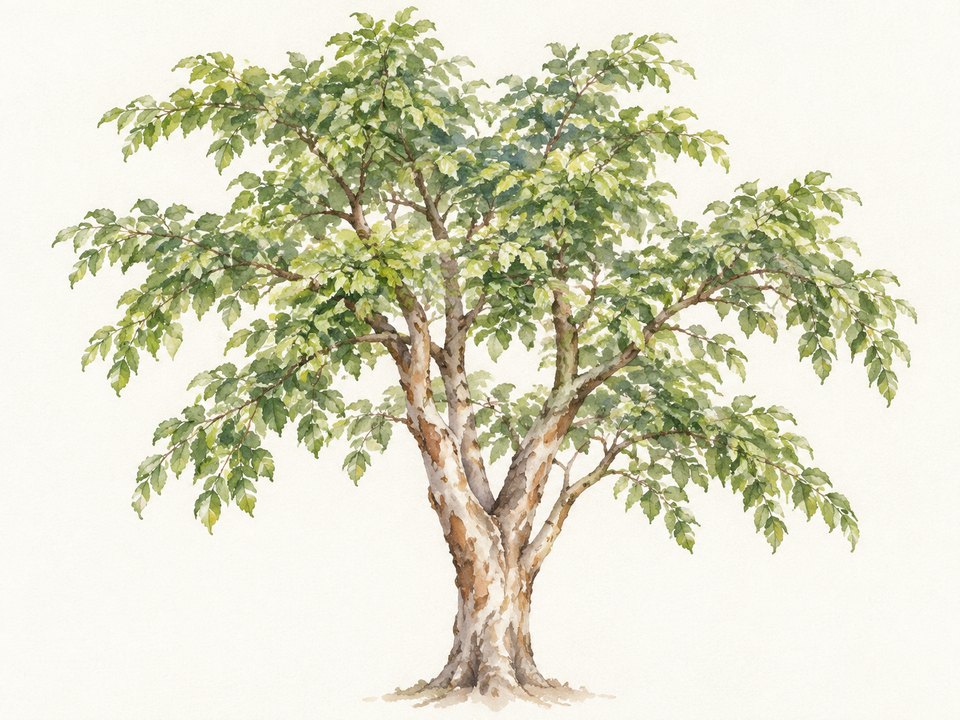
- Give it room. The bark is the feature. It flakes off in patches of orange, tan and gray, most striking in winter.[4] The tree grows 40-50 feet tall and wide. It is a real shade tree, so give it room from the house and power lines.[5] Give the canopy and roots plenty of vertical and horizontal room.[3]
- For the site and care, expect few problems. Watch for elm leaf beetle and prune young trees for structure. It is otherwise one of the most carefree shade trees.[6]
- For timing, the best time to plant Lacebark Elm is fall through late winter. That means roughly October through February. Cooler weather and fall rains let the roots establish before summer heat arrives.[2]
- Water for at least the first two years, without overwatering. A thorough soaking beats light, frequent watering.[3]
- Mulch 2 to 3 inches deep, out to the drip line and up to but not touching the trunk. Stake only if the tree cannot stand on its own. Take stakes off within a year. Most trees need no support. Do not fertilize during the first growing season.[3]
Care Instructions for Your Lacebark Elm
How to Water a Lacebark Elm
Sunlight and soil
Yes. Ulmus parvifolia is tough, fast, drought tolerant and resistant to Dutch elm disease.[7]
Pests, disease, and problems
Expect few problems. Watch for elm leaf beetle and prune young trees for structure. It is otherwise one of the most carefree shade trees.[6]
Lacebark elm questions
Is lacebark elm a good shade tree for Texas?
Yes. Ulmus parvifolia is tough, fast, drought tolerant and resistant to Dutch elm disease.[7]
Why is my lacebark elm's bark peeling?
That is the feature. The bark flakes off in patches of orange, tan and gray, most striking in winter.[4]
How big does lacebark elm get?
It grows 40-50 feet tall and wide. It is a real shade tree, so give it room from the house and power lines.[5]
Does lacebark elm have problems?
Expect few problems. Watch for elm leaf beetle and prune young trees for structure. It is otherwise one of the most carefree shade trees.[6]
Next step: Our horticulturalists can structure-prune a young elm so it never needs heroic correction.
Let Texas Allied Landscape care for your Lacebark Elm
Lacebark Elm does best with steady, knowledgeable care. That means the right water, pruning at the right time, and a trained eye for stress. The horticulturists at Texas Allied Landscape care for plants like yours across the San Antonio area. They bring over 40 years of landscape experience.
In these community guides
- Art in progress
Cordillera Ranch Landscaping
Bring your address, survey and yard ideas. We check the right guideline set, plan planting and irrigation, prepare the…
- Art in progress
Homestead Landscaping
Share your Homestead address, survey and yard ideas with Texas Allied Landscape. We help prepare a clear plan for…

Illustration. Illustration based on reference photos of Johnson Ranch. Not a single literal view. Johnson Ranch Landscaping
Share your Johnson Ranch address, survey and yard ideas. Texas Allied Landscape can help plan planting, irrigation and…
Illustration. Illustration based on reference photos of Rogers Ranch - Point Bluff and other neighborhoods. Not a single literal view. Rogers Ranch Landscaping
Plan your Rogers Ranch landscape with lawn, tree and irrigation guidance. Get help with the review package, approved…
Illustration. Illustration based on reference photos of Shavano Rogers Ranch - Crosstimber. Not a single literal view. Crosstimber Landscaping
Plan your Crosstimber plants, shade and irrigation. Get help matching your lot rules, preparing the review package and…
Sources
- Ulmus parvifolia (Lacebark Elm), North Carolina Extension Gardener Plant Toolbox.https://plants.ces.ncsu.edu/plants/ulmus-parvifolia/abc
- October Gardening Checklist, Travis County AgriLife Extension.https://travis-tx.tamu.edu/about-2/horticulture/monthly-gardening-calendar-for-austin-area/october-gardening-checklist-for-austin-and-central-texas/ab
- Planting, Texas A&M Forest Service.https://tfsweb.tamu.edu/trees/tree-care/planting/abcdefg
- Morton Arboretum, "Lacebark Elm."https://mortonarb.org/plant-and-protect/trees-and-plants/lacebark-elm/ab
- Texas Tech Plant Resources, "Ulmus parvifolia."https://www.depts.ttu.edu/plantresources/Pages/directories/landscape-info-sheets/woody-info/Ulmus_parvifolia.phpab
- Texas A&M Plant Disease Handbook, "Elm."https://plantdiseasehandbook.tamu.edu/landscaping/trees/elm/abc
- Texas A&M Forest Service, Texas Tree Planting, "Lacebark Elm."https://texastreeplanting.tamu.edu/display_onetree.aspx?tid=101ab