
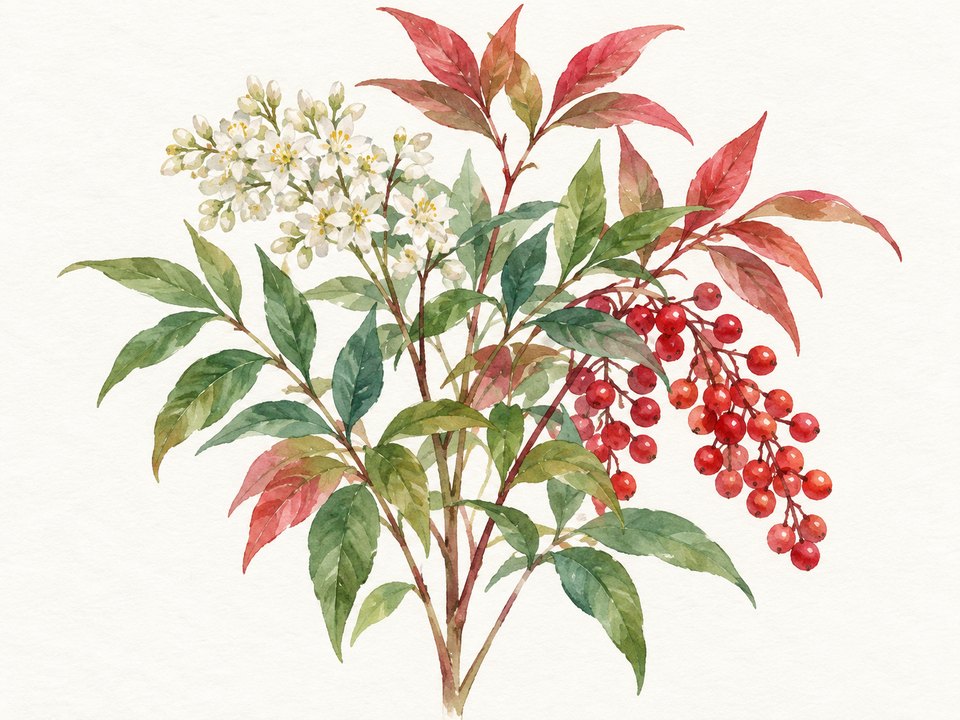
Property owners
Nandina
- Plant
- Nandina
- Botanical name
- Nandina domestica
- Group
- Medium shrubs and perennials
Nandina (Nandina domestica): light, water, soil, size and care for San Antonio area landscapes.
On this page
Its botanical name is Nandina domestica.
Light
It grows in full sun to part sun/shade.[1]
Foliage
It is evergreen.
Water
It needs low water. If watering ever feels like a guessing game, our horticulturists can care for your Nandina on a schedule that fits your yard.
Pruning
It needs no pruning.
Seasonal behavior
Nandina has spread aggressively into natural areas throughout the southeastern U.S. That includes central Texas and Bexar County. Its roots are tough and difficult to eradicate. Its berries are toxic to birds and mammals. Cedar waxwings are particularly at risk because they eat so many berries at once. The berries are also toxic to cats.[2]
Height
3 to 8 ft tall and 2 to 5 ft wide, an upright evergreen shrub.[3]
When to Plant Nandina
Plant Nandina in fall or early spring in Central Texas. A fall planting establishes roots through the cool season. It is then ready to grow and bloom the following year. Spring planting works too if you water through the first summer.[4]
If you would like a hand, the Texas Allied Landscape team can plant your Nandina and keep it thriving.
Planting
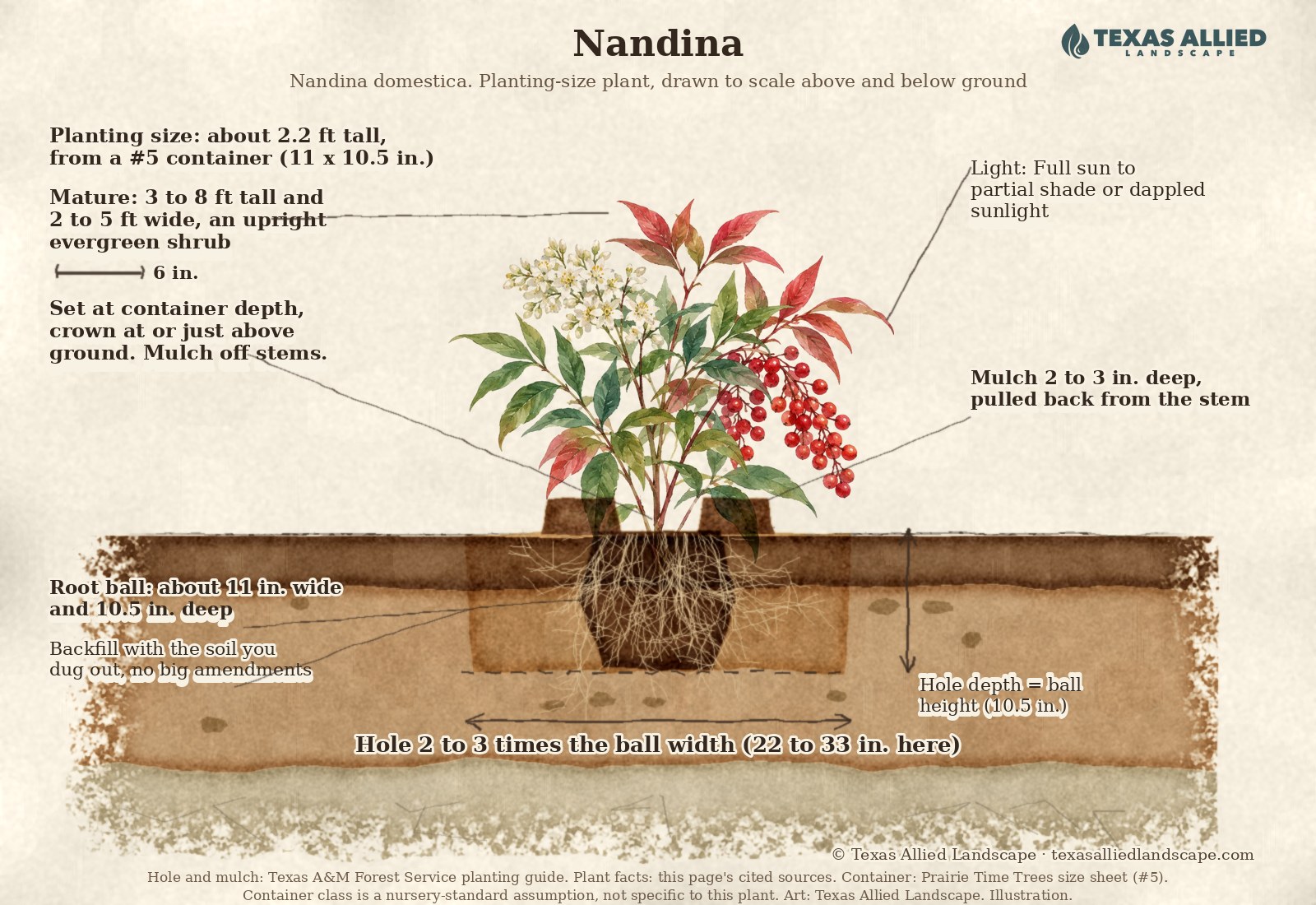
- Dig a hole twice as wide as the pot and no deeper, with sloping sides. Set the plant at the same depth it grew in its pot. Loosen any circling roots before backfilling.[5]
- For a new bed, clear grass and weeds first, roots and all.[5]
- Site: It grows in full sun to part sun/shade.[1]
- Timing: A fall planting establishes roots through the cool season and is ready to grow and bloom the following year. Spring planting works too if you water through the first summer.[4]
- Soak it well at planting and keep watering while the roots establish.[5]
- Mulch 2 to 4 inches, kept a few inches away from the stems to prevent crown rot. It needs no staking or other support.[5]
Is nandina a problem plant here?
Nandina is invasive and not recommended. It has spread into natural areas including Bexar County. Its berries are toxic to birds and mammals, with cedar waxwings especially at risk. If nandina is used at all, another source advises the sterile selections that do not set berries.
Care Instructions for Your Nandina
How to Water a Nandina
It needs low water.
Sunlight
It grows in full sun to part sun/shade.[1]
Pruning
It needs no pruning.
Normal seasonal behavior
Nandina has spread aggressively into natural areas throughout the southeastern U.S. That includes central Texas and Bexar County. Its roots are tough and difficult to eradicate. Its berries are toxic to birds and mammals. Cedar waxwings are particularly at risk because they eat so many berries at once. The berries are also toxic to cats.[2]
Nandina questions
Is nandina invasive in Texas?
Standard heavenly bamboo is listed as invasive in Texas. It spreads by seed from its berries and by underground shoots. It escapes into greenbelts and natural areas. Sterile dwarf cultivars produce few or no berries and are the responsible choice.[6]
Are nandina berries toxic?
Yes. The berries contain cyanogenic compounds. They have poisoned cedar waxwings that ate large amounts. They are also a hazard to pets and small children who might eat them. Clipping off berry clusters removes the risk and the spread.[7]
Why doesn't my nandina have berries?
It is probably a sterile dwarf cultivar, which is good news. No berries means no invasive spread and no toxicity risk. Standard and older varieties are the heavy berry producers.[8]
How do I prune a leggy nandina?
Nandina grows as a clump of canes, so prune by height. In late winter, cut the oldest, tallest canes to the ground and leave shorter ones. Shearing the whole plant into a ball gives you a box of leaves on bare sticks.[9]
Next step: Our horticulturalists can thin and re-layer an overgrown nandina bed in one visit.
Let Texas Allied Landscape care for your Nandina
Nandina does best with steady, knowledgeable care. That means the right water, pruning at the right time, and a trained eye for stress. The horticulturists at Texas Allied Landscape care for plants like yours across the San Antonio area. They are backed by over 40 years of landscape experience.
In these community guides
- Art in progress
Cordillera Ranch Landscaping
Bring your address, survey and yard ideas. We check the right guideline set, plan planting and irrigation, prepare the…
Illustration. Illustration based on reference photos of Mountain Springs Ranch. Not a single literal view. Mountain Springs Ranch Landscaping
Plan your Mountain Springs Ranch yard with planting, lawn and irrigation guidance. Get help from the review package…
Illustration. Illustration based on reference photos of The Reserve at Schertz II. Not a single literal view. Reserve at Schertz II Landscaping
Plan your Reserve at Schertz II yard with lawn, tree and irrigation guidance. Get help with the review package…
Sources
- Nandina, San Antonio Water System - Garden Style San Antonio.https://www.gardenstylesanantonio.com/plants/nandina/abc
- Plants that overstay their welcome, San Antonio Water System - Garden Style San Antonio.https://www.gardenstylesanantonio.com/garden-articles/plants-that-overstay-their-welcome/ab
- Nandina domestica (Heavenly Bamboo), North Carolina Extension Gardener Plant Toolbox.https://plants.ces.ncsu.edu/plants/nandina-domestica/↑
- October Gardening Checklist, Travis County AgriLife Extension.https://travis-tx.tamu.edu/about-2/horticulture/monthly-gardening-calendar-for-austin-area/october-gardening-checklist-for-austin-and-central-texas/ab
- Back to basics: Planting perennials, SAWS Garden Style San Antonio.https://www.gardenstylesanantonio.com/garden-articles/back-to-basics-planting-perennials/abcd
- Texas Invasives, "Nandina domestica."https://www.texasinvasives.org/plant_database/detail.php?symbol=NADO↑
- Poison Control (National Capital Poison Center), "What to know about Nandina domestica - or Heavenly Bamboo."https://www.poison.org/articles/nandina-domestica-heavenly-bamboo↑
- Native Plant Society of Texas, "Nandina domestica (invasive)."https://www.npsot.org/posts/invasive-plant/nandina-domestica/↑
- Clemson Cooperative Extension, "Nandina."https://hgic.clemson.edu/factsheet/nandina/↑