
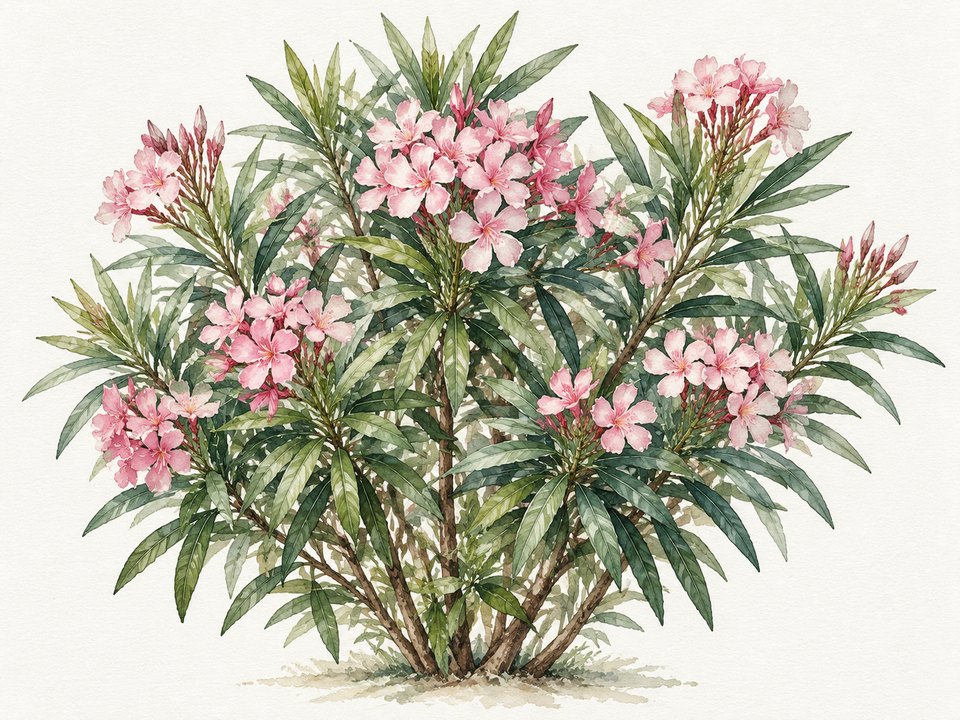
Property owners
Oleander
- Plant
- Oleander
- Botanical name
- Nerium oleander
- Group
- Large shrubs
Oleander (Nerium oleander): light, water, soil, size and care for San Antonio area landscapes.
On this page
Botanical name: Nerium oleander.
Light
Sun.[1]
Soil and drainage
Thin, sandy and clay soils.
Height
5-19.5 feet for the species; another source notes dwarf cultivars are available.[2]
Spread
6 to 8 feet.
Foliage
Evergreen in the local profile.
Water
Low Water; supplemental summer water may help depending on site. If watering ever feels like a guessing game, our horticulturists can care for your Oleander on a schedule that fits your yard.
Pruning
Cut back as needed after winter freeze damage.
Seasonal behavior
Evergreen in mild conditions; may freeze to the ground in cold winters. All parts are toxic to humans and livestock. Leaf scorch can cause progressive decline, but similar symptoms can have other causes.
Is oleander safe around pets?
Oleander is toxic to dogs, cats and horses. ASPCA identifies cardiac glycosides and lists serious possible effects, including death. The NC State profile warns that fresh and dry plant material are poisonous. Do not rely on an asserted safe dose or on drying clippings to make them safe.[3]
Do wilting gray leaves prove my oleander has bacterial leaf scorch?
No. Another source describes wilting grayish leaves and branch-by-branch decline as signs associated with oleander leaf scorch, and says there is no remedy for that disease. Those signs alone do not establish a diagnosis or justify replacing a plant before it is assessed.
Can I burn oleander cuttings?
Not to burn oleander because the smoke is injurious and says not to consume any part. Its fresh and dry plant material are poisonous; drying clippings does not make them safe.
When to Plant Oleander
Oleander is frost-tender in San Antonio, so plant it in spring after the last frost, usually around mid-March. Spring planting gives it a full growing season to establish before its first winter.
Even established plants can be damaged by hard freezes.
If you would like a hand, the Texas Allied Landscape team can plant your Oleander and keep it thriving.
Planting
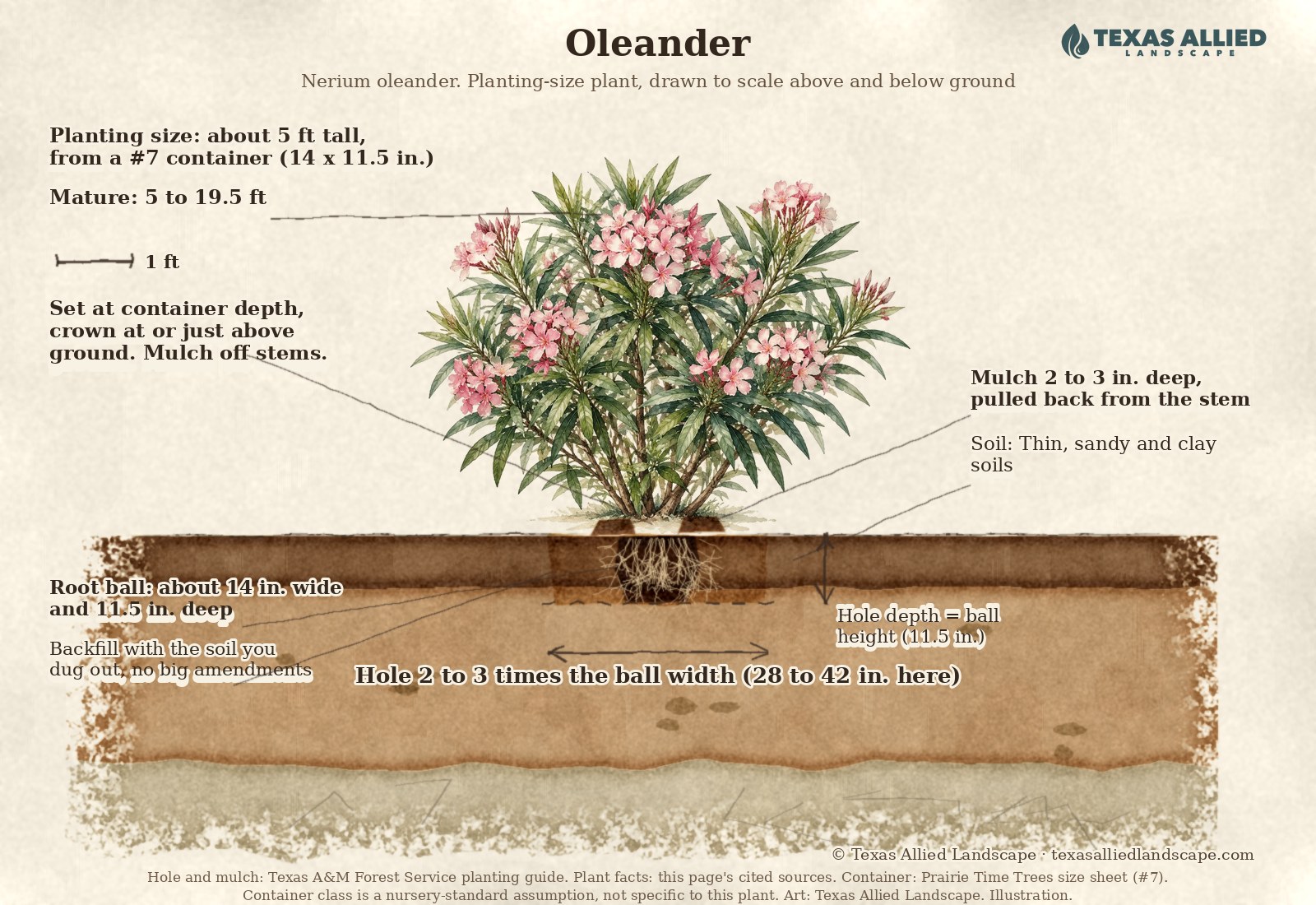
- Dig a hole at least twice as wide as the root ball and no deeper, so the roots can grow out into the surrounding soil.[4]
- Fill the empty hole with water and check the drainage. If it takes longer than 24 hours to drain, choose another spot: roots sitting under water will kill the plant.[4]
- Set it with the root collar (where the stems meet the roots) level with the ground, and take off the container and any twine or bags before backfilling.[4]
- Backfill with the same soil that came out of the hole, without amendments, and settle it with water rather than packing it down.[4]
- Soil: Thin, sandy and clay soils. 5-19.5 feet for the species; another source notes dwarf cultivars are available.[2]
- Timing: Oleander is frost-tender in San Antonio, so plant it in spring after the last frost, usually around mid-March.
- Water regularly through the first growing season while roots establish, without overwatering: a thorough soaking beats light, frequent watering.[4]
- Mulch 2 to 3 inches deep, up to but not touching the stems. It needs no staking or other support. Do not fertilize during the first growing season.[4]
Care Instructions for Your Oleander
How to Water an Oleander
Low Water; supplemental summer water may help depending on site.
Sunlight
Sun.[1]
Soil and drainage
Thin, sandy and clay soils.
Mature height and spread
5-19.5 feet for the species; another source notes dwarf cultivars are available.[2] 6 to 8 feet.
Pruning
Cut back as needed after winter freeze damage.
Normal seasonal behavior
Evergreen in mild conditions; may freeze to the ground in cold winters. All parts are toxic to humans and livestock. Leaf scorch can cause progressive decline, but similar symptoms can have other causes.
Oleander questions
Is oleander really that poisonous?
Yes. Every part of the plant is toxic to people, pets and livestock if eaten, and the sap can irritate skin. Never burn oleander trimmings - the smoke is toxic too. It is a safe plant to look at, not one for grazing pets or curious toddlers.[5]
Will my oleander come back after a freeze?
Most of the time, yes. Central Texas freezes knock oleanders to the ground some winters, but established plants regrow from the roots. Wait for spring, see where new growth starts, then cut away the dead wood.[6]
Next step: Our horticulturalists can do the spring cutback and reshape a freeze-hit oleander in a single visit.
When should I prune oleander?
Right after the main bloom finishes. Oleanders flower on new growth, so a light shaping after blooming keeps them full without costing next season's flowers. Wear gloves for the sap, and never compost near edible beds.[7]
Why does my oleander have scorched, dying branches?
Oleander leaf scorch, a bacterial disease spread by leafhopper insects, shows as yellowing, browning leaf edges and dying branches with no obvious cause. There is no cure; pruning out infected branches slows it, but heavily infected plants are usually replaced.[8]
Next step: If you suspect leaf scorch, our horticulturalists can confirm it and plan a replacement before it spreads to other oleanders.
Let Texas Allied Landscape care for your Oleander
Oleander does best with steady, knowledgeable care: the right water, pruning at the right time, and a trained eye for stress. The horticulturists at Texas Allied Landscape care for plants like yours across the San Antonio area, backed by over 40 years of landscape experience.
Community rules
No community rule is on file for this. A community saying nothing is not permission: check with its architectural committee before you plant.
In these community guides
Illustration. Illustration based on reference photos of Cibolo Trails. Not a single literal view. Cibolo Trails Landscaping
Bring your address, survey and yard ideas. We help check private-yard and common-area rules, prepare the review package…
- Art in progress
Cordillera Ranch Landscaping
Bring your address, survey and yard ideas. We check the right guideline set, plan planting and irrigation, prepare the…
- Art in progress
Esperanza Landscaping
Plan your Esperanza landscape with help on plants, irrigation and the approval package. We check your neighborhood, lot…

Illustration. Illustration based on reference photos of Johnson Ranch. Not a single literal view. Johnson Ranch Landscaping
Share your Johnson Ranch address, survey and yard ideas. Texas Allied Landscape can help plan planting, irrigation and…
Sources
- Oleander, San Antonio Water System - Garden Style San Antonio.https://www.gardenstylesanantonio.com/plants/oleander/ab
- Nerium oleander, NC State Extension.https://plants.ces.ncsu.edu/plants/nerium-oleander/abc
- Oleander toxicity, ASPCA Poison Control.https://www.aspca.org/pet-care/aspca-poison-control/toxic-and-non-toxic-plants/oleander↑
- Planting, Texas A&M Forest Service.https://tfsweb.tamu.edu/trees/tree-care/planting/abcdef
- Texas A&M Plants of Texas Rangelands, "Common Oleander."https://rangeplants.tamu.edu/plant/common-oleander/↑
- University of Arkansas Extension, "Oleander."https://www.uaex.uada.edu/yard-garden/resource-library/plant-week/oleander_01-10-14.aspx↑
- Clemson Cooperative Extension, "Oleander."https://hgic.clemson.edu/factsheet/oleander/↑
- Clemson Cooperative Extension, "Oleander."https://hgic.clemson.edu/factsheet/oleander/↑