
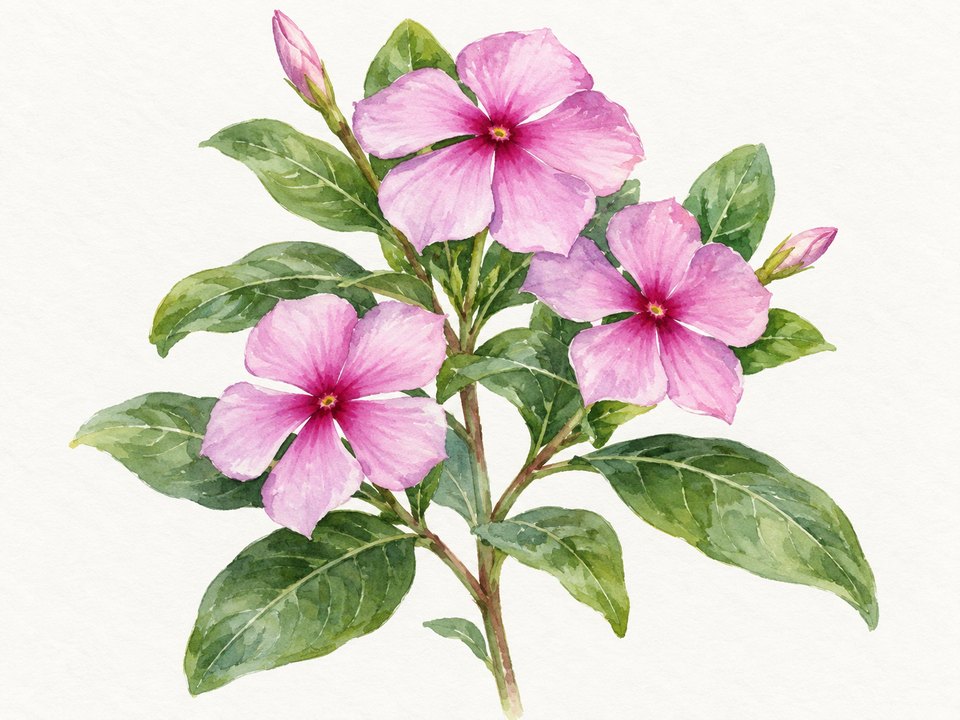
Property owners
Periwinkle
- Plant
- Periwinkle
- Botanical name
- Catharanthus roseus
- Group
- Low shrubs and perennials
Periwinkle (Catharanthus roseus): light, water, soil, size and care for San Antonio area landscapes.
On this page
Its botanical name is Catharanthus roseus.
Light
It needs full sun. It tolerates semi-shade.[^texassuperstar-vinca-cora]
Soil and drainage
It is adaptable to most soils with good drainage. Another source stresses well-drained soil and drying out between waterings.[^saws-vinca-cora]
Height
It grows 14 to 18 inches tall.
Foliage
It is a warm-season annual bedding plant.
Water
It needs medium water. Another source advises regular water at moderate levels with good drainage. Do not overwater it. If watering ever feels like a guessing game, our horticulturists can care for your Periwinkle on a schedule that fits your yard.
Seasonal behavior
It blooms in pink, rose and white in summer until frost. Plant it in May so it establishes before summer heat.
When to Plant Periwinkle
Periwinkle is a warm-season annual in San Antonio. Plant seeds or transplants after the last spring frost. That is from mid-March on, once the soil has warmed. It grows through the warm season and is removed or replanted after frost.
If you would like a hand, the Texas Allied Landscape team can plant your Periwinkle and keep it thriving.
Planting
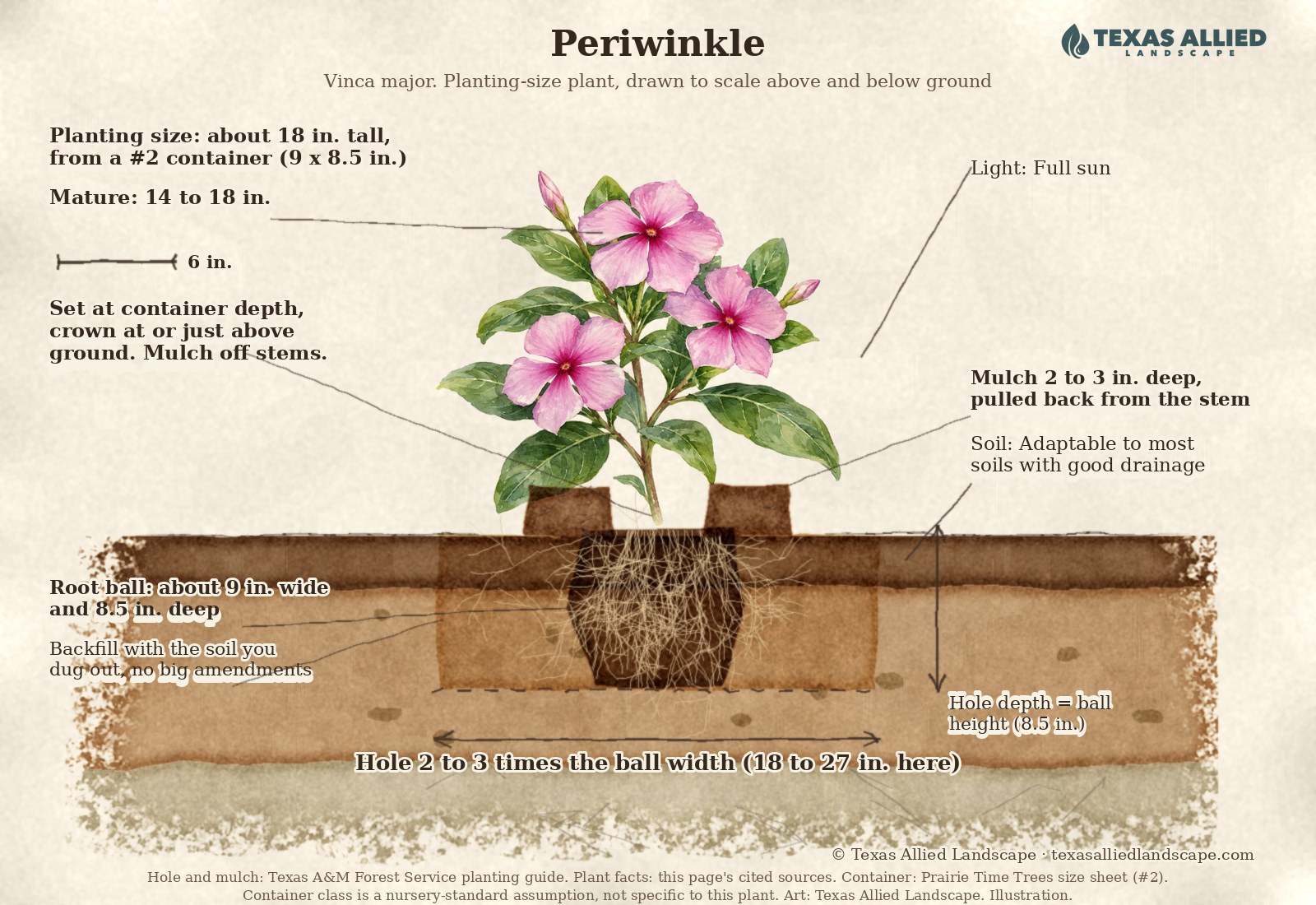
- Dig a hole twice as wide as the pot and no deeper, with sloping sides. Set the plant at the same depth it grew in its pot. Loosen any circling roots before backfilling.[1]
- For a new bed, clear grass and weeds first, roots and all.[1]
- For the site, it needs full sun. It tolerates semi-shade.
- For soil, it is adaptable to most soils with good drainage. Another source stresses well-drained soil and drying out between waterings.
- For timing, plant seeds or transplants after the last spring frost. That is from mid-March on, once the soil has warmed.
- Soak it well at planting and keep watering while the roots establish.[1]
- Mulch 2 to 4 inches, kept a few inches away from the stems to prevent crown rot. It needs no staking or other support.[1]
Why did my vincas collapse in spring?
Pythium root and stem rot can kill periwinkles fast. Overwatering makes it worse. The Cora series was bred for resistance to aerial Phytophthora. That is the disease that historically limited this species in Texas.[^tamu-plant-disease-periwinkle]
Let Texas Allied Landscape care for your Periwinkle
Periwinkle does best with steady, knowledgeable care. That means the right water, pruning at the right time, and a trained eye for stress. The horticulturists at Texas Allied Landscape care for plants like yours across the San Antonio area. They bring over 40 years of landscape experience.
In these community guides

Illustration. Illustration based on reference photos of Arbors of Fair Oaks. Not a single literal view. Arbors of Fair Oaks Landscaping
Bring your address, unit and yard ideas. Texas Allied Landscape helps design the planting and irrigation, prepare the…
- Art in progress
Cordillera Ranch Landscaping
Bring your address, survey and yard ideas. We check the right guideline set, plan planting and irrigation, prepare the…

Illustration. Illustration based on reference photos of Johnson Ranch. Not a single literal view. Johnson Ranch Landscaping
Share your Johnson Ranch address, survey and yard ideas. Texas Allied Landscape can help plan planting, irrigation and…
Care Instructions for Your Periwinkle
How to Water a Periwinkle
It needs medium water. Another source advises regular water at moderate levels with good drainage. Do not overwater it.
Sunlight
It needs full sun. It tolerates semi-shade.[^texassuperstar-vinca-cora]
Soil and drainage
It is adaptable to most soils with good drainage. Another source stresses well-drained soil and drying out between waterings.[^saws-vinca-cora]
Mature height and spread
It grows 14 to 18 inches tall.
Normal seasonal behavior
It blooms in pink, rose and white in summer until frost. Plant it in May so it establishes before summer heat.
Periwinkle questions
Is periwinkle an annual or perennial in Texas?
It is a warm-season annual here. Catharanthus roseus (annual vinca) is tropical, so it dies with frost. But it outblooms almost everything from May to November.[2]
Why did my periwinkles suddenly wilt and die?
The cause is usually aerial phytophthora or root rot from too much water. Vinca is the one annual that wants to dry out between waterings. Wet beds in summer can take a whole planting down fast.[3]
Next step: Our horticulturalists can spot the disease early, adjust irrigation, and replant with resistant varieties.
Sun or shade for periwinkles?
Give them full sun to part shade. They bloom heaviest in sun. They are one of the few flowers that keep going through brutal Texas August heat.[4]
How much water do periwinkles need?
They need less than you think. Water to establish, then only when the soil dries. They are built for heat. They tolerate drought better than wet feet.[5]
Sources
- Back to basics: Planting perennials, SAWS Garden Style San Antonio.https://www.gardenstylesanantonio.com/garden-articles/back-to-basics-planting-perennials/abcd
- Clemson Home & Garden Information Center, "Annual Vinca."https://hgic.clemson.edu/factsheet/annual-vinca/↑
- Clemson Home & Garden Information Center, "Vinca Diseases."https://hgic.clemson.edu/factsheet/vinca-diseases/↑
- UF/IFAS Gardening Solutions, "Periwinkles."https://gardeningsolutions.ifas.ufl.edu/plants/ornamentals/periwinkles/↑
- University of Minnesota Extension, "Vinca."https://extension.umn.edu/garden-and-home/yard-and-garden/gardening-in-minnesota/vinca↑