
Property owners
Prickly Pear
- Plant
- Prickly Pear
- Botanical name
- Opuntia spp.
- Group
- Succulents and cacti
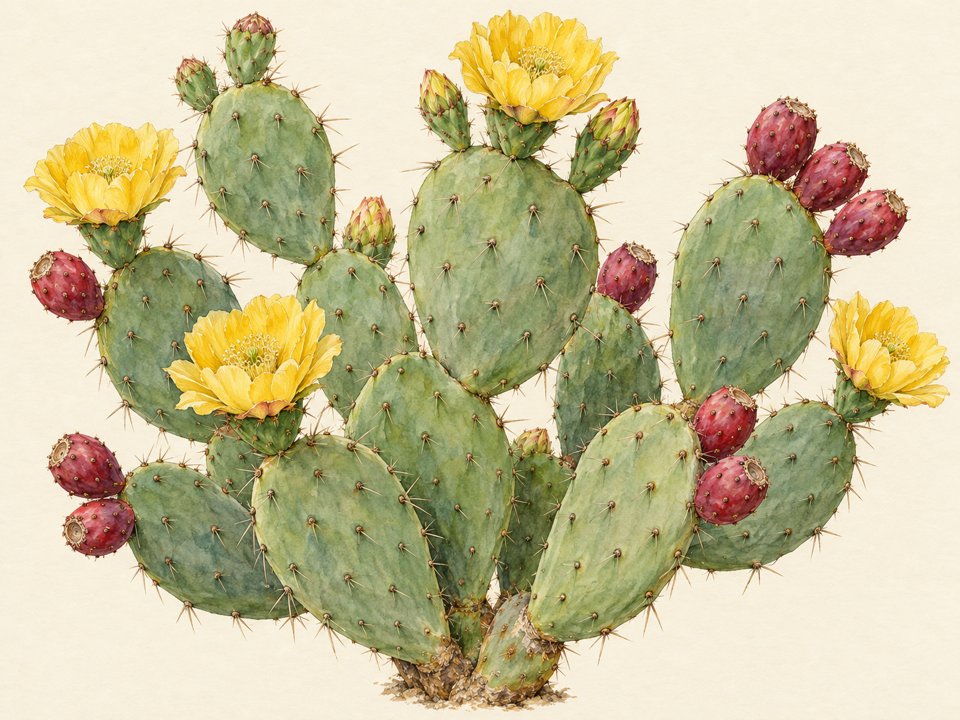
Prickly Pear (Opuntia spp.) is a clump-forming cactus with flat pads and yellow flowers for full sun.
On this page
Its botanical name is Opuntia spp. It belongs to the succulents and cacti group.
Prickly Pear is a clump-forming cactus with flat, jointed pads. It has showy yellow flowers, and edible fruit follows them. It needs full sun and well-drained soil. It is extremely drought tolerant once established.[1]
Light
Full sun.[2]
Soil and drainage
Well-drained sandy or loamy soil; very heat and drought tolerant and highly salt tolerant.[2]
Height
Varies by species, from small 3 ft clumps to tree-like 15 to 20 ft plants.[2]
When to Plant Prickly Pear
Plant Prickly Pear in spring through early fall, while the soil is warm. Drainage matters most going into winter. Roots sitting in cold, wet soil rot. A plant established long before winter handles the season better.
Avoid planting right before winter.
If you would like a hand, the Texas Allied Landscape team can plant your Prickly Pear and keep it thriving.
Planting
- Set the plant at the same depth it grew in its pot - never deeper. Ease it out of the container instead of pulling on the stems.[3]
- For soil and drainage, it needs full sun and well-drained soil. It is extremely drought tolerant once established.[1]
- For timing, plant Prickly Pear in spring through early fall, while the soil is warm.
- It needs no staking or other support.
Care Instructions for Your Prickly Pear
How to Water a Prickly Pear
Watering
It needs essentially none once established. Full sun and well-drained soil are all it asks. Too much water is the way to kill it.[4]
Growth and size
Dig out whole pads including the base. Every pad fragment that touches soil can root. For big colonies, Texas A&M's individual-plant treatment guidance is the proven route.[5]
Prickly pear questions
Is prickly pear a Texas native?
Yes - Opuntia engelmannii var. lindheimeri grows wild all over South and West Texas. It is a signature plant of the landscape, with yellow spring blooms and purple tunas.[6]
How do I get rid of spreading prickly pear?
Dig out whole pads including the base. Every pad fragment that touches soil can root. For big colonies, Texas A&M's individual-plant treatment guidance is the proven route.[5]
Next step: Our horticulturalists can clear prickly pear from beds and fence lines safely, globs and glochids included.
Can you eat prickly pear?
Yes - the young pads are nopales, and the ripe fruits are tunas. Both are staples of Texas-Mexican cooking. De-spine them carefully before handling.[7]
How much water does prickly pear need?
It needs essentially none once established. Full sun and well-drained soil are all it asks. Too much water is the way to kill it.[4]
Let Texas Allied Landscape care for your Prickly Pear
Prickly Pear does best with steady, knowledgeable care: the right water, pruning at the right time, and a trained eye for stress. The horticulturists at Texas Allied Landscape care for plants like yours across the San Antonio area, backed by over 40 years of landscape experience.
In these community guides
Sources
- NC State Extension, "Opuntia"https://plants.ces.ncsu.edu/plants/opuntia/ab
- Opuntia (Prickly Pear), North Carolina Extension Gardener Plant Toolbox.https://plants.ces.ncsu.edu/plants/opuntia/abc
- Back to basics: Planting perennials, SAWS Garden Style San Antonio.https://www.gardenstylesanantonio.com/garden-articles/back-to-basics-planting-perennials/↑
- UC ANR, "Growing Prickly Pear Cactus."https://ucanr.edu/sites/default/files/2025-09/PD-08-23-2025-Growing-Prickly-Pear-Cactus.pdfab
- Texas A&M AgriLife, "How to Control Prickly Pear and Other Cacti."https://mytexas.ag.tamu.edu/publications/how-to-control-prickly-pear-and-other-cacti-individual-plant-treatment-leaf-and-stem-applications/ab
- Central Texas Gardener, "Prickly Pear Cactus."https://centraltexasgardener.org/resource/prickly-pear-cactus/↑
- Central Texas Gardener, "Prickly Pear Cactus."https://centraltexasgardener.org/resource/prickly-pear-cactus/↑