
Property owners
Rosemary (trailing)
- Plant
- Rosemary (trailing)
- Botanical name
- Salvia rosmarinus
- Group
- Low shrubs and perennials
Rosemary (trailing) (Salvia rosmarinus): light, water, soil, size and care for San Antonio area landscapes.
On this page
Its botanical name is Salvia rosmarinus.
Light
It takes sun or shade. It performs best in full sun.[1]
Soil and drainage
It tolerates rocky and poor soil with little watering once established. It needs good drainage.
Height
Trailing rosemary can still grow 2-3 ft tall and wide.
Spread
It spreads 2-3 ft wide as a groundcover.
Foliage
It is evergreen. Another source cautions that few survived the extended 2021 freeze in central Texas. Assume some freeze risk.
Water
Its water needs are low, with little watering once established. If watering ever feels like a guessing game, our horticulturists can care for your Rosemary (trailing) on a schedule that fits your yard.
Pruning
Clip back lightly in spring and summer to shape. Never remove more than one-fourth of a branch in a growing season.
Seasonal behavior
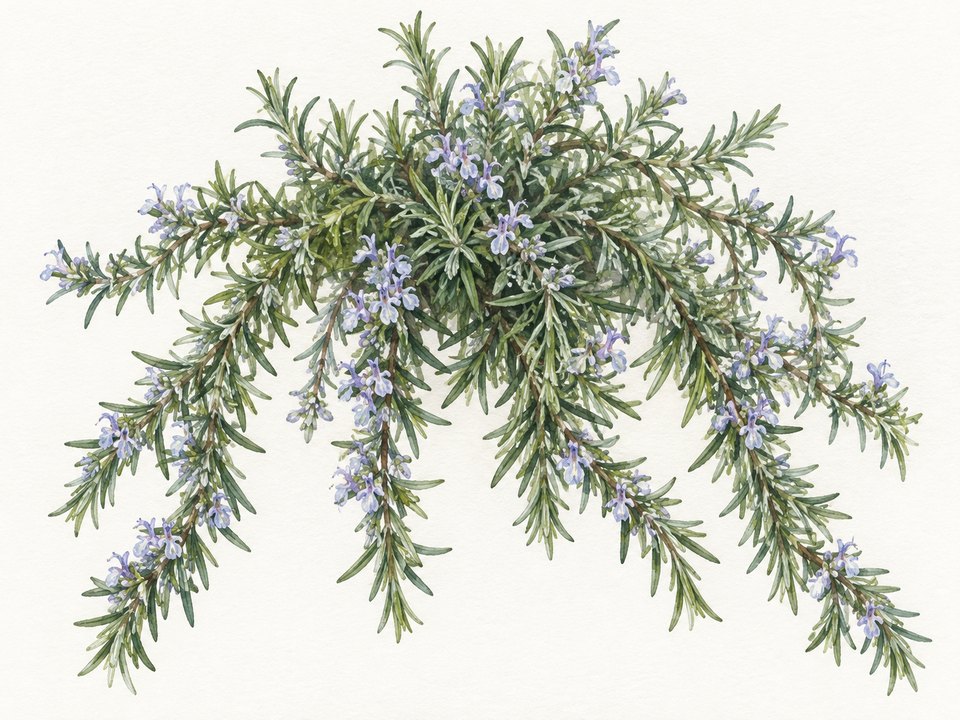
It is evergreen with periodic clusters of lavender-blue flowers. Its leaves are fragrant and edible. Prostrate varieties are used as groundcover.[2]
When to Plant Rosemary (trailing)
Plant Rosemary (trailing) in fall or early spring in Central Texas. A fall planting establishes roots through the cool season. The plant is ready to grow and bloom the following year. Spring planting works too if you water through the first summer.[3]
If you would like a hand, the Texas Allied Landscape team can plant your Rosemary (trailing) and keep it thriving.
Planting
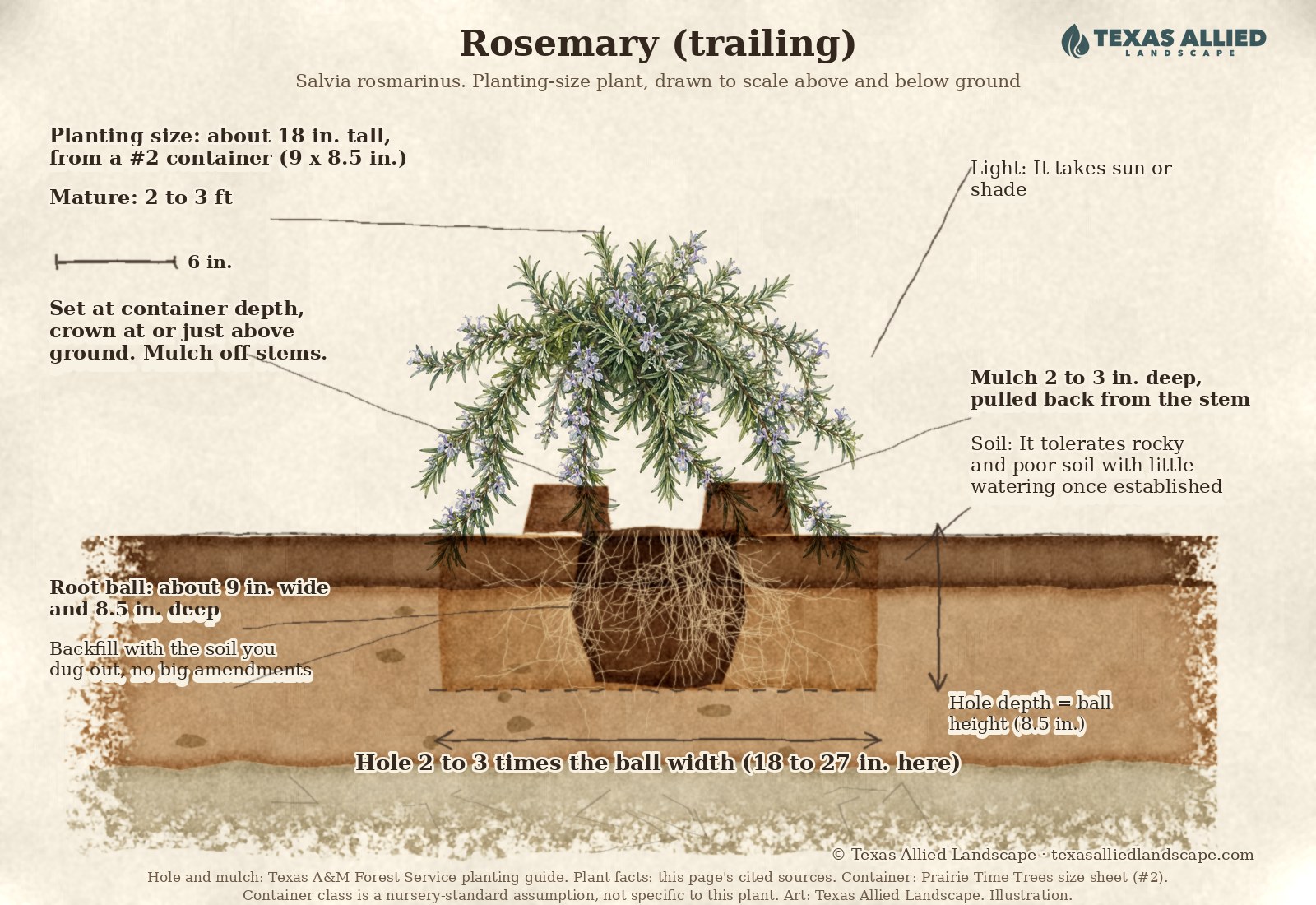
- Dig a hole twice as wide as the pot and no deeper, with sloping sides. Set the plant at the same depth it grew in its pot. Loosen any circling roots before backfilling.[4]
- For a new bed, clear grass and weeds first, roots and all.[4]
- For the site, it takes sun or shade. It performs best in full sun.[1]
- For timing, a fall planting establishes roots through the cool season. The plant is ready to grow and bloom the following year. Spring planting works too if you water through the first summer.[3]
- Soak it well at planting and keep watering while the roots establish.[4]
- Mulch 2 to 4 inches, kept a few inches away from the stems to prevent crown rot. It needs no staking or other support.[4]
Is trailing rosemary cold hardy?
Trailing rosemary is normally strongly evergreen. But few plants survived the extended freeze of 2021 in central Texas. Treat severe freezes as a real risk, not a certainty of loss.
Care Instructions for Your Rosemary (trailing)
How to Water a Rosemary (trailing)
Its water needs are low, with little watering once established.
Sunlight
It takes sun or shade. It performs best in full sun.[1]
Soil and drainage
It tolerates rocky and poor soil with little watering once established. It needs good drainage.
Mature height and spread
Trailing rosemary can still grow 2-3 ft tall and wide. It spreads 2-3 ft wide as a groundcover.
Pruning
Clip back lightly in spring and summer to shape. Never remove more than one-fourth of a branch in a growing season.
Normal seasonal behavior
It is evergreen with periodic clusters of lavender-blue flowers. Its leaves are fragrant and edible. Prostrate varieties are used as groundcover.[2]
Trailing rosemary questions
Is trailing rosemary cold hardy in Central Texas?
Yes in most winters - it is an established landscape herb here, though a hard freeze can damage it; good drainage is the key to surviving winter.[5]
Can you cook with trailing rosemary?
Absolutely - same species as upright rosemary (now Salvia rosmarinus), just a cascading habit.[6]
Why is my rosemary dying?
Nine times out of ten it is wet roots - rosemary demands sharp drainage and deep, infrequent water.[7]
Next step: Our horticulturalists can replant it high in gritty soil on a dry zone.
Where does trailing rosemary look best?
Spilling over a wall or raised bed edge in full sun - that is the whole point of the trailing form.[8]
Let Texas Allied Landscape care for your Rosemary (trailing)
Rosemary (trailing) does best with steady, knowledgeable care: the right water, pruning at the right time, and a trained eye for stress. The horticulturists at Texas Allied Landscape care for plants like yours across the San Antonio area, backed by over 40 years of landscape experience.
In these community guides

Illustration. Illustration based on reference photos of Redbird Ranch. Not a single literal view. Redbird Ranch Landscaping
Bring your survey and yard ideas. Texas Allied Landscape helps design planting and irrigation, prepare the review…

Illustration. Illustration based on reference photos of Arbors of Fair Oaks. Not a single literal view. Arbors of Fair Oaks Landscaping
Bring your address, unit and yard ideas. Texas Allied Landscape helps design the planting and irrigation, prepare the…

Illustration. Illustration based on reference photos of Rogers Ranch - Point Bluff and other neighborhoods. Not a single literal view. Rogers Ranch Landscaping
Plan your Rogers Ranch landscape with lawn, tree and irrigation guidance. Get help with the review package, approved…

Illustration. Illustration based on reference photos of Shavano Rogers Ranch - Crosstimber. Not a single literal view. Crosstimber Landscaping
Plan your Crosstimber plants, shade and irrigation. Get help matching your lot rules, preparing the review package and…
Sources
- Rosemary (Trailing), San Antonio Water System - Garden Style San Antonio.https://www.gardenstylesanantonio.com/plants/rosemary-trailing/abc
- Easy Gardening - Rosemary, Texas A&M AgriLife Extension.https://aggie-horticulture.tamu.edu/wp-content/uploads/sites/10/2013/09/EHT039.pdfab
- October Gardening Checklist, Travis County AgriLife Extension.https://travis-tx.tamu.edu/about-2/horticulture/monthly-gardening-calendar-for-austin-area/october-gardening-checklist-for-austin-and-central-texas/ab
- Back to basics: Planting perennials, SAWS Garden Style San Antonio.https://www.gardenstylesanantonio.com/garden-articles/back-to-basics-planting-perennials/abcd
- Texas A&M AgriLife Extension, "Easy Gardening: Rosemary."https://mytexas.ag.tamu.edu/publications/easy-gardening-rosemary/↑
- Garden Style San Antonio, "Rosemary, Trailing."https://www.gardenstylesanantonio.com/plants/rosemary-trailing/↑
- Texas Master Gardeners, "Rosemary."https://txmg.org/brazos/rosemary-article/↑
- Garden Style San Antonio, "Rosemary, Trailing."https://www.gardenstylesanantonio.com/plants/rosemary-trailing/↑