
Property owners
Texas Lantana
- Plant
- Texas Lantana
- Botanical name
- Lantana urticoides
- Group
- Medium shrubs and perennials
Texas Lantana (Lantana urticoides): light, water, soil, size and care for San Antonio area landscapes.
On this page
Botanical name: Lantana urticoides.
Light
Soil and drainage
Poor, well-drained soils.
Height
Up to about 6 ft, often shorter; another source gives 3-5 ft.
Spread
4-5 ft.
Foliage
Deciduous.
Water
Low water. If watering ever feels like a guessing game, our horticulturists can care for your Texas Lantana on a schedule that fits your yard.
Pruning
In winter, some gardeners prune lantana back to keep plants from getting too large.
Seasonal behavior
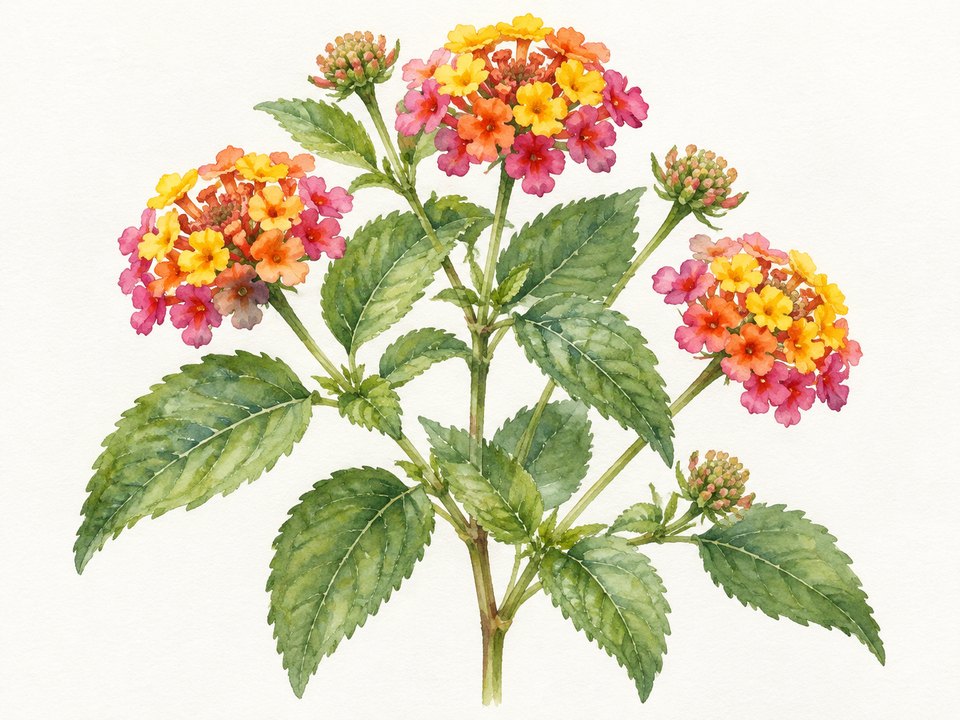
Summer color; yellow-to-orange blooms Apr-Oct; black drupe fruit. Stems become thorny with age - a placement caution. Another source notes Texas lantana's yellow-to-orange flowers distinguish it from the creamy-to-pink Lantana camara, with much hybridization between them in the trade.[3]
When to Plant Texas Lantana
Texas Lantana is frost-tender, so plant it in spring after the last frost, around mid-March in San Antonio. It needs warm months ahead to establish, and it often dies back to the roots in winter.
If you would like a hand, the Texas Allied Landscape team can plant your Texas Lantana and keep it thriving.
Planting
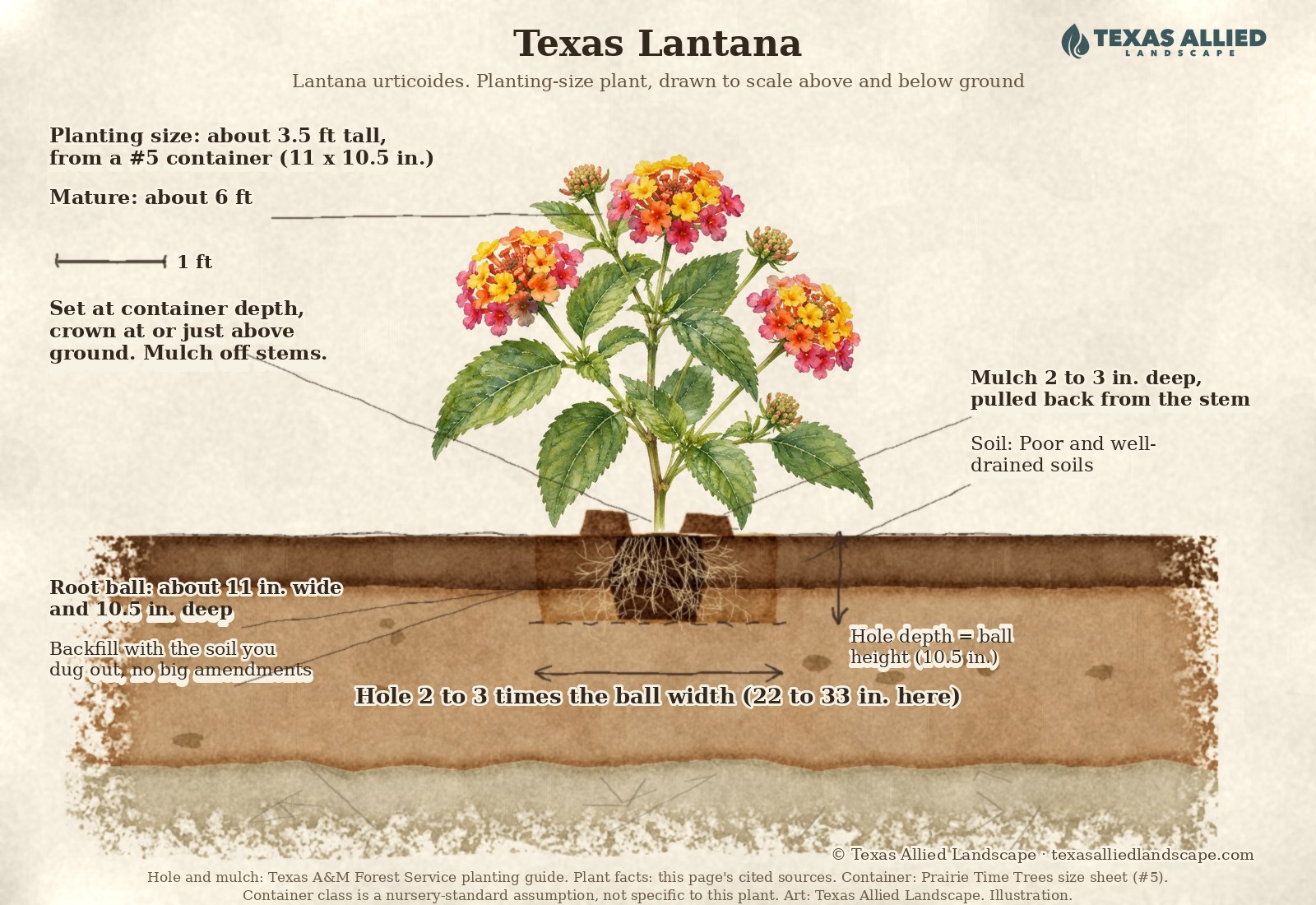
- Dig a hole twice as wide as the pot and no deeper, with sloping sides, and set the plant at the same depth it grew in its pot. Loosen any circling roots before backfilling.[4]
- For a new bed, clear grass and weeds first, roots and all.[4]
- Timing: Texas Lantana is frost-tender, so plant it in spring after the last frost, around mid-March in San Antonio.
- Soak it well at planting and keep watering while the roots establish.[4]
- Mulch 2 to 4 inches, kept a few inches away from the stems to prevent crown rot. It needs no staking or other support.[4]
How is Texas lantana different from the bedding lantanas?
Texas lantana (L. urticoides) flower color varies from yellow to orange, while Lantana camara flowers are creamy and turn pink as they age - and there is much hybridization between the two in the trade. L. urticoides is the native.[5]
Care Instructions for Your Texas Lantana
How to Water a Texas Lantana
Low water.
Sunlight
Soil and drainage
Poor, well-drained soils.
Mature height and spread
Up to about 6 ft, often shorter; another source gives 3-5 ft. 4-5 ft.
Pruning
In winter, some gardeners prune lantana back to keep plants from getting too large.
Normal seasonal behavior
Summer color; yellow-to-orange blooms Apr-Oct; black drupe fruit. Stems become thorny with age - a placement caution. Another source notes Texas lantana's yellow-to-orange flowers distinguish it from the creamy-to-pink Lantana camara, with much hybridization between them in the trade.[3]
Texas lantana questions
Is Texas lantana different from nursery lantana?
Yes - Lantana urticoides is our tough native, with orange-red-yellow clusters, and it comes back from the roots after freezes that kill the tropical bedding lantanas.[6]
When do I cut back Texas lantana?
Late winter, to a few inches - it blooms on new growth, and shearing keeps it dense and covered in flowers.[7]
Next step: Our horticulturalists can do the annual cutback with your other natives.
Is Texas lantana deer resistant?
Yes - the rough, aromatic foliage is deer-resistant and the flowers feed butterflies all summer.[8]
Is lantana poisonous?
The green berries are toxic if eaten - trim seed heads where kids or pets graze.[9]
Let Texas Allied Landscape care for your Texas Lantana
Texas Lantana does best with steady, knowledgeable care: the right water, pruning at the right time, and a trained eye for stress. The horticulturists at Texas Allied Landscape care for plants like yours across the San Antonio area, backed by over 40 years of landscape experience.
In these community guides
Illustration. Illustration based on reference photos of Arbors of Fair Oaks. Not a single literal view. Arbors of Fair Oaks Landscaping
Bring your address, unit and yard ideas. Texas Allied Landscape helps design the planting and irrigation, prepare the…
- Art in progress
Cordillera Ranch Landscaping
Bring your address, survey and yard ideas. We check the right guideline set, plan planting and irrigation, prepare the…
Illustration. Illustration based on reference photos of Johnson Ranch. Not a single literal view. Johnson Ranch Landscaping
Share your Johnson Ranch address, survey and yard ideas. Texas Allied Landscape can help plan planting, irrigation and…
Sources
- Lantana urticoides (Texas lantana), Lady Bird Johnson Wildflower Center.https://www.wildflower.org/plants/result.php?id_plant=laur2ab
- Lantana, Texas, City of Austin Watershed Protection Grow Green.https://www.austintexas.gov/watershed-protection/plant-guide/lantana-texasab
- Differences between Lantana urticoides and Lantana camara, Lady Bird Johnson Wildflower Center - Ask Mr. Smarty Plants.https://www.wildflower.org/expert/show.php?id=8479ab
- Back to basics: Planting perennials, SAWS Garden Style San Antonio.https://www.gardenstylesanantonio.com/garden-articles/back-to-basics-planting-perennials/abcd
- Plant native Lantana urticoides and not non-native Lantana, Lady Bird Johnson Wildflower Center - Ask Mr. Smarty Plants.https://www.wildflower.org/expert/show.php?id=10749↑
- Native Plant Society of Texas, "Texas Lantana."https://www.npsot.org/posts/texas-lantana-a-n-i-c-e-plant-for-a-hot-summer/↑
- City of Austin Grow Green plant guide, "Lantana, Texas."https://www.austintexas.gov/watershed-protection/plant-guide/lantana-texas↑
- Dallas County Master Gardeners, "Texas Lantana."https://dallascountymastergardeners.org/texas-lantana/↑
- City of Austin Grow Green plant guide, "Lantana, Texas."https://www.austintexas.gov/watershed-protection/plant-guide/lantana-texas↑