
Property owners
Texas Redbud Care and Planting Guide
- Plant
- Texas Redbud
- Botanical name
- Cercis canadensis
- Group
- Ornamental trees
Keep your Texas redbud healthy with practical planting, watering and seasonal care for San Antonio and the Hill Country. Learn what leaf drop can mean and when your tree needs help.
On this page
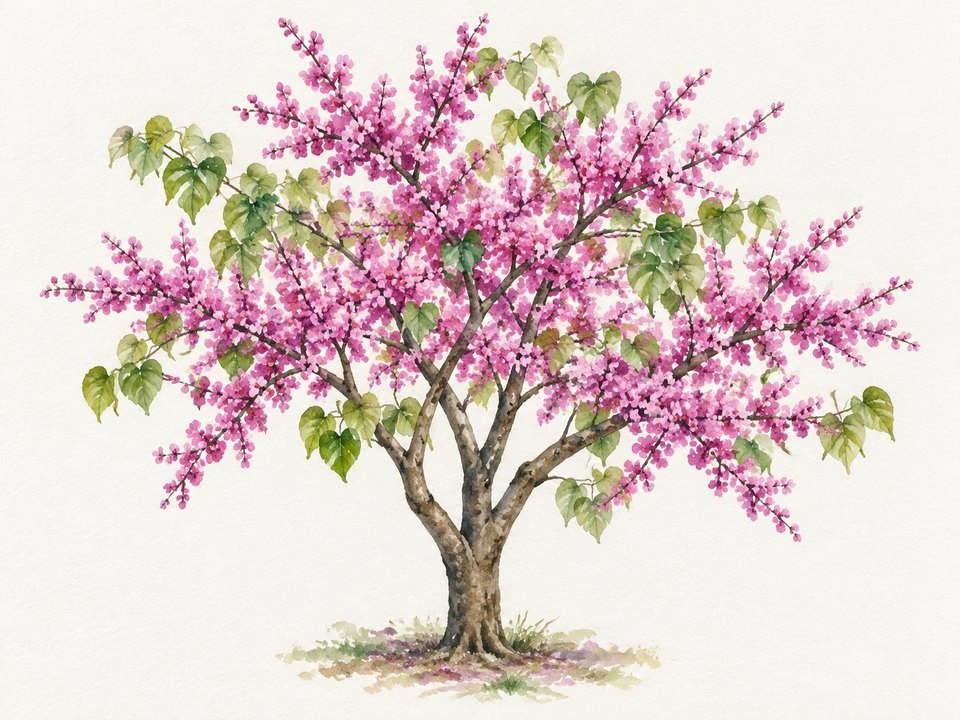
Texas redbud brings pink-purple flowers to your yard before its spring leaves open. Give it a well-drained spot, help its roots establish, and adjust watering to the weather. Texas Allied Landscape helps you choose the right location. We also help keep your tree healthy through the seasons.[1] [2]
Texas Redbud Growing Conditions
Texas redbud, Cercis canadensis var. texensis, is a deciduous small tree. It commonly reaches 15-20 feet tall. It grows in sun or part shade. Afternoon shade can help it through San Antonio summers. Allow room for the mature canopy and choose soil that drains well.[1] [2]
Established trees have low water needs. A newly planted redbud needs regular moisture checks while its roots grow into the surrounding soil. Avoid a spot that stays wet. Also avoid a spot that receives the lawn's irrigation whether the tree needs it or not.[1] [2] [3]
When to Plant Texas Redbud
Late winter and early spring are good times to select and plant Texas redbud in San Antonio. Flowering nursery stock lets you see the bloom color. Fall is another useful tree-planting season in Central Texas. Its cooler conditions help roots establish. Choose a time when you can keep up with watering and your soil drains properly.[1] [4] [3]
Texas Redbud in Central Texas. Supported planting windows: late winter, early spring.
- WinterLate winterSupported window: late part
- SpringEarly springSupported window: early part
- SummerNo supported window
- FallNo supported window
Weather and soil move these windows. Plant when the ground is workable, not frozen or waterlogged, and avoid a hot spell or a hard freeze.
Source: Texas A&M AgriLife Extension, Bexar County: Texas Redbud. Checked 2026-11-10.
How to Plant and Care for a New Texas Redbud
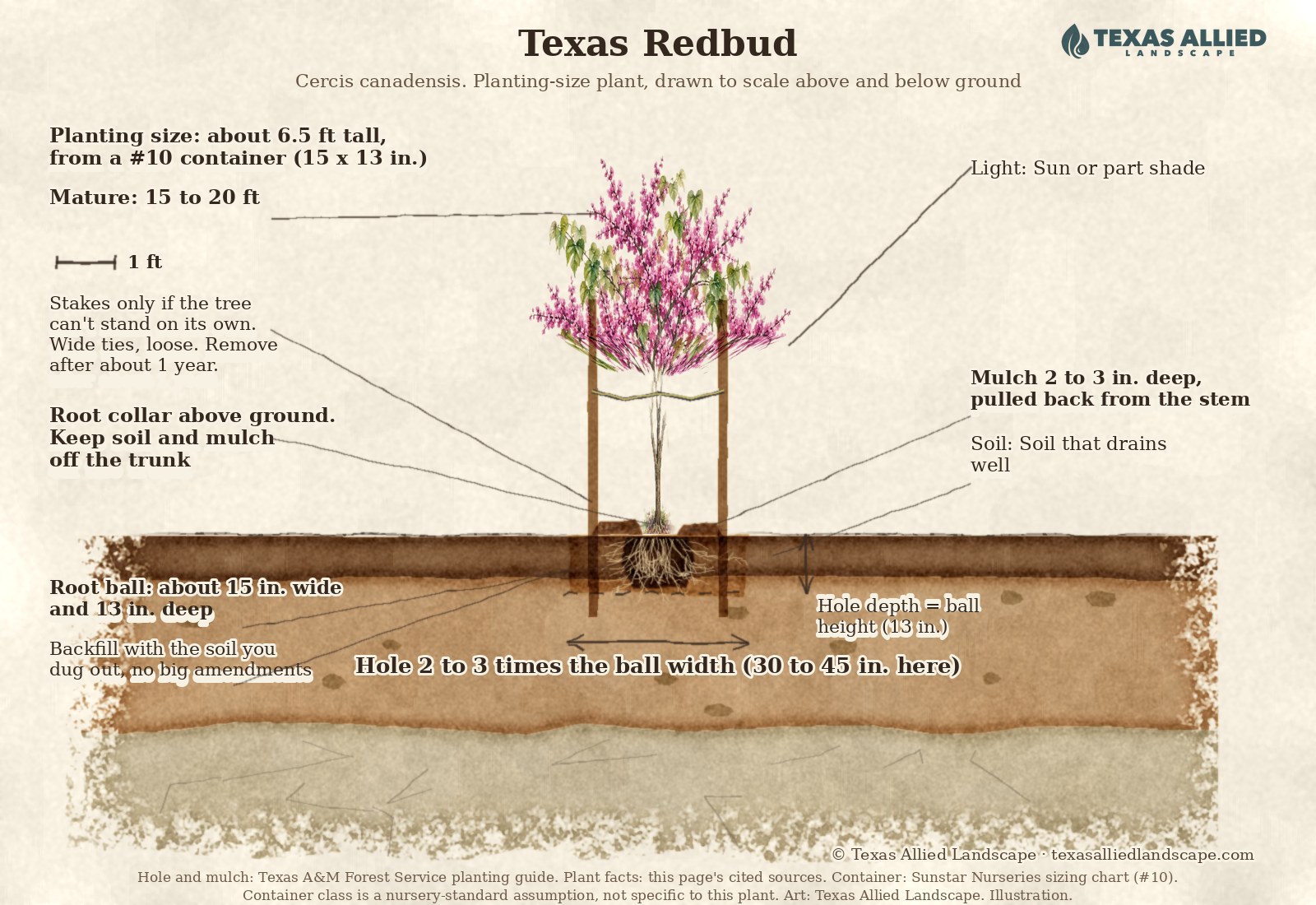
- Dig a hole at least twice as wide as the root ball and no deeper.
- Set the root collar at or slightly above the surrounding ground. Keep soil and mulch off the trunk.
- Backfill with the soil you removed, without added amendments. Water to settle the soil rather than packing it hard.
- Spread mulch 2-3 inches deep around the tree, leaving the trunk clear.
- Check moisture through the first two years. Water the root area thoroughly when needed, then let the soil drain. Adjust for rain, heat, soil and local watering restrictions. Do not follow a fixed daily timer.
- Skip fertilizer during the first growing season. Remove broken or dead branches. Avoid unnecessary pruning while roots establish.[3]
Texas Redbud Fertilizer and Soil Testing
A soil test helps you choose fertilizer only when your yard needs it. Nearby lawn fertilizer may already supply nutrients to your tree. Extra fertilizer does not fix poor drainage, incorrect planting depth or drought stress. Avoid feeding a stressed tree simply because its leaves look unhealthy.[5] [6] [7]
Herbicides and Pre-emergents Around Texas Redbud
Mulch helps reduce competition from weeds. Before using a herbicide or pre-emergent, check the exact product label. Look for the plant, landscape use, application method and whether the tree is newly planted or established. Products with the same active ingredient can have different directions. A general "ornamentals" description is not a blanket promise that a product will suit your redbud.[3] [8]
New transplants and tender spring growth can have extra restrictions. Keep the product's label with you and follow its directions. Ask Texas Allied Landscape to review your tree and the exact product before treatment. Do not use a fertilizer-and-weed-control combination as a substitute for checking both uses.[8] [9]
Plants Similar to Texas Redbud
Mexican redbud has smaller, wavier leaves and can tolerate more drought. Eastern redbud is more vulnerable to drought stress and sunscald in this region. Choose for your yard's conditions. Check the community's exact plant name before treating one as a substitute for another.[1] [2]
Care Instructions for Your Texas Redbud
How to Water a Texas Redbud
Watering
Texas redbud is deciduous, so seasonal leaf loss is normal. Leaves dropping during hot, dry weather can also be a sign of stress. That is especially true with wilting, yellowing or brown tips. Leaf drop alone does not tell you the cause or mean your tree is dead.[1] [7]
Check when the change started, how much of the canopy is affected and whether the root area is dry or staying wet. If the soil is dry, give the root area a thorough watering within local restrictions and reassess. If it remains saturated, do not keep adding water. Persistent dieback or uncertainty about whether the tree is alive deserves an arborist's assessment.[3] [7]
Sunlight and soil
Start with moisture, drainage and recent heat rather than fertilizer. Drought can cause wilting, yellowing and brown leaf tips. Unnecessary fertilizer can add stress. Note any recent planting, irrigation changes or nearby chemical use. Have the tree checked if the problem continues.[3] [7]
Growing in Central Texas
Yes. Texas redbud is an understory tree. It handles part shade well and actually appreciates afternoon shade in the hottest Central Texas exposures. It blooms heaviest with a few hours of direct sun.[10]
Pruning and maintenance
Texas redbud blooms on older wood in spring. Pruning late in winter can remove flower-bearing wood. Keep routine pruning light. Focus on the tree's shape or unwanted suckers. Get help with damaged, dying or hazardous branches.[2] [11]
Winter and cold
The usual reasons are age, shade and weather. Young redbuds can take a few years to set their first big bloom. A tree in heavy shade blooms lightly. A hard late freeze can take out the flower buds after they swell.[12]
Pests, disease, and problems
Redbuds are prone to canker diseases that kill individual limbs while the rest of the tree looks fine. Prune dead limbs back to healthy wood. Disinfect pruners between cuts. Keep the tree watered through summer so it can wall off the infection.[13]
Qualification: Dieback that keeps spreading to new limbs can mean the trunk or roots are involved, not just the branch.
Texas Redbud care questions
Why is my Texas redbud dropping leaves?
Texas redbud is deciduous, so seasonal leaf loss is normal. Leaves dropping during hot, dry weather can also be a sign of stress. That is especially true with wilting, yellowing or brown tips. Leaf drop alone does not tell you the cause or mean your tree is dead.[1] [7]
Check when the change started, how much of the canopy is affected and whether the root area is dry or staying wet. If the soil is dry, give the root area a thorough watering within local restrictions and reassess. If it remains saturated, do not keep adding water. Persistent dieback or uncertainty about whether the tree is alive deserves an arborist's assessment.[3] [7]
My leaves are wilting or turning brown at the edges. Should I fertilize?
Why should I avoid pruning late in winter?
Why didn't my redbud bloom?
The usual reasons are age, shade and weather. Young redbuds can take a few years to set their first big bloom. A tree in heavy shade blooms lightly. A hard late freeze can take out the flower buds after they swell.[12]
Next step: A redbud planted in the right spot blooms reliably. Our horticulturalists can site, plant and care for your redbud so it puts on a show every spring.
Why are limbs dying on my redbud?
Redbuds are prone to canker diseases that kill individual limbs while the rest of the tree looks fine. Prune dead limbs back to healthy wood. Disinfect pruners between cuts. Keep the tree watered through summer so it can wall off the infection.[13]
Keep in mind: Dieback that keeps spreading to new limbs can mean the trunk or roots are involved, not just the branch.
Next step: If dieback reaches the trunk or more than a limb or two, have our horticulturalists assess whether the tree can be saved.
Does Texas redbud grow in shade?
Yes. Texas redbud is an understory tree. It handles part shade well and actually appreciates afternoon shade in the hottest Central Texas exposures. It blooms heaviest with a few hours of direct sun.[10]
Get Help with Texas Redbud Care
Tell Texas Allied Landscape your address, when the tree was planted and what you are seeing. Photos of the whole tree, affected leaves and the soil around the trunk help us plan the next step. We can help with planting, irrigation and a care plan suited to your yard.
Community rules
No community rule is on file for this. A community saying nothing is not permission: check with its architectural committee before you plant.
In these community guides
Illustration. Illustration based on reference photos of Arbors of Fair Oaks. Not a single literal view. Arbors of Fair Oaks Landscaping
Bring your address, unit and yard ideas. Texas Allied Landscape helps design the planting and irrigation, prepare the…
- Art in progress
Cordillera Ranch Landscaping
Bring your address, survey and yard ideas. We check the right guideline set, plan planting and irrigation, prepare the…
Illustration. Illustration based on reference photos of Shavano Rogers Ranch - Crosstimber. Not a single literal view. Crosstimber Landscaping
Plan your Crosstimber plants, shade and irrigation. Get help matching your lot rules, preparing the review package and…
Illustration. Illustration based on reference photos of The Dominion. Not a single literal view. The Dominion Landscaping
Plan your Dominion landscape with help on planting, irrigation and the ACC package. We check your lot's standards and…
Sources
- Texas A&M AgriLife Bexar County, Texas Redbudhttps://bexar-tx.tamu.edu/homehort/archives-of-weekly-articles-davids-plant-of-the-week/texas-redbud/abcdefg
- City of Austin, Grow Green, Redbud, Texashttps://www.austintexas.gov/department/grow-green/plant-guide/redbud-texasabcdef
- Texas A&M Forest Service, Plantinghttps://tfsweb.tamu.edu/trees/tree-care/planting/abcdefgh
- Travis County AgriLife, October Gardening Checklisthttps://travis-tx.tamu.edu/about-2/horticulture/monthly-gardening-calendar-for-austin-area/october-gardening-checklist-for-austin-and-central-texas/↑
- AgriLife Today, soil testing, March 27, 2025https://agrilifetoday.tamu.edu/2025/03/27/boost-plant-growth-with-a-simple-soil-test/↑
- AgriLife Earth-Kind, Fertilizing Woody Ornamentalshttps://aggie-horticulture.tamu.edu/earthkind/landscape/fertilizing-woody-ornamentals/↑
- Texas A&M Forest Service, Drought and treeshttps://tfsweb.tamu.edu/drought-and-trees-explained/abcdefg
- EPA, Directions for usehttps://www.epa.gov/pesticide-labels/label-review-training-module-2-parts-label-page-8ab
- EPA, Prodiamine 65WG 53883-429, June 5, 2025 label, printed pp.8-9 (example of product-specific transplant and new-growth restrictions, not a redbud product recommendation)https://www3.epa.gov/pesticides/chem_search/ppls/053883-00429-20250605.pdf↑
- UC Davis Arboretum, "Texas redbud - Cercis canadensis var. texensis."https://campusgrown.ucdavis.edu/tree-database/texas-redbud-cercis-canadensis-var-texensisab
- Native Plant Society of Texas, Texas Redbudhttps://www.npsot.org/posts/native-plant/cercis-canadensis-var-texensis/ab
- Lady Bird Johnson Wildflower Center, Mr. Smarty Plants.https://www.wildflower.org/expert/show.php?id=3573ab
- Ask Extension, "Redbud dying."https://ask.extension.org/kb/faq.php?id=877937ab