
Property owners
Carolina Jessamine
- Plant
- Carolina Jessamine
- Botanical name
- Gelsemium sempervirens
- Group
- Vines
Sourced light, water, pruning and safety details for Carolina Jessamine.
On this page
Botanical name: Gelsemium sempervirens. Also called Yellow Jessamine.[1]
Safety first
Flowers, leaves and roots are poisonous and can be fatal if eaten by people or livestock. Sap can irritate skin. Wear gloves when pruning. This is not an edible jasmine.[1][2]
Light, soil and water
Sun to partial shade; best flowering in full sun. The Wildflower Center lists medium water use and moist, well-drained soil. SAWS labels it low-water but still advises mulch to hold soil moisture. These are different ratings, not a reason to let the root zone dry out completely.[1][2]
Size and flowers
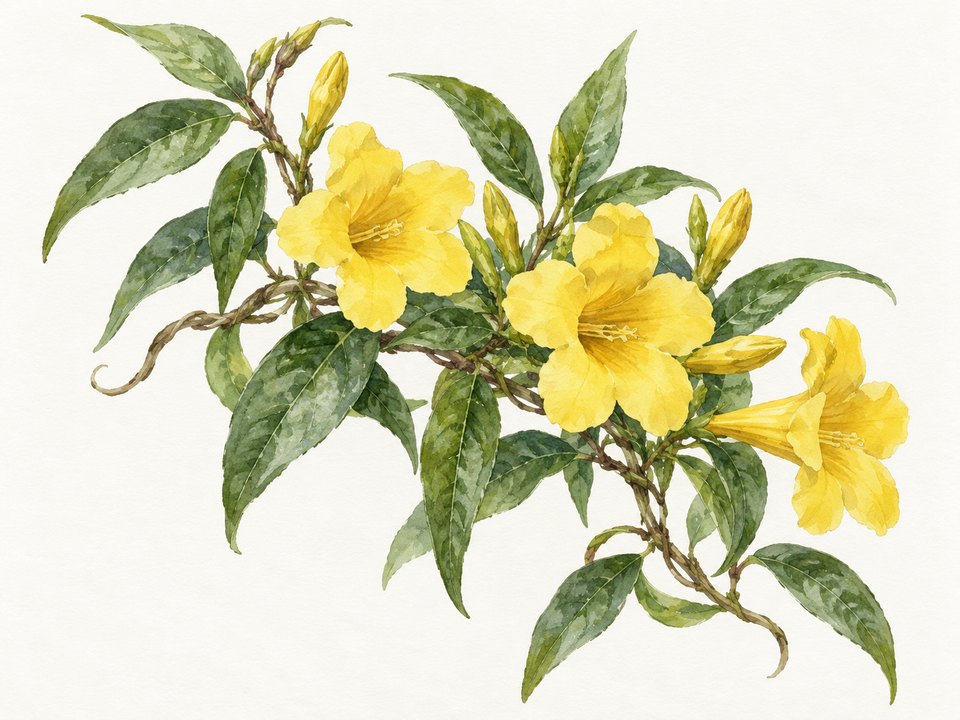
An evergreen twining vine, usually 10 to 20 feet long. It can pile over nearby trees and structures. Fragrant yellow trumpet flowers usually appear in early spring, with some repeat bloom in fall.[1][2]
Pruning
Local guidance says to prune by hand in spring after blooming, then again in summer as needed. Where possible, remove unwanted stems back to their base.[2]
When to Plant Carolina Jessamine
Plant Carolina Jessamine in fall or spring in Central Texas, when cooler weather lets the roots establish before the vine has to support top growth through summer heat.[3]
If you would like a hand, the Texas Allied Landscape team can plant your Carolina Jessamine and keep it thriving.
Planting
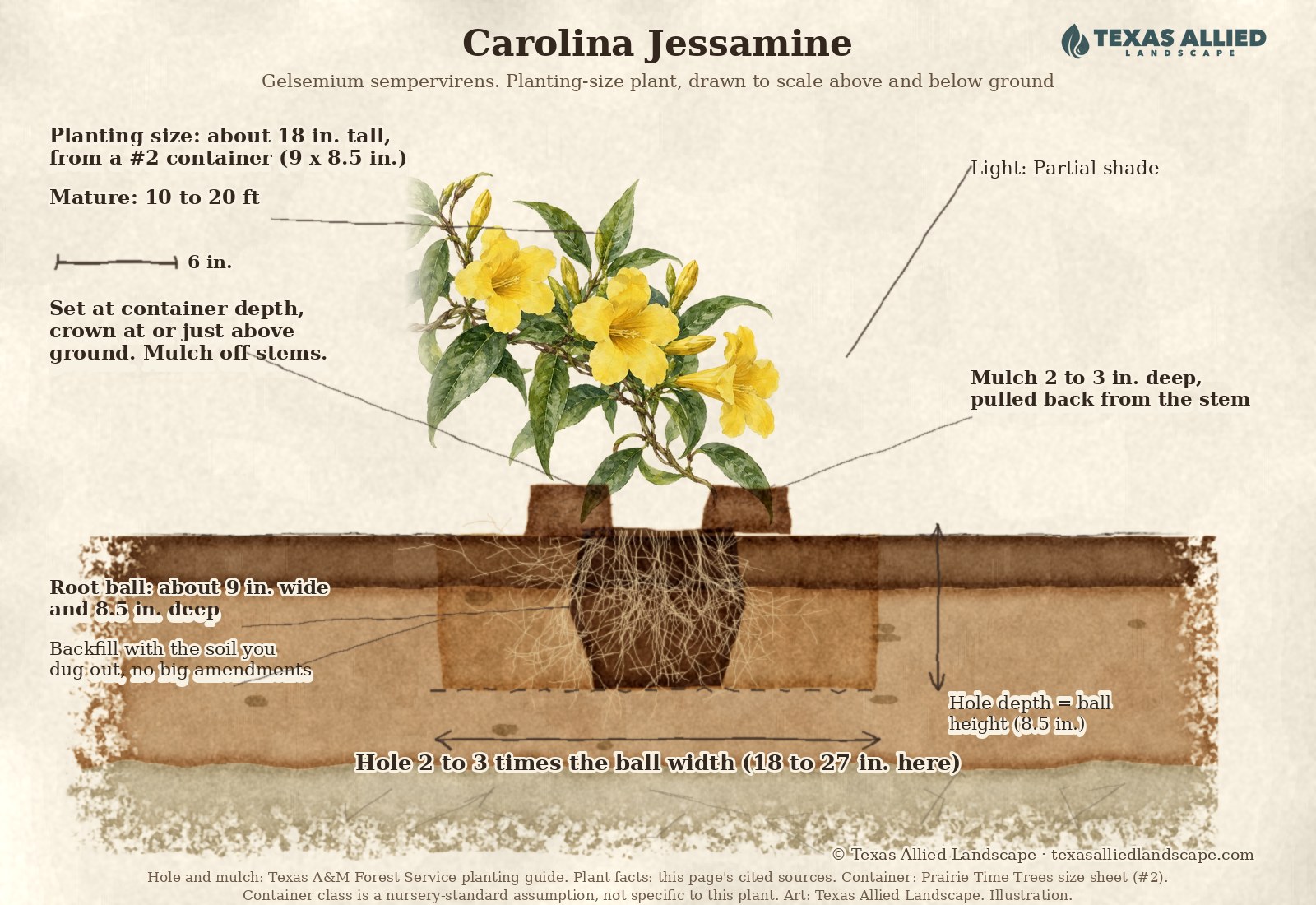
- Dig a hole twice as wide as the pot and no deeper, with sloping sides, and set the plant at the same depth it grew in its pot. Loosen any circling roots before backfilling.[4]
- Support: plant it at the base of whatever it should climb - a trellis, fence or arbor - so it can take hold from the start.
- Timing: Plant Carolina Jessamine in fall or spring in Central Texas, when cooler weather lets the roots establish before the vine has to support top growth through summer heat.[3]
- Soak it well at planting and keep watering while the roots establish.[4]
- Mulch 2 to 4 inches, kept a few inches away from the stems to prevent crown rot.[4]
Care Instructions for Your Carolina Jessamine
Sunlight, soil and water
Sun to partial shade; best flowering in full sun. The Wildflower Center lists medium water use and moist, well-drained soil. SAWS labels it low-water but still advises mulch to hold soil moisture. These are different ratings, not a reason to let the root zone dry out completely.[1][2]
Mature height and spread
An evergreen twining vine, usually 10 to 20 feet long. It can pile over nearby trees and structures. Fragrant yellow trumpet flowers usually appear in early spring, with some repeat bloom in fall.[1][2]
Pruning
Local guidance says to prune by hand in spring after blooming, then again in summer as needed. Where possible, remove unwanted stems back to their base.[2]
Carolina jessamine questions
Is Carolina jessamine poisonous?
Yes - all parts of the plant are toxic if eaten, to people and pets. It is fine to grow on a fence or trellis, but keep it away from grazing pets and teach kids not to taste the sweet-smelling flowers.[5]
Why isn't my Carolina jessamine blooming?
It sets its early-spring flowers on old wood. Pruning in fall or winter removes the buds - prune right after the yellow bloom finishes. Heavy shade also cuts flowering.[6]
Does Carolina jessamine take full Texas sun?
Yes, and it also blooms respectably in part shade, which makes it one of the most flexible flowering vines for this area. Full sun gives the heaviest spring show.[7]
Will Carolina jessamine take over my yard?
No - it is a well-mannered native vine. It twines to 12 to 20 feet but does not strangle trees or send up runners like trumpet vine or wisteria. An annual trim after flowering keeps it where you want it.[8]
Next step: Our horticulturalists can train a jessamine onto a fence or arbor and keep it shaped with one visit a year.
Let Texas Allied Landscape care for your Carolina Jessamine
Carolina Jessamine does best with steady, knowledgeable care: the right water, pruning at the right time, and a trained eye for stress. The horticulturists at Texas Allied Landscape care for plants like yours across the San Antonio area, backed by over 40 years of landscape experience.
In these community guides
- Art in progress
Cordillera Ranch Landscaping
Bring your address, survey and yard ideas. We check the right guideline set, plan planting and irrigation, prepare the…
- Art in progress
Homestead Landscaping
Share your Homestead address, survey and yard ideas with Texas Allied Landscape. We help prepare a clear plan for…

Illustration. Illustration based on reference photos of Johnson Ranch. Not a single literal view. Johnson Ranch Landscaping
Share your Johnson Ranch address, survey and yard ideas. Texas Allied Landscape can help plan planting, irrigation and…

Illustration. Illustration based on reference photos of Redbird Ranch. Not a single literal view. Redbird Ranch Landscaping
Bring your survey and yard ideas. Texas Allied Landscape helps design planting and irrigation, prepare the review…

Illustration. Illustration based on reference photos of Rogers Ranch - Point Bluff and other neighborhoods. Not a single literal view. Rogers Ranch Landscaping
Plan your Rogers Ranch landscape with lawn, tree and irrigation guidance. Get help with the review package, approved…
Illustration. Illustration based on reference photos of Shavano Rogers Ranch - Crosstimber. Not a single literal view. Crosstimber Landscaping
Plan your Crosstimber plants, shade and irrigation. Get help matching your lot rules, preparing the review package and…
Sources
- Gelsemium sempervirens, Lady Bird Johnson Wildflower Center.https://www.wildflower.org/plants/result.php?id_plant=geseabcdefg
- Carolina Jessamine, SAWS Garden Style San Antonio.https://www.gardenstylesanantonio.com/plants/carolina-jessamine/abcdefgh
- October Gardening Checklist, Travis County AgriLife Extension.https://travis-tx.tamu.edu/about-2/horticulture/monthly-gardening-calendar-for-austin-area/october-gardening-checklist-for-austin-and-central-texas/ab
- Back to basics: Planting perennials, SAWS Garden Style San Antonio.https://www.gardenstylesanantonio.com/garden-articles/back-to-basics-planting-perennials/abc
- IVIS, "Gelsemium sempervirens: Carolina jessamine (poisonous plants guide)."https://www.ivis.org/library/guide-to-poisonous-house-and-garden-plants/gelsemium-sempervirens-carolina-jessamine↑
- Lady Bird Johnson Wildflower Center, Ask Mr. Smarty Plants on Carolina jessamine.https://www.wildflower.org/expert/show.php?id=7651↑
- City of Austin Grow Green plant guide, "Carolina Jessamine."https://www.austintexas.gov/watershed-protection/plant-guide/carolina-jessamine↑
- City of Austin Grow Green plant guide, "Carolina Jessamine."https://www.austintexas.gov/watershed-protection/plant-guide/carolina-jessamine↑