
Property owners
Flameleaf Sumac
- Plant
- Flameleaf Sumac
- Botanical name
- Rhus copallina
- Group
- Large shrubs
Sourced light, water, size and fall color details for Flameleaf Sumac.
On this page
Its botanical name is Rhus copallina.[1]
Light, soil and water
SAWS lists sun to partial shade, low water use and thin, sandy or clay soils, with very high heat tolerance. NC State Extension says full sun is best because the plant is not very shade tolerant. It also says the plant grows in moist to dry fertile soils and tolerates poor ones, except wet sites.[2][1]
Size and spread
It is deciduous and forms thickets. SAWS lists a width up to 12 feet. NC State describes a native shrub or small tree that spreads by root suckers into large colonies. Give it room or plant it where spreading is welcome.[2][1]
Fall color, flowers and fruit
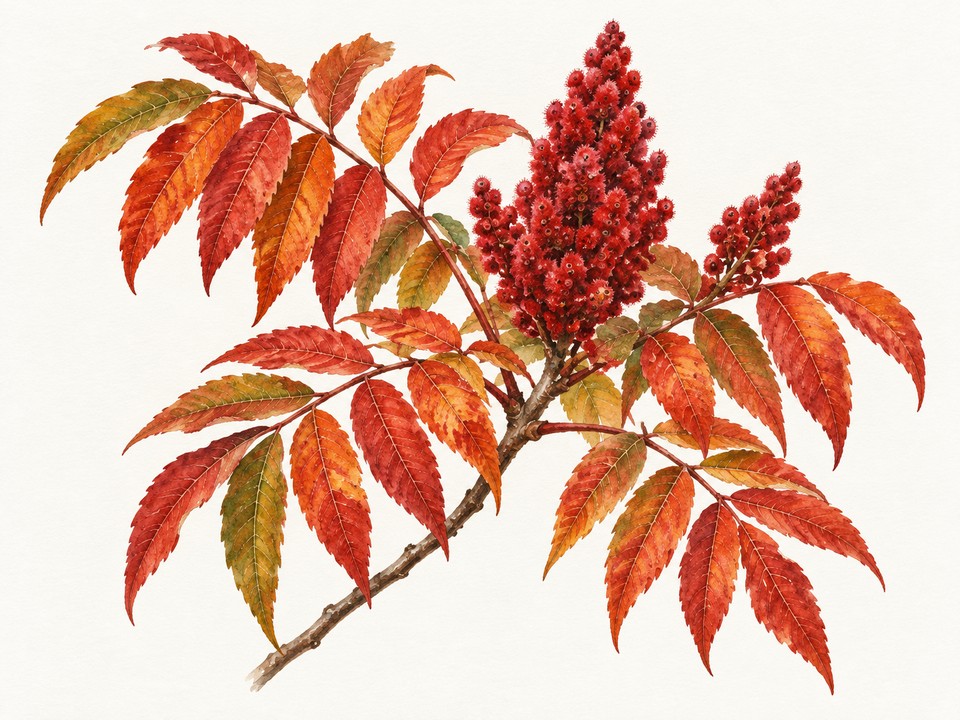
Scarlet and orange fall color is the main reason to plant it. White flowers appear in summer, and red fruit follows in fall and stays into winter. Plants are usually male or female. Both are needed for fruit.[2][1]
Uses and wildlife
SAWS suggests massing or pairing it with native evergreens such as evergreen sumac to form screens. NC State suggests naturalized areas and slopes where it can spread. Birds and mammals eat the fruit. It also hosts the red-banded hairstreak butterfly. Despite the name, neither flameleaf nor evergreen sumac is poisonous.[2][1]
When to Plant Flameleaf Sumac
Fall, October through November, and late winter into early spring are the best times to plant Flameleaf Sumac in Central Texas. Cooler months give the roots time to establish before summer heat.[3]
Container-grown shrubs can go in at other times if you keep up with watering. Avoid planting in the peak of summer.
If you would like a hand, the Texas Allied Landscape team can plant your Flameleaf Sumac and keep it thriving.
Planting
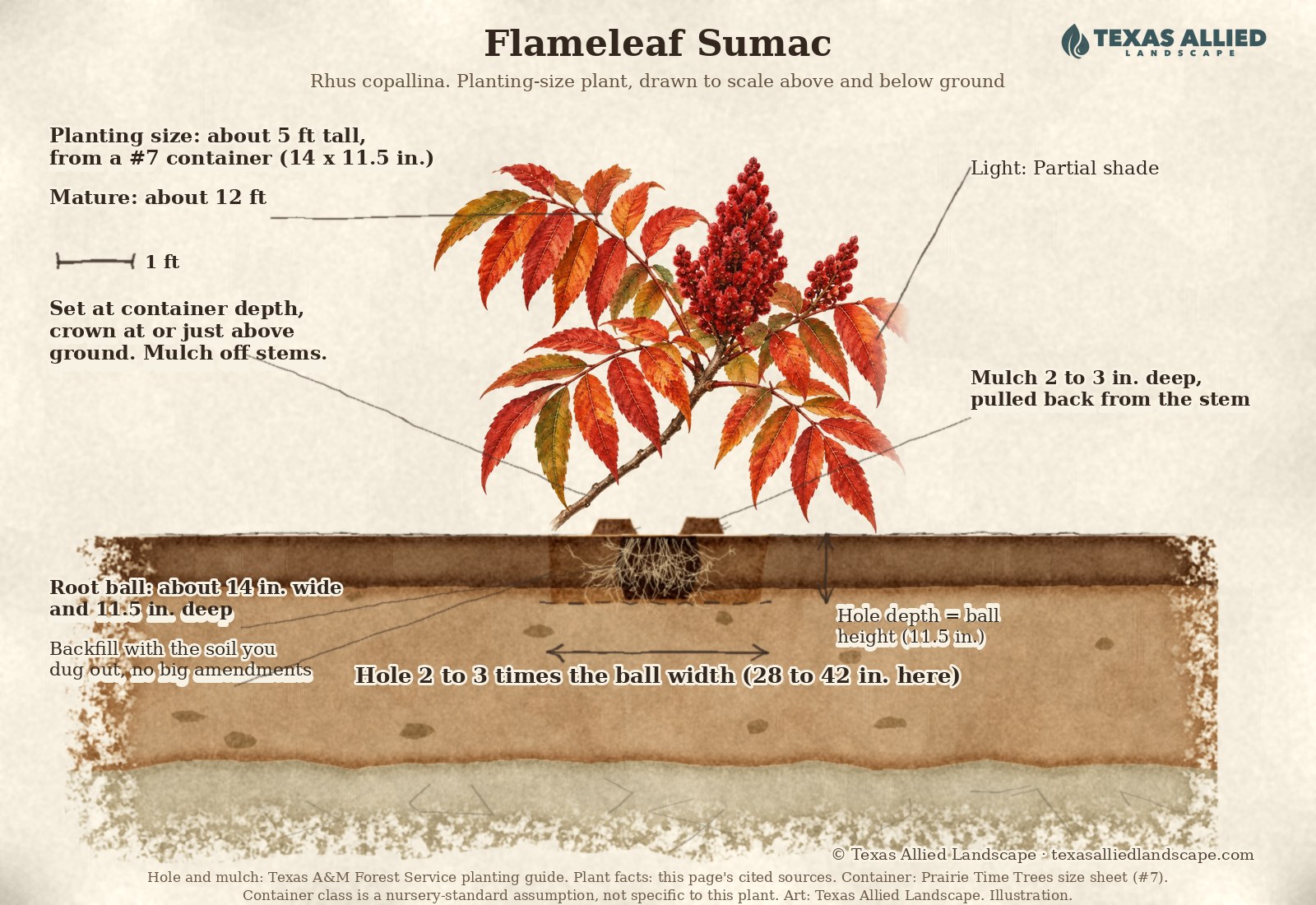
- Dig a hole at least twice as wide as the root ball and no deeper. This lets the roots grow out into the surrounding soil.[4]
- Fill the empty hole with water and check the drainage. If it takes longer than 24 hours to drain, choose another spot. Roots sitting under water will kill the plant.[4]
- Set it with the root collar (where the stems meet the roots) level with the ground. Take off the container and any twine or bags before backfilling.[4]
- Backfill with the same soil that came out of the hole, without amendments. Settle it with water rather than packing it down.[4]
- For soil and light, SAWS lists sun to partial shade, low water use and thin, sandy or clay soils, with very high heat tolerance. NC State Extension says full sun is best because the plant is not very shade tolerant. It also says the plant grows in moist to dry fertile soils and tolerates poor ones, except wet sites.[2][1]
- For timing, fall, October through November, and late winter into early spring are the best times to plant Flameleaf Sumac in Central Texas.
- Water regularly through the first growing season while the roots establish, without overwatering. A thorough soaking beats light, frequent watering.[4]
- Mulch 2 to 3 inches deep, up to but not touching the stems. It needs no staking or other support. Do not fertilize during the first growing season.[4]
Care Instructions for Your Flameleaf Sumac
Sunlight, soil and water
SAWS lists sun to partial shade, low water use and thin, sandy or clay soils, with very high heat tolerance. NC State Extension says full sun is best because the plant is not very shade tolerant. It also says the plant grows in moist to dry fertile soils and tolerates poor ones, except wet sites.[2][1]
Flameleaf sumac questions
Why is flameleaf sumac famous in Texas?
It is famous for the best fall color in the Hill Country. Its compound leaves turn blazing scarlet-orange in November, lighting up limestone slopes.[5]
Is flameleaf sumac a Texas native?
Yes. Rhus copallinum var. lanceolata is a native shrub or small tree of our dry rocky country. It is firewise to boot.[6]
Does flameleaf sumac spread?
It suckers into a thicket or motte over time. That is wonderful for a naturalized screen on a slope, but give it room or plan to thin the suckers.[7]
Is sumac good for wildlife?
Yes. The red berry clusters feed birds into winter, and the flowers work for bees in summer.[8]
Next step: Our horticulturalists can plant flameleaf sumac where its suckering habit becomes a free privacy screen.
Let Texas Allied Landscape care for your Flameleaf Sumac
Flameleaf Sumac does best with steady, knowledgeable care. That means the right water, pruning at the right time, and a trained eye for stress. The horticulturists at Texas Allied Landscape care for plants like yours across the San Antonio area. They bring over 40 years of landscape experience.
In these community guides
Sources
- Rhus copallinum, North Carolina Extension Gardener Plant Toolbox.https://plants.ces.ncsu.edu/plants/rhus-copallinum/abcdefgh
- Flameleaf Sumac, SAWS Garden Style San Antonio.https://www.gardenstylesanantonio.com/plants/flameleaf-sumac/abcdefg
- October Gardening Checklist, Travis County AgriLife Extension.https://travis-tx.tamu.edu/about-2/horticulture/monthly-gardening-calendar-for-austin-area/october-gardening-checklist-for-austin-and-central-texas/↑
- Planting, Texas A&M Forest Service.https://tfsweb.tamu.edu/trees/tree-care/planting/abcdef
- Native Plant Society of Texas, "Plant of the Month: Flame-leaf Sumac."https://www.npsot.org/posts/plant-of-the-month-flame-leaf-sumac/↑
- Texas A&M Forest Service, Trees of Texas, "Flameleaf Sumac."https://texastreeid.tfs.tamu.edu/content/TreeDetails/?id=111↑
- Texas A&M Forest Service, Texas Tree Selector, "Prairie Flameleaf Sumac."https://texastreeplanting.tamu.edu/Display_Onetree.aspx?tid=90↑
- Native Plant Society of Texas, "Plant of the Month: Flame-leaf Sumac."https://www.npsot.org/posts/plant-of-the-month-flame-leaf-sumac/↑