
Property owners
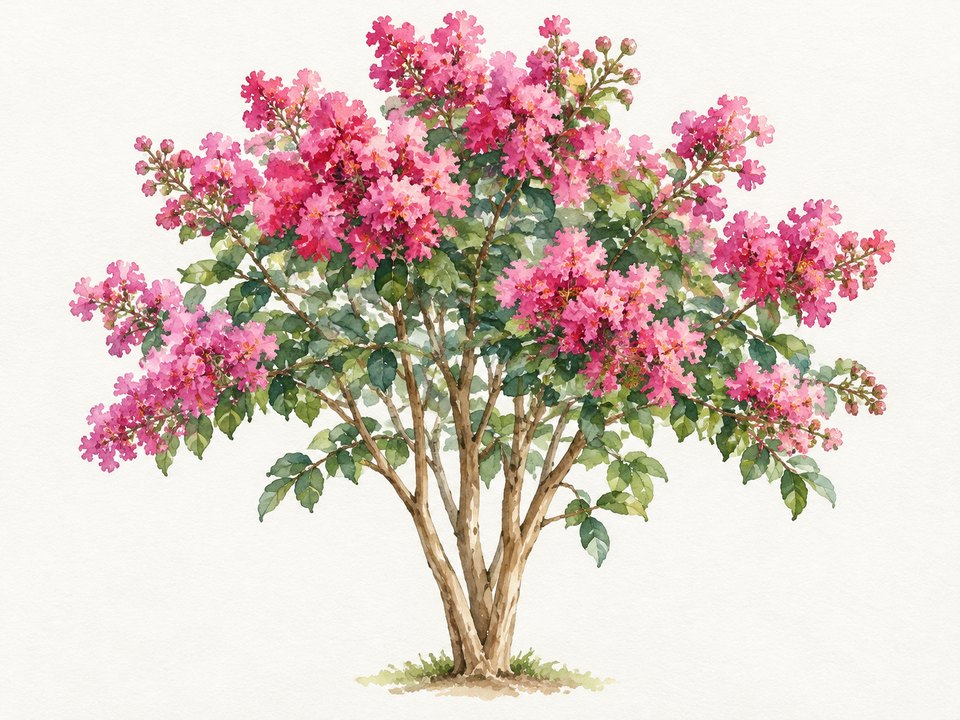
Crape Myrtle
- Plant
- Crape Myrtle
- Botanical name
- Lagerstroemia indica
- Group
- Ornamental trees
Crape Myrtle: light, water, soil, size and care for San Antonio area landscapes.
On this page
Crape myrtle covers many varieties. The notes here are general care for the ones planted in South Texas.
Light
Plant in full sun. Mildew-tolerant hybrids can take partial shade. Sun and good air circulation are the best prevention for mildew and aphids.[1]
Height
Sizes range by variety, from miniatures to 45 feet tall.
Water
Water weekly for the first 3-9 months. Once established, water about twice a month. It is drought-tolerant and low-maintenance. If watering ever feels like a guessing game, our horticulturists can care for your Crape Myrtle on a schedule that fits your yard.
Pruning
Prune very minimally, and never top a crape myrtle.
Seasonal behavior
It blooms all summer. Bloom color ranges from red, coral, pink, and rose to lavender, purple, or white, depending on the variety. The bark ranges from tan to cinnamon. Flowers attract birds and butterflies.
When to Plant Crape Myrtle
In Central Texas, the best time to plant Crape Myrtle is fall through late winter. That is roughly October through February. Cooler weather and fall rains let the roots establish before summer heat arrives.[2]
Container-grown trees can also go in the ground in spring. They can even go in during summer if you can commit to deep, regular watering through the first growing season. Spring and summer planting demand more from you and the tree.
If you would like a hand, the Texas Allied Landscape team can plant your Crape Myrtle and keep it thriving.
Planting
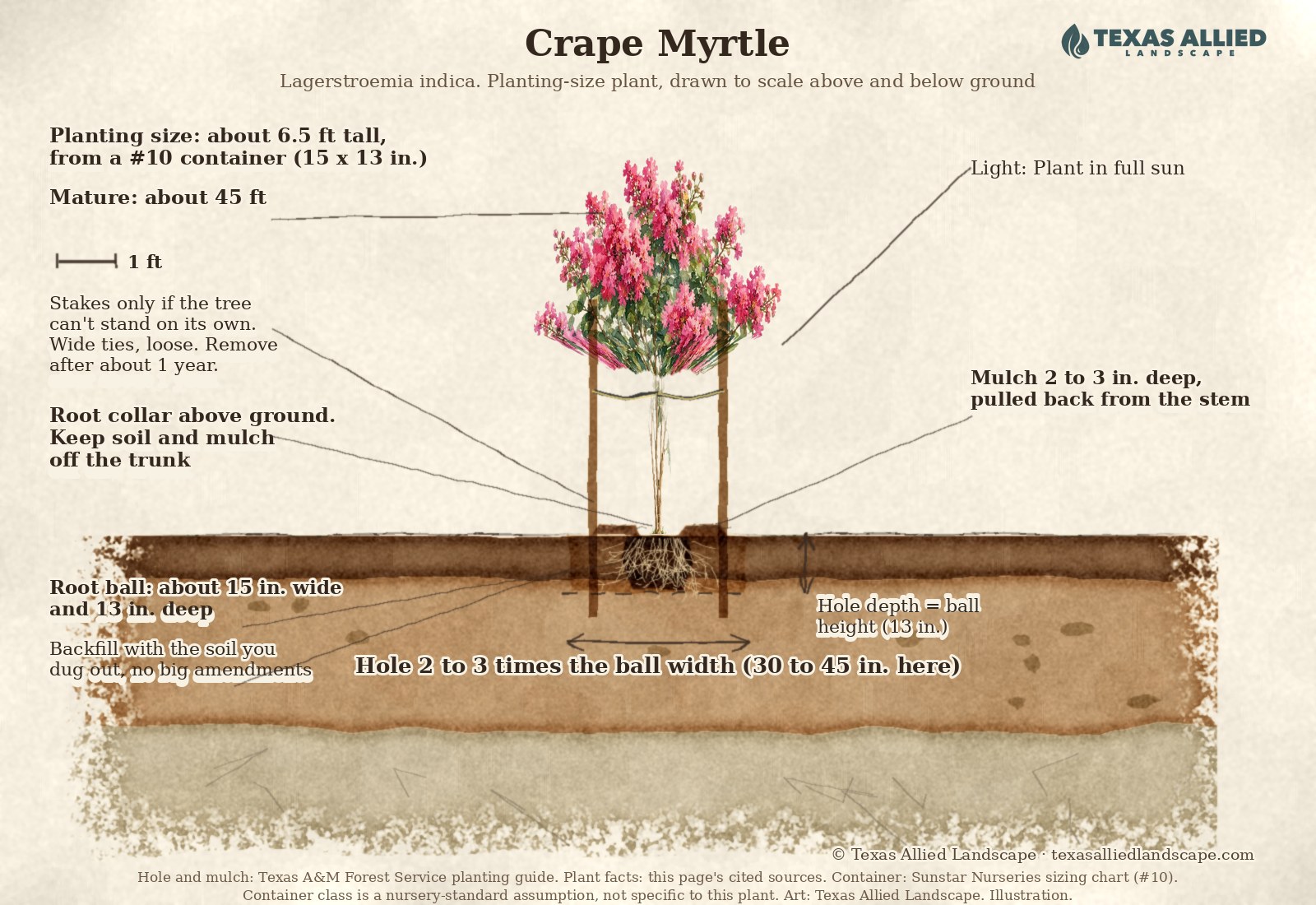
- Dig a hole at least twice as wide as the root ball and no deeper. A square hole keeps the roots from settling too deep. It also lets them grow out into the surrounding soil.[3]
- Fill the empty hole with water and check the drainage. If it takes longer than 24 hours to drain, choose another spot. Roots sitting under water will kill the tree.[3]
- Set it with the root collar (the flare just above the roots) level with or slightly above the ground. Take off all wire, twine, containers and bags before backfilling.[3]
- Backfill with the same soil that came out of the hole, without amendments. Settle it with water rather than packing it down.[3]
- For the site, plant in full sun. Mildew-tolerant hybrids can take partial shade. Sun and good air circulation are the best prevention for mildew and aphids.[1]
- For timing, the best time to plant Crape Myrtle is fall through late winter, roughly October through February. Cooler weather and fall rains let the roots establish before summer heat arrives.[2]
- Water for at least the first two years, without overwatering. A thorough soaking beats light, frequent watering.[3]
- Mulch 2 to 3 inches deep, out to the drip line and up to but not touching the trunk. Stake only if it cannot stand on its own. Take stakes off within a year. Most trees need no support. Do not fertilize during the first growing season.[3]
Care Instructions for Your Crape Myrtle
How to Water a Crape Myrtle
Water weekly for the first 3-9 months. Once established, water about twice a month. It is drought-tolerant and low-maintenance.
Sunlight
Plant in full sun. Mildew-tolerant hybrids can take partial shade. Sun and good air circulation are the best prevention for mildew and aphids.[1]
Mature height and spread
Sizes range by variety, from miniatures to 45 feet tall.
Pruning
Prune very minimally, and never top a crape myrtle.
Normal seasonal behavior
It blooms all summer. Bloom color ranges from red, coral, pink, and rose to lavender, purple, or white, depending on the variety. The bark ranges from tan to cinnamon. Flowers attract birds and butterflies.
Crape myrtle questions
Why won't my crape myrtle bloom?
Sun is the big one. A crape myrtle needs full sun to set flowers. A tree that got shaded out as the yard grew up will bloom less every year. Too much nitrogen fertilizer pushes leaves instead of flowers. And since crape myrtles bloom on new growth, a hard prune at the wrong time costs you a season of flowers.[4]
Next step: Our horticulturalists can tell in one visit whether it is light, feeding or pruning, and get your crape myrtle blooming again.
Should I top my crape myrtle?
No. Topping, sometimes called "crape murder," leaves knobby stubs, weak whippy regrowth and fewer flowers. The right prune is light. Remove suckers, crossing branches and last year's seed heads in late winter. Let the tree keep its natural vase shape.[5]
Next step: If a past topping left your tree misshapen, our horticulturalists can rebuild its structure over a few seasons of corrective pruning.
Is it normal for crape myrtle bark to peel?
Yes, completely normal. Crape myrtles naturally shed thin sheets of bark in summer, showing smooth trunks in cream, tan and cinnamon underneath. It is one of the tree's best features, not a health problem.[6]
What is the white powder or black coating on the leaves?
White powder is powdery mildew, which is common on crape myrtles in humid stretches. A sticky black coating is sooty mold growing on aphid droppings. Both are manageable. Mildew-resistant varieties, good airflow, and washing aphids off with water keep most trees clean.[7]
Keep in mind: Similar symptoms come from different causes, and the treatment differs.
Next step: If mildew or aphids come back every year, our horticulturalists can put the tree on a simple prevention plan.
Let Texas Allied Landscape care for your Crape Myrtle
Crape Myrtle does best with steady, knowledgeable care. That means the right water, pruning at the right time, and a trained eye for stress. The horticulturists at Texas Allied Landscape care for plants like yours across the San Antonio area. They bring over 40 years of landscape experience.
In these community guides

Illustration. Illustration based on reference photos of Arbors of Fair Oaks. Not a single literal view. Arbors of Fair Oaks Landscaping
Bring your address, unit and yard ideas. Texas Allied Landscape helps design the planting and irrigation, prepare the…
- Art in progress
Cordillera Ranch Landscaping
Bring your address, survey and yard ideas. We check the right guideline set, plan planting and irrigation, prepare the…
- Art in progress
Homestead Landscaping
Share your Homestead address, survey and yard ideas with Texas Allied Landscape. We help prepare a clear plan for…

Illustration. Illustration based on reference photos of Johnson Ranch. Not a single literal view. Johnson Ranch Landscaping
Share your Johnson Ranch address, survey and yard ideas. Texas Allied Landscape can help plan planting, irrigation and…
Illustration. Illustration based on reference photos of Rogers Ranch - Point Bluff and other neighborhoods. Not a single literal view. Rogers Ranch Landscaping
Plan your Rogers Ranch landscape with lawn, tree and irrigation guidance. Get help with the review package, approved…
Illustration. Illustration based on reference photos of Shavano Rogers Ranch - Crosstimber. Not a single literal view. Crosstimber Landscaping
Plan your Crosstimber plants, shade and irrigation. Get help matching your lot rules, preparing the review package and…
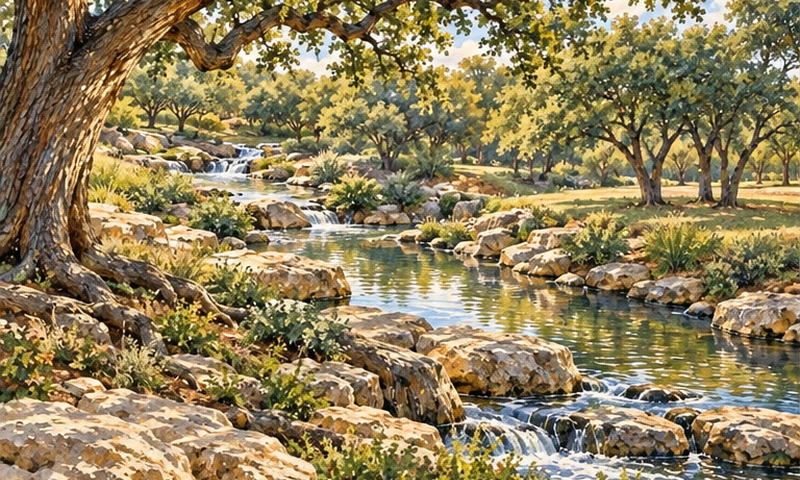
Illustration. Illustration based on reference photos of The Dominion. Not a single literal view. The Dominion Landscaping
Plan your Dominion landscape with help on planting, irrigation and the ACC package. We check your lot's standards and…
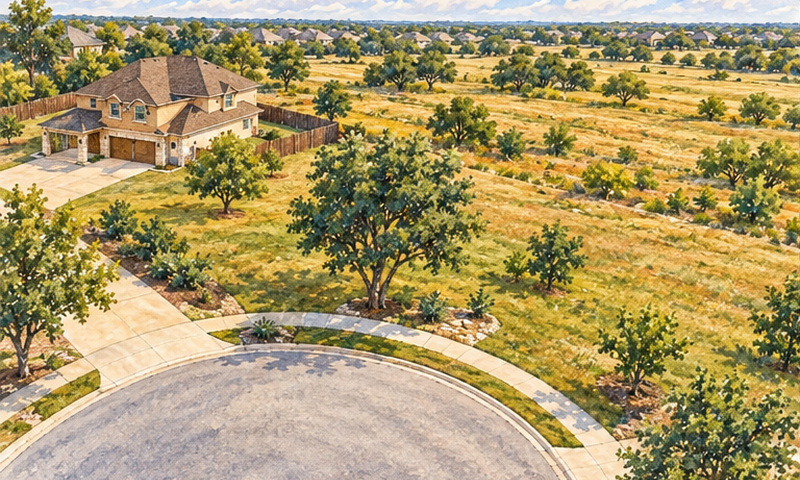
Illustration. Illustration based on reference photos of The Reserve at Schertz II. Not a single literal view. Reserve at Schertz II Landscaping
Plan your Reserve at Schertz II yard with lawn, tree and irrigation guidance. Get help with the review package…
Sources
- Crape Myrtle: Carefree and Colorful, SAWS Garden Style San Antonio.https://www.gardenstylesanantonio.com/garden-articles/crape-myrtle-carefree-and-colorful/abc
- October Gardening Checklist, Travis County AgriLife Extension.https://travis-tx.tamu.edu/about-2/horticulture/monthly-gardening-calendar-for-austin-area/october-gardening-checklist-for-austin-and-central-texas/ab
- Tree Care - Planting, Texas A&M Forest Service.https://tfsweb.tamu.edu/trees/tree-care/planting/abcdef
- Texas Tree Surgeons, "Why is my crape myrtle not blooming?"https://texastreesurgeons.com/blog/2021/03/30/cm-not-blooming/↑
- Clemson Cooperative Extension, "Crape myrtle pruning."https://hgic.clemson.edu/factsheet/crape-myrtle-pruning/↑
- Crape Myrtle Trails of McKinney, "FAQ."https://crapemyrtletrails.org/faq/↑
- University of Arkansas Extension, "Crape myrtle problems."https://www.uaex.uada.edu/counties/white/news/horticulture/crape-myrtle-problems.aspx↑