
Property owners
Evergreen Sumac
- Plant
- Evergreen Sumac
- Botanical name
- Rhus virens
- Group
- Large shrubs
Evergreen Sumac (Rhus virens): light, water, soil, size and care for San Antonio area landscapes.
On this page
Botanical name: Rhus virens.
Light
Sun or partial shade.[1]
Soil and drainage
Thin and clay soils.
Height
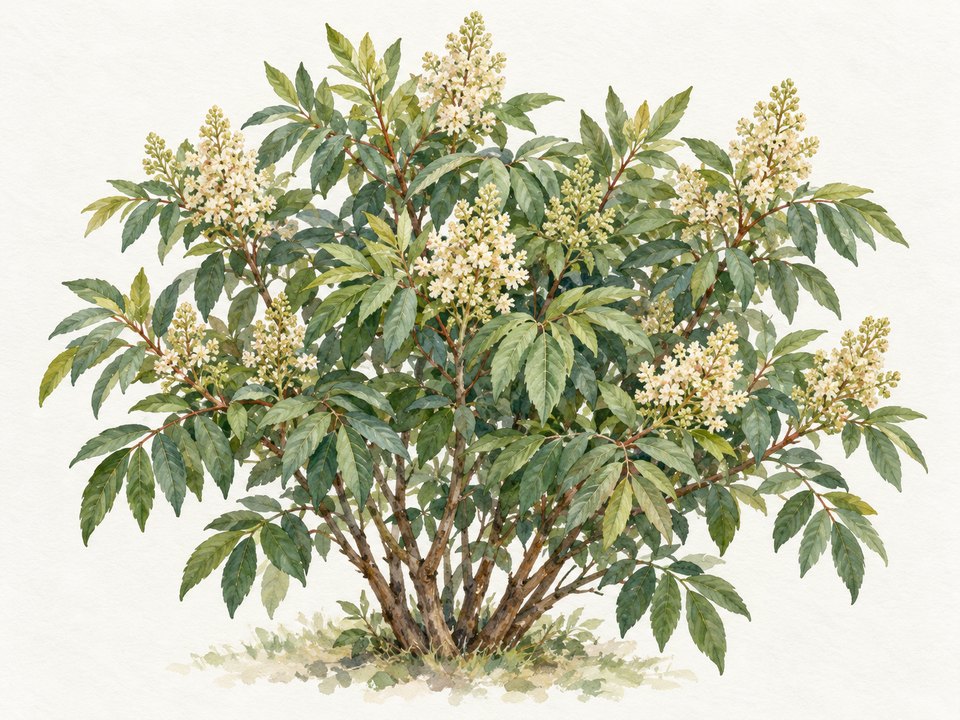
A 6-10-foot shrub or small tree, with size notes up to about 10 feet.[2]
Spread
A maximum of 12 feet.
Foliage
Evergreen in the local profile.
Water
Low Water. If watering ever feels like a guessing game, our horticulturists can care for your Evergreen Sumac on a schedule that fits your yard.
Pruning
No routine maintenance required.
Seasonal behavior
Evergreen and fast growing; white summer flowers followed by red fruit. Handle potted root balls carefully during transplanting to avoid pulling roots loose.
How can I avoid damaging a potted evergreen sumac during planting?
That a loose root ball can come apart if the plant is pulled out of its pot. Support the root ball and avoid tearing it loose. Its profile notes that some landscapers cut the pot away to reduce disturbance; that caution takes priority over generic root-loosening advice.
Why is evergreen sumac dropping old leaves even though it is called evergreen?
Leaves remain green through winter, then are dropped and replaced with a new crop within about a week. It also describes pink-tinged early-spring foliage and maroon after frost. Those seasonal patterns do not explain every episode of prolonged or severe leaf loss.
When to Plant Evergreen Sumac
Fall, October through November, and late winter into early spring are the best times to plant Evergreen Sumac in Central Texas. Cooler months give the roots time to establish before summer heat.[3]
Container-grown shrubs can go in at other times if you keep up with watering, but avoid planting in the peak of summer.
If you would like a hand, the Texas Allied Landscape team can plant your Evergreen Sumac and keep it thriving.
Planting
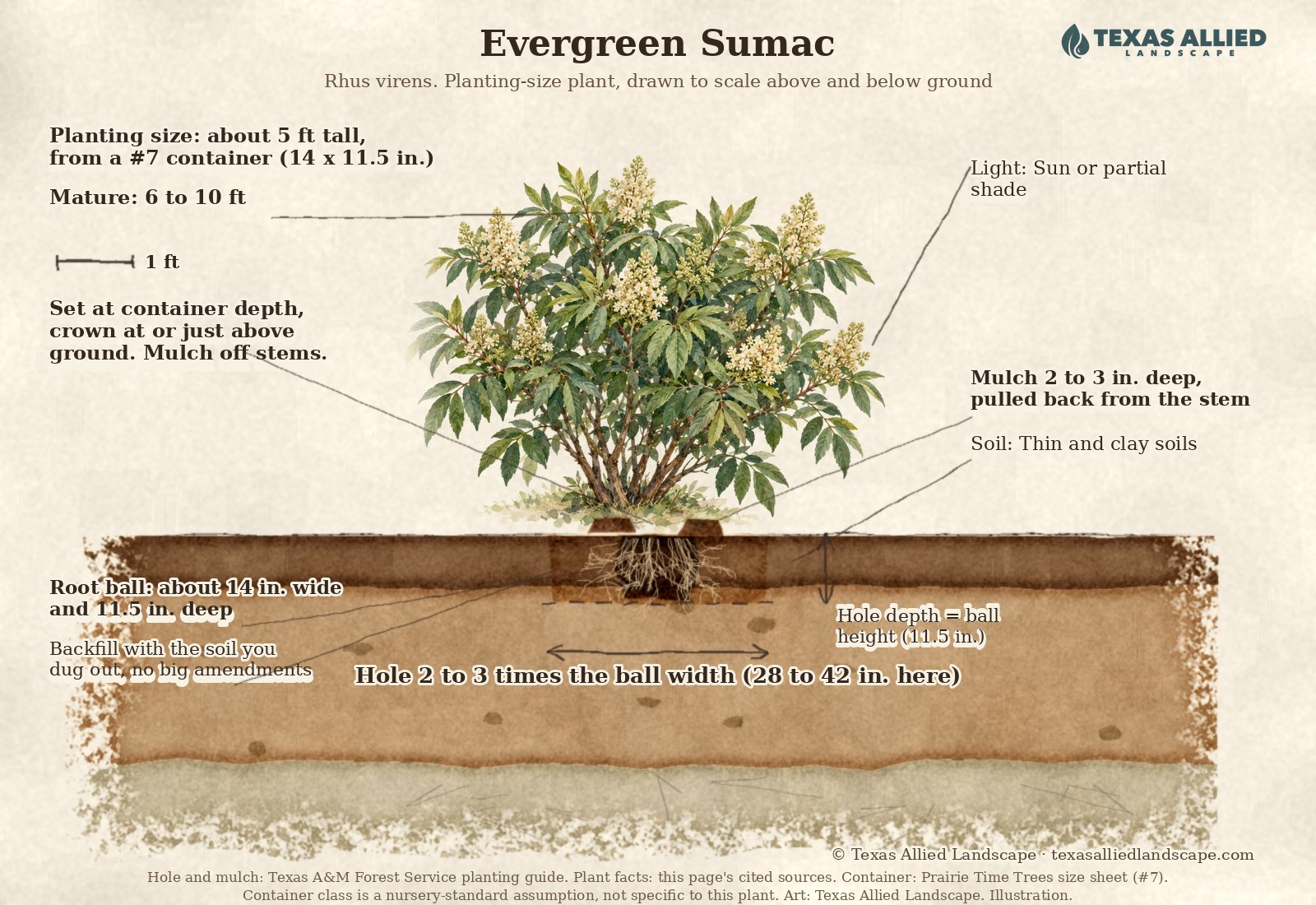
- Dig a hole at least twice as wide as the root ball and no deeper, so the roots can grow out into the surrounding soil.[4]
- Fill the empty hole with water and check the drainage. If it takes longer than 24 hours to drain, choose another spot: roots sitting under water will kill the plant.[4]
- Set it with the root collar (where the stems meet the roots) level with the ground, and take off the container and any twine or bags before backfilling.[4]
- Backfill with the same soil that came out of the hole, without amendments, and settle it with water rather than packing it down.[4]
- Site and soil: Sun or partial shade.[1] Thin and clay soils. A 6-10-foot shrub or small tree, with size notes up to about 10 feet.[2]
- Timing: Fall, October through November, and late winter into early spring are the best times to plant Evergreen Sumac in Central Texas.
- Water regularly through the first growing season while roots establish, without overwatering: a thorough soaking beats light, frequent watering.[4]
- Mulch 2 to 3 inches deep, up to but not touching the stems. It needs no staking or other support. Do not fertilize during the first growing season.[4]
Care Instructions for Your Evergreen Sumac
How to Water an Evergreen Sumac
Low Water.
Sunlight
Sun or partial shade.[1]
Soil and drainage
Thin and clay soils.
Mature height and spread
A 6-10-foot shrub or small tree, with size notes up to about 10 feet.[2] A maximum of 12 feet.
Pruning
No routine maintenance required.
Normal seasonal behavior
Evergreen and fast growing; white summer flowers followed by red fruit. Handle potted root balls carefully during transplanting to avoid pulling roots loose.
Evergreen sumac questions
Is evergreen sumac a Texas native?
Yes - Rhus virens is a Hill Country native and one of our best tough evergreen shrubs.[5]
Is evergreen sumac related to poison ivy?
Distantly, but it does not cause a rash - it is a safe, friendly landscape shrub.[6]
How big does evergreen sumac get?
6-8 feet or more, and it takes shearing - it makes an excellent native screen.[7]
Sun or shade for evergreen sumac?
Both - it is one of the rare evergreens equally happy in full sun or bright shade.[8]
Next step: Our horticulturalists can shape it as a screen or a small tree.
Let Texas Allied Landscape care for your Evergreen Sumac
Evergreen Sumac does best with steady, knowledgeable care: the right water, pruning at the right time, and a trained eye for stress. The horticulturists at Texas Allied Landscape care for plants like yours across the San Antonio area, backed by over 40 years of landscape experience.
In these community guides

Illustration. Illustration based on reference photos of Arbors of Fair Oaks. Not a single literal view. Arbors of Fair Oaks Landscaping
Bring your address, unit and yard ideas. Texas Allied Landscape helps design the planting and irrigation, prepare the…
- Art in progress
Cordillera Ranch Landscaping
Bring your address, survey and yard ideas. We check the right guideline set, plan planting and irrigation, prepare the…
- Art in progress
Homestead Landscaping
Share your Homestead address, survey and yard ideas with Texas Allied Landscape. We help prepare a clear plan for…

Illustration. Illustration based on reference photos of Johnson Ranch. Not a single literal view. Johnson Ranch Landscaping
Share your Johnson Ranch address, survey and yard ideas. Texas Allied Landscape can help plan planting, irrigation and…

Illustration. Illustration based on reference photos of Redbird Ranch. Not a single literal view. Redbird Ranch Landscaping
Bring your survey and yard ideas. Texas Allied Landscape helps design planting and irrigation, prepare the review…

Illustration. Illustration based on reference photos of Rogers Ranch - Point Bluff and other neighborhoods. Not a single literal view. Rogers Ranch Landscaping
Plan your Rogers Ranch landscape with lawn, tree and irrigation guidance. Get help with the review package, approved…

Illustration. Illustration based on reference photos of Shavano Rogers Ranch - Crosstimber. Not a single literal view. Crosstimber Landscaping
Plan your Crosstimber plants, shade and irrigation. Get help matching your lot rules, preparing the review package and…
Sources
- Evergreen Sumac (Rhus virens), Garden Style San Antonio (San Antonio Water System).https://www.gardenstylesanantonio.com/plants/evergreen-sumac/abc
- Rhus virens, Lady Bird Johnson Wildflower Center.https://www.wildflower.org/plants/result.php?id_plant=rhvi3abc
- October Gardening Checklist, Travis County AgriLife Extension.https://travis-tx.tamu.edu/about-2/horticulture/monthly-gardening-calendar-for-austin-area/october-gardening-checklist-for-austin-and-central-texas/↑
- Planting, Texas A&M Forest Service.https://tfsweb.tamu.edu/trees/tree-care/planting/abcdef
- Native Plant Society of Texas, "Rhus virens."https://www.npsot.org/posts/native-plant/rhus-virens/↑
- Native Plant Society of Texas, "Red and Resilient: Texas Native Sumacs."https://www.npsot.org/posts/red-and-resilient-texas-native-sumacs/↑
- Central Texas Gardener, "Evergreen Sumac."https://centraltexasgardener.org/resource/evergreen-sumac/↑
- Central Texas Gardener, "Evergreen Sumac."https://centraltexasgardener.org/resource/evergreen-sumac/↑