
Property owners
Mexican Plum
- Plant
- Mexican Plum
- Botanical name
- Prunus mexicana
- Group
- Ornamental trees
Mexican Plum: sourced light needs, height, spread, foliage, water needs, seasonal behavior and planting.
On this page
Its botanical name is Prunus mexicana.
Light
It grows in sun to part shade.[1]
Height
It reaches 15 ft to 20 ft or more.
Spread
It spreads 15 ft to 20 ft.
Foliage
It is deciduous.
Water
It has low water needs. Give it good drainage and a fair amount of soil. If watering ever feels like a guessing game, our horticulturists can care for your Mexican Plum on a schedule that fits your yard.
Seasonal behavior
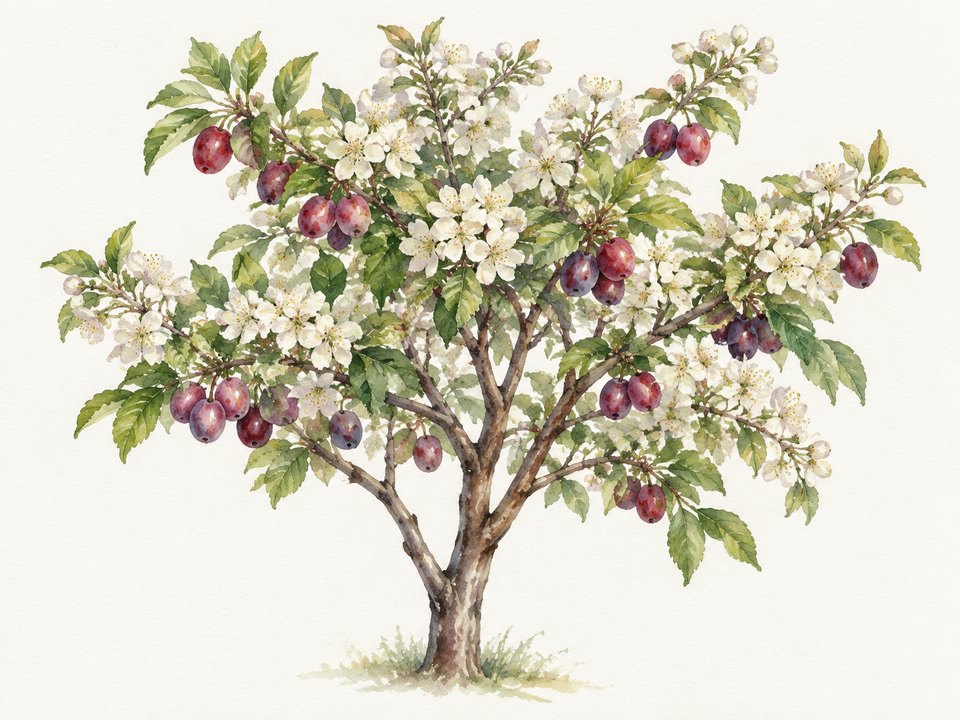
Its white, fragrant flowers are the earliest spring bloomer and a nectar source. Its edible fruit ripens July to September, and it is a butterfly larval host. It is a great understory tree. Prune it to shape or raise the canopy if needed.
Care Instructions for Your Mexican Plum
How to Water a Mexican Plum
It has low water use once established.[2][3] For a newly planted tree of any kind, the Texas A&M Forest Service advises watering for at least the first two years. It recommends a thorough soaking rather than light, frequent watering, and it warns against overwatering.[4]
Region
Mexican Plum is native to both the Blackland Prairie and the Edwards Plateau of Central Texas.[2] Its native range runs from southern Ohio to southeastern South Dakota, south to South Carolina, Alabama, Texas and Mexico. It grows in dry to moist thin woods, river bottoms and prairies. Within Texas it grows mostly in the northeast and north central part of the state.[3]
Sunlight
It grows in sun to part shade.[2][3]
Soil and drainage
Give it good drainage.[2] Soils from dry to moist and well drained suit it, from sandy to clay and limestone-based.[3]
Mature height and spread
The two sources do not agree, so no single maximum is stated.[2][3] The City of Austin lists 15 to 20 feet or more tall and 15 to 20 feet wide.[2] The Lady Bird Johnson Wildflower Center lists 10 to 35 feet tall, often much shorter, and gives no spread.[3]
Pruning
Prune it to shape or raise the canopy if needed.[2]
Normal seasonal behavior
White, fragrant flowers open as the earliest spring bloom and are a source of nectar.[2] The Lady Bird Johnson Wildflower Center gives the bloom time as February through April.[3] Edible fruit ripens from July to September.[2] The tree is deciduous.[2][3]
When to Plant Mexican Plum
In Central Texas, the best time to plant Mexican Plum is fall through late winter, roughly October through February. Cooler weather and fall rains let the roots establish before summer heat arrives.[5]
Container-grown trees can also go in the ground in spring, and even in summer if you can commit to deep, regular watering through the first growing season. Spring and summer planting demand more from you and the tree.
If you would like a hand, the Texas Allied Landscape team can plant your Mexican Plum and keep it thriving.
Planting
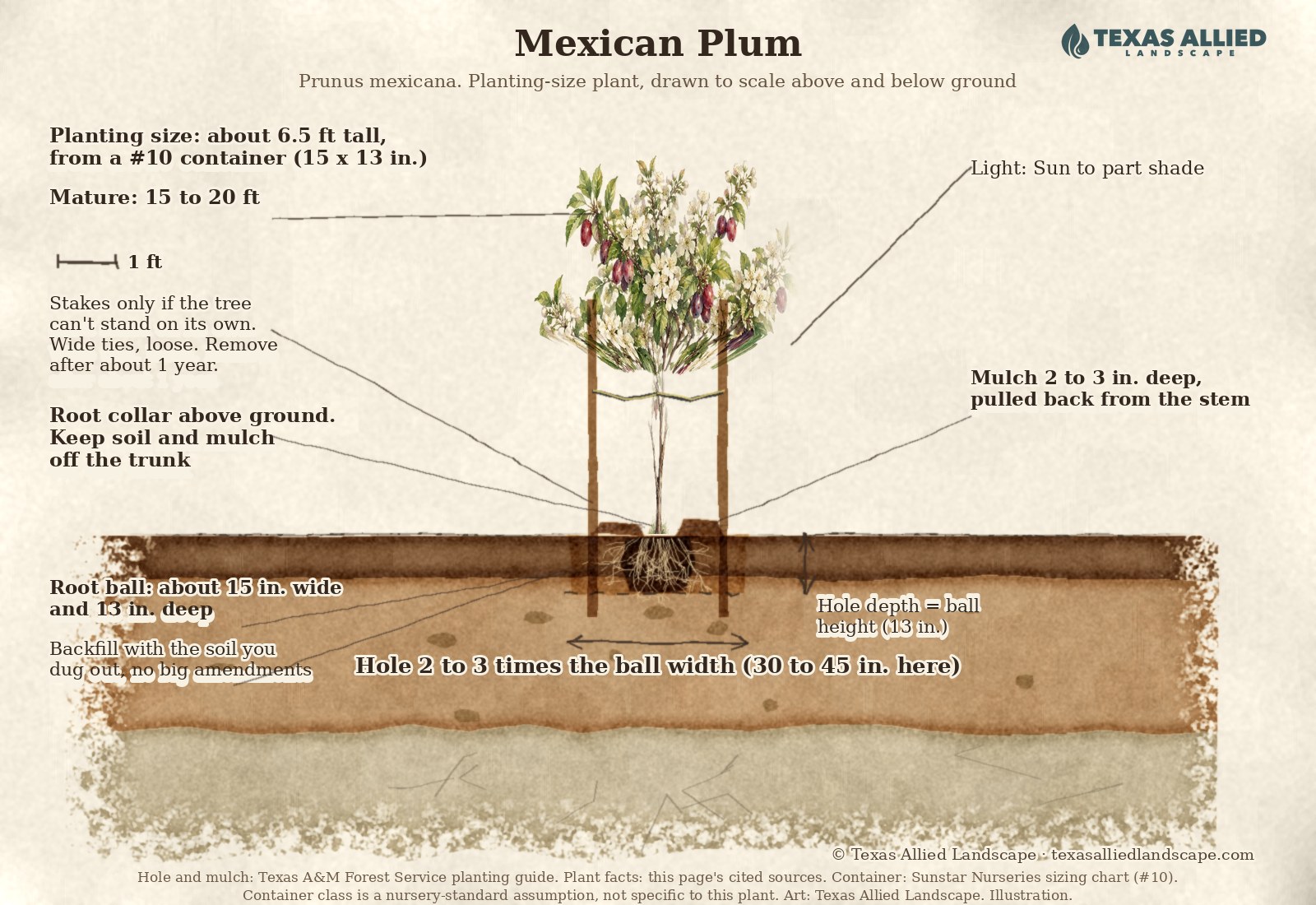
- Dig a hole 2-3 times wider than the root ball and no deeper than the root ball height. Set the tree at the same depth it grew in the container, and water it thoroughly at planting. Keep mulch away from the trunk.[6]
Mexican plum questions
Can you eat Mexican plum fruit?
Yes. The small plums ripen in late summer and are tart right off the tree, and they make excellent jelly and preserves. Leave some for the birds and wildlife, which rely on them.[7]
Why is my Mexican plum sending up shoots from the roots?
Suckering is normal for Mexican plum. The roots send up shoots that can form a thicket over time. Mow or prune the suckers if you want a single-trunk tree, or let them grow if you like a natural screen.[8]
Next step: Our horticulturalists can prune a suckering plum into a clean single-trunk tree and keep it that way with seasonal visits.
When does Mexican plum bloom?
It blooms in very early spring, often late February in Central Texas. Fragrant white flowers cover the bare branches before the leaves come in. That makes it one of the first trees to bloom each year.[9]
Why does my Mexican plum have spots on its leaves?
Plums pick up several leaf spot and fungal issues, especially in wet springs. Most are cosmetic and the tree grows through them once the weather dries. Rake up fallen leaves in autumn so the fungus has less to overwinter in.[10]
Keep in mind: Spots alone do not say which disease it is, and the wrong spray wastes money.
Next step: If the tree loses most of its leaves two years in a row, our horticulturalists can identify the exact issue and treat it correctly.
Let Texas Allied Landscape care for your Mexican Plum
Mexican Plum does best with steady, knowledgeable care. That means the right water, pruning at the right time, and a trained eye for stress. The horticulturists at Texas Allied Landscape care for plants like yours across the San Antonio area. They are backed by over 40 years of landscape experience.
In these community guides

Illustration. Illustration based on reference photos of Redbird Ranch. Not a single literal view. Redbird Ranch Landscaping
Bring your survey and yard ideas. Texas Allied Landscape helps design planting and irrigation, prepare the review…

Illustration. Illustration based on reference photos of Arbors of Fair Oaks. Not a single literal view. Arbors of Fair Oaks Landscaping
Bring your address, unit and yard ideas. Texas Allied Landscape helps design the planting and irrigation, prepare the…
- Art in progress
Cordillera Ranch Landscaping
Bring your address, survey and yard ideas. We check the right guideline set, plan planting and irrigation, prepare the…
- Art in progress
Homestead Landscaping
Share your Homestead address, survey and yard ideas with Texas Allied Landscape. We help prepare a clear plan for…

Illustration. Illustration based on reference photos of Johnson Ranch. Not a single literal view. Johnson Ranch Landscaping
Share your Johnson Ranch address, survey and yard ideas. Texas Allied Landscape can help plan planting, irrigation and…

Illustration. Illustration based on reference photos of Rogers Ranch - Point Bluff and other neighborhoods. Not a single literal view. Rogers Ranch Landscaping
Plan your Rogers Ranch landscape with lawn, tree and irrigation guidance. Get help with the review package, approved…
Illustration. Illustration based on reference photos of Shavano Rogers Ranch - Crosstimber. Not a single literal view. Crosstimber Landscaping
Plan your Crosstimber plants, shade and irrigation. Get help matching your lot rules, preparing the review package and…
Sources
- Mexican Plum, City of Austin Grow Green plant guide.https://www.austintexas.gov/watershed-protection/plant-guide/plum-mexican↑
- City of Austin, Grow Green plant guide: Mexican Plum. Reviewed 2026-11-12https://www.austintexas.gov/watershed-protection/plant-guide/plum-mexicanabcdefghijk
- Lady Bird Johnson Wildflower Center, Native Plant Database: Prunus mexicana (Mexican plum). Reviewed 2026-11-12https://www.wildflower.org/plants/result.php?id_plant=prmeabcdefgh
- Texas A&M Forest Service, Tree Care: Planting. Reviewed 2026-11-12https://tfsweb.tamu.edu/trees/tree-care/planting/ab
- October Gardening Checklist, Travis County AgriLife Extension.https://travis-tx.tamu.edu/about-2/horticulture/monthly-gardening-calendar-for-austin-area/october-gardening-checklist-for-austin-and-central-texas/↑
- Tree Care - Planting, Texas A&M Forest Service.https://tfsweb.tamu.edu/trees/tree-care/planting/↑
- Oklahoma State University Extension, "Mexican plum - Prunus mexicana."https://extension.okstate.edu/programs/plant-id/plant-profiles/mexican-plum/↑
- Texas A&M Forest Service, "Mexican plum - tree details."https://texastreeid.tfs.tamu.edu/content/TreeDetails/?id=85↑
- Lady Bird Johnson Wildflower Center, Mr. Smarty Plants.https://www.wildflower.org/expert/show.php?frontpage=true&id=9540↑
- Texas Plant Disease Handbook, "Plum."https://plantdiseasehandbook.tamu.edu/food-crops/fruit-crops/plum/↑