
Property owners
Turk's Cap
- Plant
- Turk's Cap
- Botanical name
- Malvaviscus arboreus var. drummondii
- Variety
- var. drummondii
- Group
- Medium shrubs and perennials
Turk's Cap (Malvaviscus arboreus var. drummondii): light, water, soil, size and care for San Antonio area landscapes.
On this page
Botanical name: Malvaviscus arboreus var. drummondii.
Light
Part shade to shade preferred; one source says full sun to partial shade; another source lists sun/part shade.[1][2][3]
Soil and drainage
Sandy, loamy, clay, and limestone soils; moist, well-drained woodland soils are best.
Height
Sources differ: 2-6 ft; another source says up to about 10 ft, often shorter.
Spread
3-5 ft.
Foliage
Deciduous.
Water
Medium water use; one source tags it Low Water and another source notes it is drought tolerant. If watering ever feels like a guessing game, our horticulturists can care for your Turk's Cap on a schedule that fits your yard.
Pruning
Can be cut back as needed before it leafs out in spring.
Seasonal behavior
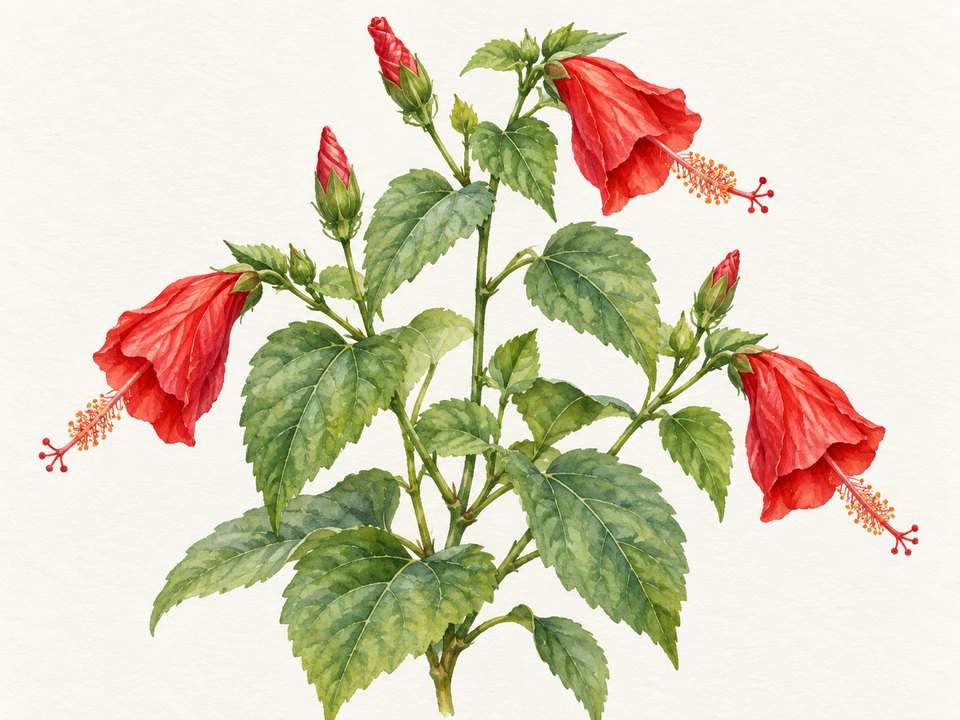
Red turban-shaped blooms May-Nov; dark red 1-inch fruit, with 'Mexican apple' among its common names. Freeze hardy; attracts hummingbirds and butterflies.[4]
When to Plant Turk's Cap
Plant Turk's Cap in fall or early spring in Central Texas. A fall planting establishes roots through the cool season and is ready to grow and bloom the following year; spring planting works too if you water through the first summer.[5]
If you would like a hand, the Texas Allied Landscape team can plant your Turk's Cap and keep it thriving.
Planting
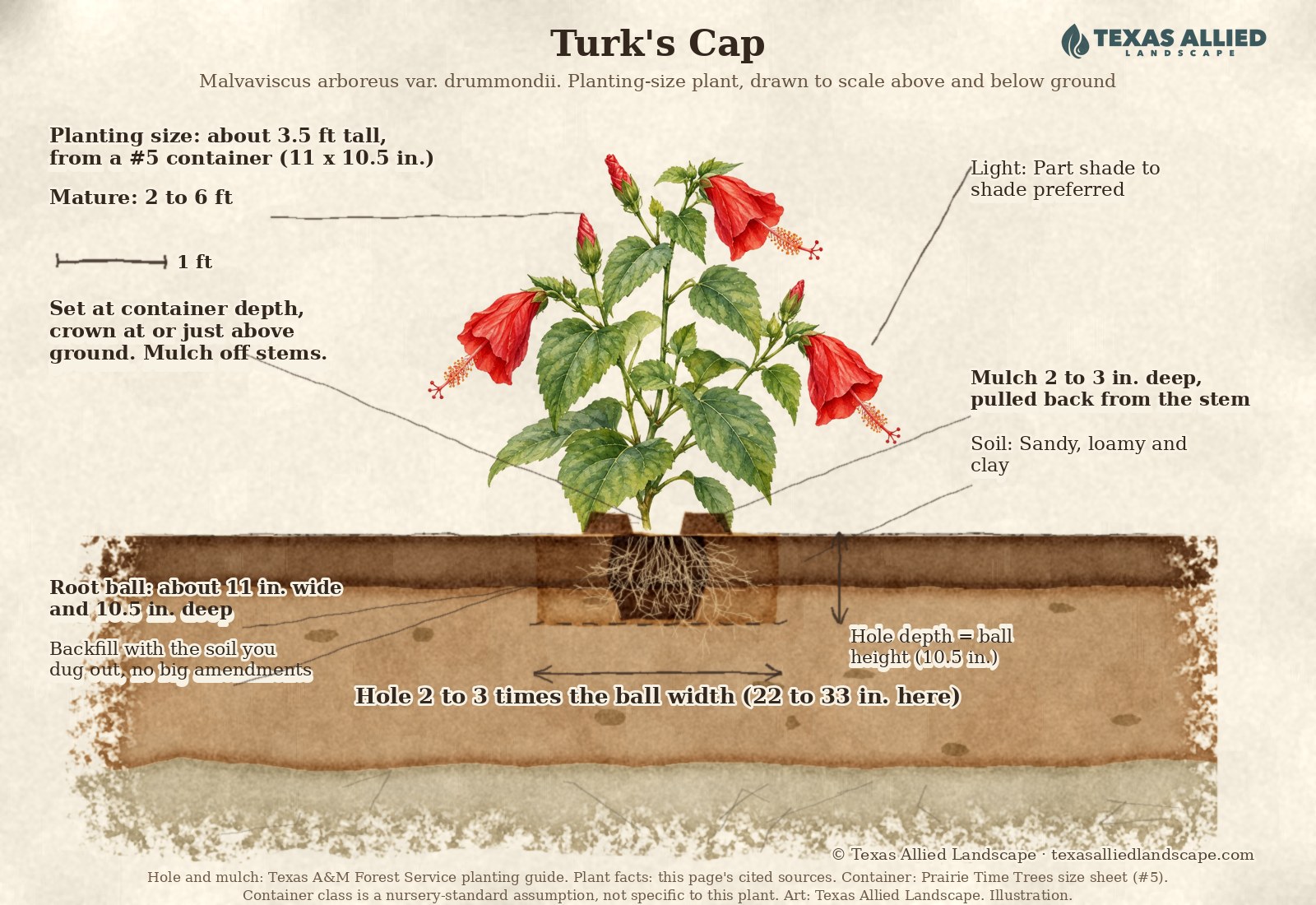
- Dig a hole twice as wide as the pot and no deeper, with sloping sides, and set the plant at the same depth it grew in its pot. Loosen any circling roots before backfilling.[6]
- For a new bed, clear grass and weeds first, roots and all.[6]
- Site: Part shade to shade preferred; one source says full sun to partial shade; another source lists sun/part shade.[1][2][3]
- Timing: A fall planting establishes roots through the cool season and is ready to grow and bloom the following year; spring planting works too if you water through the first summer.[5]
- Soak it well at planting and keep watering while the roots establish.[6]
- Mulch 2 to 4 inches, kept a few inches away from the stems to prevent crown rot. It needs no staking or other support.[6]
Care Instructions for Your Turk's Cap
How to Water a Turk's Cap
Medium water use; one source tags it Low Water and another source notes it is drought tolerant.
Sunlight
Part shade to shade preferred; one source says full sun to partial shade; another source lists sun/part shade.[1][2][3]
Soil and drainage
Sandy, loamy, clay, and limestone soils; moist, well-drained woodland soils are best.
Mature height and spread
Sources differ: 2-6 ft; another source says up to about 10 ft, often shorter. 3-5 ft.
Pruning
Can be cut back as needed before it leafs out in spring.
Normal seasonal behavior
Red turban-shaped blooms May-Nov; dark red 1-inch fruit, with 'Mexican apple' among its common names. Freeze hardy; attracts hummingbirds and butterflies.[4]
Turk's cap questions
Will Turk's cap really grow in full shade?
Yes - it is one of the few Central Texas shrubs that blooms in deep shade, and it handles full sun too. Shade-grown plants stretch taller and bloom a bit less; either way it is one of the most versatile natives you can plant.[7]
Does Turk's cap die back in winter?
In most Central Texas winters the top growth freezes back, and it returns from the roots in spring. Cut the dead stems to a few inches in late winter; in mild years just thin and shape it.[8]
Are Turk's cap fruits edible?
Yes - the small red fruits are edible (mild, apple-like) and the flowers are too. Birds and wildlife get to most of them first.[9]
Is Turk's cap good for hummingbirds?
Excellent. The red turban-shaped flowers are built for hummingbirds and bloom from late spring into fall, one of the longest nectar seasons of any Texas native.[10]
Let Texas Allied Landscape care for your Turk's Cap
Turk's Cap does best with steady, knowledgeable care: the right water, pruning at the right time, and a trained eye for stress. The horticulturists at Texas Allied Landscape care for plants like yours across the San Antonio area, backed by over 40 years of landscape experience.
In these community guides
Illustration. Illustration based on reference photos of Vicinia. Not a single literal view. Vicinia Landscaping
Bring your address, survey and ideas. Texas Allied Landscape helps check the rules, design the space and prepare for…

Illustration. Illustration based on reference photos of Redbird Ranch. Not a single literal view. Redbird Ranch Landscaping
Bring your survey and yard ideas. Texas Allied Landscape helps design planting and irrigation, prepare the review…
- Art in progress
Cordillera Ranch Landscaping
Bring your address, survey and yard ideas. We check the right guideline set, plan planting and irrigation, prepare the…

Illustration. Illustration based on reference photos of Johnson Ranch. Not a single literal view. Johnson Ranch Landscaping
Share your Johnson Ranch address, survey and yard ideas. Texas Allied Landscape can help plan planting, irrigation and…

Illustration. Illustration based on reference photos of Rogers Ranch - Point Bluff and other neighborhoods. Not a single literal view. Rogers Ranch Landscaping
Plan your Rogers Ranch landscape with lawn, tree and irrigation guidance. Get help with the review package, approved…
Illustration. Illustration based on reference photos of Shavano Rogers Ranch - Crosstimber. Not a single literal view. Crosstimber Landscaping
Plan your Crosstimber plants, shade and irrigation. Get help matching your lot rules, preparing the review package and…
Sources
- Malvaviscus arboreus var. drummondii (Turk's cap), Lady Bird Johnson Wildflower Center.https://www.wildflower.org/plants/result.php?id_plant=MAARDabc
- Turk's Cap, San Antonio Water System - Garden Style San Antonio.https://www.gardenstylesanantonio.com/plants/turks-cap/abc
- Turk's Cap, City of Austin Watershed Protection Grow Green.https://www.austintexas.gov/watershed-protection/plant-guide/turks-capabc
- Trimming of turkscap, Lady Bird Johnson Wildflower Center - Ask Mr. Smarty Plants.https://www.wildflower.org/expert/show.php?id=4947ab
- October Gardening Checklist, Travis County AgriLife Extension.https://travis-tx.tamu.edu/about-2/horticulture/monthly-gardening-calendar-for-austin-area/october-gardening-checklist-for-austin-and-central-texas/ab
- Back to basics: Planting perennials, SAWS Garden Style San Antonio.https://www.gardenstylesanantonio.com/garden-articles/back-to-basics-planting-perennials/abcd
- City of Austin Grow Green plant guide, "Turk's Cap."https://www.austintexas.gov/watershed-protection/plant-guide/turks-cap↑
- Central Texas Gardener, "Turks cap."https://centraltexasgardener.org/resource/turks-cap/↑
- Native Plant Society of Texas, "Plant of the Month: Turk's Cap."https://www.npsot.org/posts/plant-of-the-month-turks-cap/↑
- Lady Bird Johnson Wildflower Center, Ask Mr. Smarty Plants on Turk's cap.https://www.wildflower.org/expert/show.php?id=11083↑