
Property owners
Virginia Creeper
- Plant
- Virginia Creeper
- Botanical name
- Parthenocissus quinquefolia
- Group
- Vines
Sourced shade, water, fall color and safety details for Virginia Creeper.
On this page
Its botanical name is Parthenocissus quinquefolia.[^wild]
Safety first
Do not eat the berries. The Wildflower Center warns they are highly poisonous and may be fatal. Plant tissues can also irritate skin. It usually has five leaflets, but sometimes three or seven. So leaflet count alone is not a safe way to identify an unknown vine.[^wild]
Light, soil and water
It grows in sun, partial shade or shade. It has low water use and prefers moist, well-drained soil. The profile lists sandy, loamy, clay, rocky and limestone-based soils.[^wild]
Size and seasonal color
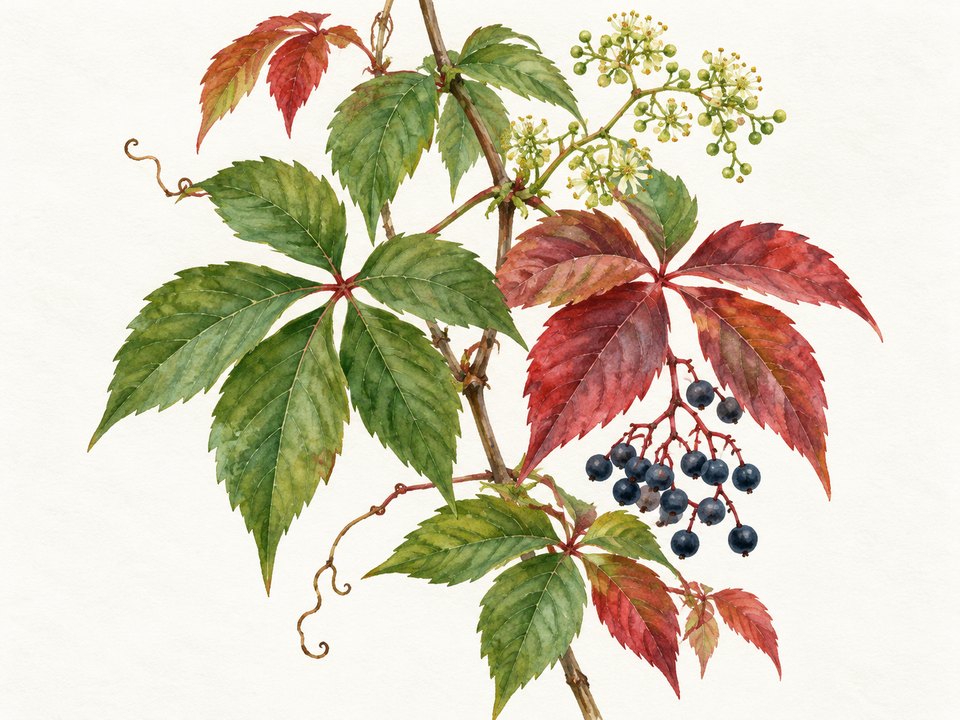
It is a woody, deciduous vine. It can trail or climb up to about 40 feet, depending on the support. Green leaves turn red, mauve or purple in fall. Small spring flowers are followed by blue-black berries that birds eat.[^wild]
Climbing surfaces
Its tendrils have adhesive discs rather than penetrating roots. Even so, the remaining holdfasts can mark walls after removal. The source's general building comparison is not a guarantee that every wall finish will stay unmarked.[^wild]
When to Plant Virginia Creeper
Plant Virginia Creeper in fall or spring in Central Texas. Cooler weather lets the roots establish before the vine has to support top growth through summer heat.[^travis-oct-checklist]
If you would like a hand, the Texas Allied Landscape team can plant your Virginia Creeper and keep it thriving.
Planting
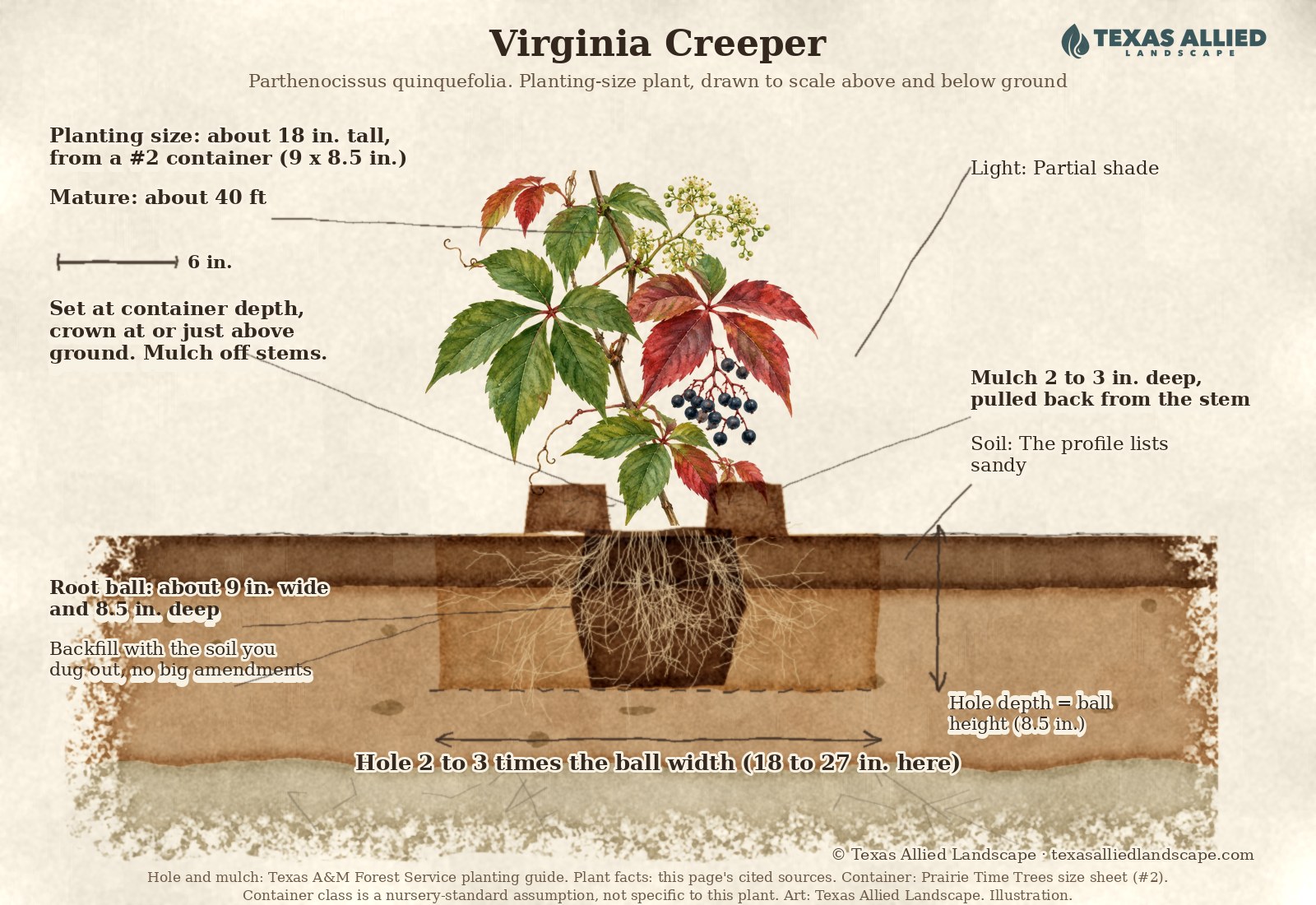
- Dig a hole twice as wide as the pot and no deeper, with sloping sides. Set the plant at the same depth it grew in its pot. Loosen any circling roots before backfilling.[1]
- Support: Plant it at the base of whatever it should climb, such as a trellis, fence or arbor. It can then take hold from the start.
- Soil: It has low water use and prefers moist, well-drained soil. The profile lists sandy, loamy, clay, rocky and limestone-based soils.
- Timing: Plant Virginia Creeper in fall or spring in Central Texas. Cooler weather lets the roots establish before the vine has to support top growth through summer heat.
- Soak it well at planting and keep watering while the roots establish.[1]
- Mulch 2 to 4 inches, kept a few inches away from the stems to prevent crown rot.[1]
Let Texas Allied Landscape care for your Virginia Creeper
Virginia Creeper does best with steady, knowledgeable care. That means the right water, pruning at the right time, and a trained eye for stress. The horticulturists at Texas Allied Landscape care for plants like yours across the San Antonio area. They are backed by over 40 years of landscape experience.
In these community guides

Illustration. Illustration based on reference photos of Redbird Ranch. Not a single literal view. Redbird Ranch Landscaping
Bring your survey and yard ideas. Texas Allied Landscape helps design planting and irrigation, prepare the review…

Illustration. Illustration based on reference photos of Arbors of Fair Oaks. Not a single literal view. Arbors of Fair Oaks Landscaping
Bring your address, unit and yard ideas. Texas Allied Landscape helps design the planting and irrigation, prepare the…
- Art in progress
Cordillera Ranch Landscaping
Bring your address, survey and yard ideas. We check the right guideline set, plan planting and irrigation, prepare the…
- Art in progress
Homestead Landscaping
Share your Homestead address, survey and yard ideas with Texas Allied Landscape. We help prepare a clear plan for…

Illustration. Illustration based on reference photos of Johnson Ranch. Not a single literal view. Johnson Ranch Landscaping
Share your Johnson Ranch address, survey and yard ideas. Texas Allied Landscape can help plan planting, irrigation and…

Illustration. Illustration based on reference photos of Rogers Ranch - Point Bluff and other neighborhoods. Not a single literal view. Rogers Ranch Landscaping
Plan your Rogers Ranch landscape with lawn, tree and irrigation guidance. Get help with the review package, approved…
Illustration. Illustration based on reference photos of Shavano Rogers Ranch - Crosstimber. Not a single literal view. Crosstimber Landscaping
Plan your Crosstimber plants, shade and irrigation. Get help matching your lot rules, preparing the review package and…
Care Instructions for Your Virginia Creeper
How to Water a Virginia Creeper
Sunlight, soil and water
It grows in sun, partial shade or shade. It has low water use and prefers moist, well-drained soil. The profile lists sandy, loamy, clay, rocky and limestone-based soils.[^wild]
Virginia creeper questions
Is Virginia creeper invasive?
No. Parthenocissus quinquefolia is a Texas native vine. It is vigorous and self-clinging, so it needs watching. But it is not an invasive exotic like English ivy.[2]
Will Virginia creeper damage my walls or trees?
It climbs with adhesive discs that do not harm sound masonry or living bark. But they can pull loose paint and old mortar. The vine can also smother small shrubs if unchecked.[3]
Does Virginia creeper have good fall color?
It is one of the best. The leaves turn brilliant scarlet to burgundy in fall, even in shade. That is the main reason to grow it.[4]
Sun or shade for Virginia creeper?
Either works. It grows in full sun to deep shade. It also shrugs off poor soil, drought, and neglect. That makes it one of the toughest vines for a Texas fence.[5]
Next step: Our horticulturalists can train it where you want it and keep it off where you do not.
Sources
- Back to basics: Planting perennials, SAWS Garden Style San Antonio.https://www.gardenstylesanantonio.com/garden-articles/back-to-basics-planting-perennials/abc
- The Morton Arboretum, "Virginia creeper."https://mortonarb.org/plant-and-protect/trees-and-plants/virginia-creeper/↑
- Wisconsin Horticulture, "Virginia Creeper, Parthenocissus quinquefolia."https://hort.extension.wisc.edu/articles/virginia-creeper-parthenocissus-quinquefolia/↑
- Clemson Home & Garden Information Center, "Virginia Creeper."https://hgic.clemson.edu/virginia-creeper/↑
- Utah State University Extension, "Vines in the Landscape: Virginia Creeper."https://extension.usu.edu/yardandgarden/research/vines-in-the-landscape-virginia-creeper↑