
Property owners
Santolina
- Plant
- Santolina
- Botanical name
- Santolina sp.
- Group
- Ground cover
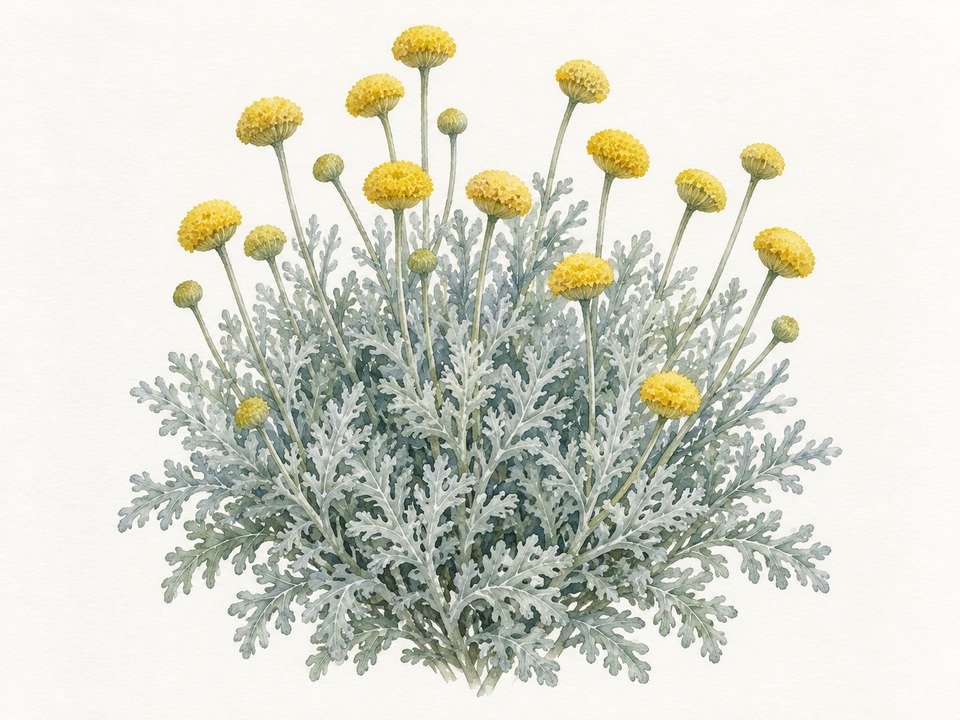
Santolina is a silver, herbal-scented mound for full sun and lean limestone soil, with yellow button flowers in late spring.
On this page
Its botanical name is Santolina sp.
It belongs to the perennials group.
Light
It needs full sun. It needs open, bright exposure to stay tight and silvery.[1]
Soil and drainage
Lean, alkaline, sharply drained soil suits it perfectly. Rich soil and standing water rot it. It is a natural fit for San Antonio limestone ground.[2]
Height
It grows 1 to 2 feet tall. It is a low mounding subshrub.[3]
Spread
It spreads 2 to 3 feet wide as a rounded mound. Shearing keeps it dense.
Foliage
It is evergreen, with finely cut silver-gray leaves and a herbal scent. The foliage, not the flower, is the main show.[1]
Water
It needs low water. It is drought-tolerant once established and resents overwatering. If watering ever feels like a guessing game, our horticulturists can set a schedule that fits your beds.[2]
Pruning
Shear after the yellow button bloom to keep the mound tight, and again lightly in late winter. Old, unclipped plants sprawl and split open.[3]
Seasonal behavior
It stays silvery all year, with bright yellow button flowers in late spring to early summer.[1]
When to Plant Santolina
Plant santolina in fall or early spring in Central Texas. Cool-season planting lets it root before summer. Good drainage matters more than timing.[2]
If you would like a hand, the Texas Allied Landscape team can plant your Santolina and keep it thriving.
Planting
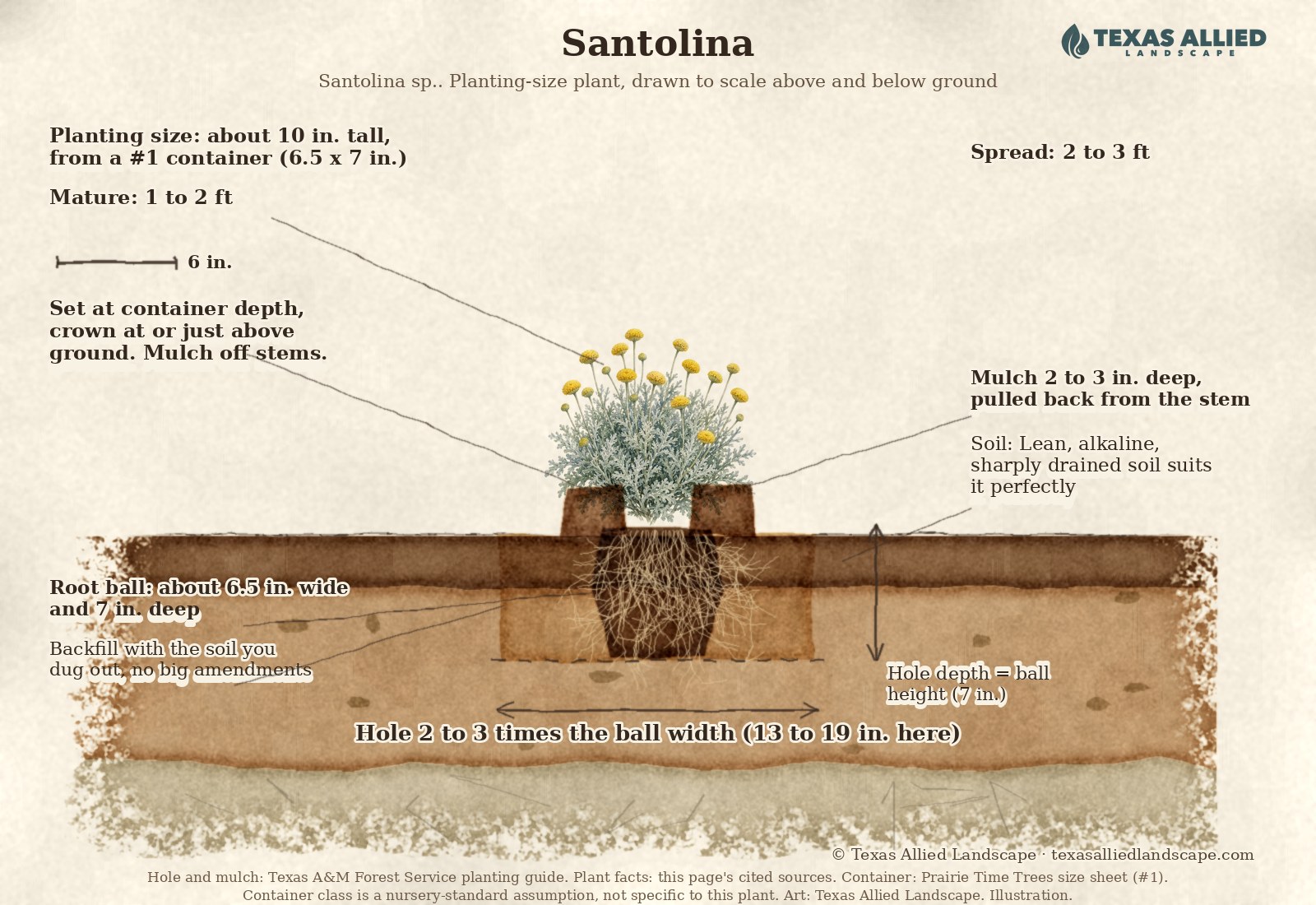
- Dig a hole twice as wide as the pot and no deeper, with sloping sides. Set the plant at the same depth it grew in its pot. Loosen any circling roots before backfilling.[4]
- For a new bed, clear grass and weeds first, roots and all.[4]
- Give it room. It spreads 2 to 3 feet wide as a rounded mound, and shearing keeps it dense. It is evergreen, with finely cut silver-gray leaves and a herbal scent. The foliage, not the flower, is the main show.[1] Space plants for that full size, not the pot size.[4]
- Site: It needs full sun. It needs open, bright exposure to stay tight and silvery.[1]
- Soil: Lean, alkaline, sharply drained soil suits it perfectly. Rich soil and standing water rot it. It is a natural fit for San Antonio limestone ground.[2]
- Timing: Cool-season planting lets it root before summer. Good drainage matters more than timing.[2]
- Soak it well at planting and keep watering while the roots establish.[4] Once it is established, it wants full sun, lean soil and sharp drainage. It is drought-tolerant and rots with too much water, which makes it a natural for Texas beds.[5]
- Mulch 2 to 4 inches, kept a few inches away from the stems to prevent crown rot. It needs no staking or other support.[4]
Care Instructions for Your Santolina
Sunlight
It needs full sun. It needs open, bright exposure to stay tight and silvery.[1]
Soil and drainage
Lean, alkaline, sharply drained soil suits it perfectly. Rich soil and standing water rot it. It is a natural fit for San Antonio limestone ground.[2]
Mature height and spread
It grows 1 to 2 feet tall, a low mounding subshrub.[3] It spreads 2 to 3 feet wide as a rounded mound, and shearing keeps it dense.
Pruning
Shear after the yellow button bloom to keep the mound tight, and again lightly in late winter. Old, unclipped plants sprawl and split open.[3]
Normal seasonal behavior
It stays silvery all year, with bright yellow button flowers in late spring to early summer.[1]
Santolina questions
What is santolina?
It is a small Mediterranean evergreen subshrub in the daisy family. It is grown for its aromatic foliage (silver-gray or green) and yellow button flowers. It is often called lavender cotton.[6]
What is the difference between gray and green santolina?
Gray santolina (S. chamaecyparissus) has silver foliage. Green santolina (S. rosmarinifolia or virens) has bright green, rosemary-like leaves. Both need the same care.[7]
How do I keep santolina from getting leggy?
Shear it after the yellow buttons bloom and again lightly in early spring. Never cut into bare old wood, which may not resprout.[8]
Next step: Our horticulturalists can shear santolina borders on the right schedule so they stay tight mounds.
What conditions does santolina need in Texas?
Give it full sun, lean soil and sharp drainage. It is drought-tolerant and rots with too much water, which makes it a natural for Texas beds.[5]
Let Texas Allied Landscape care for your Santolina
Santolina does best with steady, knowledgeable care. That means the right water, pruning at the right time, and a trained eye for stress. The horticulturists at Texas Allied Landscape care for plants like yours across the San Antonio area. They are backed by over 40 years of landscape experience.
In these community guides
Sources
- Santolina, Central Texas Gardener.https://centraltexasgardener.org/resource/santolina/abcdefg
- Santolina, City of Austin Grow Green plant guide.https://www.austintexas.gov/watershed-protection/plant-guide/santolinaabcdefg
- Cotton Lavender or Santolina, David Rolston Landscape Architects.https://dallasgardens.com/plant-library/cotton-lavender/abcd
- Back to basics: Planting perennials, SAWS Garden Style San Antonio.https://www.gardenstylesanantonio.com/garden-articles/back-to-basics-planting-perennials/abcde
- San Marcos Growers, "Santolina."https://www.smgrowers.com/products/plants/plantdisplay.asp?plant_id=1469ab
- San Marcos Growers, "Santolina."https://www.smgrowers.com/products/plants/plantdisplay.asp?plant_id=1469↑
- North Carolina Extension Gardener Plant Toolbox, "Santolina rosmarinifolia."https://plants.ces.ncsu.edu/plants/santolina-rosmarinifolia/↑
- North Carolina Extension Gardener Plant Toolbox, "Green Lavender Cotton."https://plants.ces.ncsu.edu/plants/santolina-virens/common-name/green-lavender-cotton/↑